vxedge documentation
Specification, results and user documentation for vxedge.
vxedge is a virtual zonal vehicle for OEM and Tier 1 engineers. Software updates, new functions and faults run as packaged experiments on one machine, and every result ships with its digests. 5G network slicing onto zonal and central software-defined-vehicle (SDV) E/E architectures is one family of its measured cases (H1, H2).
Pre-release (0.x): the manifest schema and vxAPI may change between minor versions; published results are frozen.
| Document | What |
|---|---|
| ARCHITECTURE.md | The architecture specification: research goals and hypotheses, topology, vxAPI, manifest schemas, network/service/virtualization models, methodology, phased roadmap |
| RESULTS.md | Measured results for H1–H4, with numbers, verdicts and caveats |
| FACTS.md | The registry of every published number and state. The website and every README quote it |
| ROADMAP.md | Phase status and what has shipped |
| GETTING-STARTED.md | From zero to a measured experiment |
| USER-GUIDE.md | Concepts, CLI reference, workflows, SDV vocabulary map |
| TESTBED-SETUP.md | Host requirements, tiered by experiment class |
| VERSIONING.md | SemVer and changelog conventions across repos |
| ACRONYMS.md | Glossary |
| diagrams/ | E/E architecture diagrams (draw.io) |
Repositories
All repositories below are public.
| Repo | What |
|---|---|
| vxedge | The control plane (vxedged), vxAPI, CLI, and vxgateway |
| vxagents | Measurement agents: probes and traffic generation |
| vxtelemetry | Telemetry ingestion and results archiving |
| vxota | OTA server and signing (the H4 workload) |
| vxperiments | Experiments, analysis, frozen results |
| vxparts | OCI/ORAS registry of every loadable the platform boots |
| vxmodels | SysML v2 models and the manifest renderer |
| vxmcp | MCP server over vxAPI |
| vxvhal | Android Automotive's gRPC Vehicle HAL, served from Kuksa VSS signals |
Links
- Site: https://vxedge.dev
- Contributing: CONTRIBUTING · Security: SECURITY
- License: Apache-2.0 (
LICENSE) for code; CC BY 4.0 (LICENSE-DOCS) for docs, results, figures and models
Getting started
vxedge is a virtual vehicle with environmental parity, for packaged, measured SDV
(software-defined vehicle) experiments on one machine: a virtual edge gateway
(vxgateway), QEMU/KVM virtual ECUs, containerized AD compute, and a Rust control plane
(vxedged) driven entirely by YAML manifests. Read
ARCHITECTURE.md for the full picture; this page gets you from
zero to a measured experiment; day-to-day usage lives in USER-GUIDE.md, and
every acronym is defined in ACRONYMS.md.
Pre-release (0.x). The manifest schema and vxAPI may change between minor versions
(VERSIONING.md); published results are frozen and do not change.
Repository status. All nine repositories (docs, vxedge, vxagents, vxtelemetry, vxota, vxperiments,
vxparts, vxmodels and vxmcp) are public. The zone bundle step in section 4 builds from the vxparts clone, so it
runs as written.
1. Prerequisites
Verified versions as of 2026-10:
| Tool | Version | Install |
|---|---|---|
| Rust | 1.99+ (pinned by rust-toolchain.toml; with rustup installed, the first cargo command in the repo fetches the right toolchain automatically) | curl https://sh.rustup.rs -sSf | sh |
| protoc | any recent (36.x current upstream, as of 2026-10) | distro package, or the release zip → ~/.local/bin |
| buf | 1.71+ (optional: proto lint/SDK gen) | release binary → ~/.local/bin |
| git + gh | any recent | distro package |
Later phases additionally need QEMU/KVM + libvirt, Open vSwitch, and an NVIDIA GPU (CARLA/Autoware/Alpamayo workloads); none of that is required to build and run the control plane today.
2. Workspace layout
vxedge is a meta-workspace of independent git repos, cloned side by side (the parent folder is not a git repo):
mkdir vxedge && cd vxedge
for r in docs vxedge vxagents vxtelemetry vxota vxperiments vxparts vxmodels vxmcp; do
  gh repo clone vxedge/$r
done
| Repo | What |
|---|---|
docs | Architecture specification (ARCHITECTURE.md), user documentation, results, roadmap and the facts registry (FACTS.md) |
vxedge | Start here: control plane (vxedged), vxAPI (gRPC/Protobuf), CLI |
vxparts | Unified loadable registry of zone (virtual-ECU) and central-compute images, published via OCI/ORAS |
vxota / vxtelemetry | OTA and telemetry service code |
vxagents | Rust measurement agents (latency probes, traffic gen, pcap) |
vxperiments | Experiment packages, vehicle manifests, frozen results |
vxmodels | SysML v2 system models + vxmodel manifest renderer, track M (ARCHITECTURE.md §6.3) |
vxmcp | MCP (Model Context Protocol) server over vxAPI, for agent tooling |
Every repo has an AGENTS.md (scope + rules) and a CHANGELOG.md; docs/ROADMAP.md is the
public phase status.
3. Get the binaries
Prebuilt (CLI and daemon, Linux x86-64 and ARM64): download the latest vxedge release, check it, and run it.
Each release carries SHA256SUMS and build provenance.
gh release download -R vxedge/vxedge --pattern '*x86_64*' --pattern SHA256SUMS      # aarch64 on ARM
sha256sum --ignore-missing -c SHA256SUMS                                             # must say OK
gh attestation verify vxedge-*-x86_64-unknown-linux-gnu.tar.gz -R vxedge/vxedge     # needs gh 2.49 or newer
tar xzf vxedge-*-x86_64-unknown-linux-gnu.tar.gz                                     # vxedge, vxedged, LICENSE, NOTICE
The binaries are built on Ubuntu 24.04 (glibc 2.39), so they run on 24.04 and newer. The campaign in §4 also
runs vxprobe and vxtraffic (vxagents) and vxtelemetry: download those releases the same way, or build
them from source below. vxedged finds them on its PATH.
Or build everything from source
for r in vxedge vxagents vxtelemetry; do (cd $r && cargo build --workspace); done
Quick unprivileged smoke (daemon + CLI over a Unix socket):
cd vxedge
./target/debug/vxedged --listen unix:///tmp/vxedge.sock --runtime-dir /tmp/vxrt &
./target/debug/vxedge --endpoint unix:///tmp/vxedge.sock status
# gateway vxgateway: state=1 detail=no gateway provisioned
./target/debug/vxedge --help          # full command tree
Real provisioning (up, zone up) needs CAP_NET_ADMIN, plus CAP_SYS_ADMIN to enter a
node's network namespace: run vxedged under sudo, or
sudo setcap cap_net_admin,cap_sys_admin+ep target/debug/vxedged. Without it, up validates the
manifest and then fails with an actionable message (by design).
4. Run your first experiment (exp-001)
The flagship walkthrough: the H1 slice-isolation campaign, run from its package. Every experiment in
vxperiments is a vxp/1 package, and every campaign runs the same way.
A campaign runs through vxedged, which needs CAP_NET_ADMIN (§3) and finds vxprobe, vxtraffic and
vxtelemetry on its PATH. From the workspace root, with vxedge, vxedged and those three on your PATH:
sudo -v                                                 # so the daemon below starts without a prompt
sudo env "PATH=$PATH" vxedged --listen unix:///tmp/vx.sock --runtime-dir /tmp/vxrt &
sudo chown $USER /tmp/vx.sock                           # once the daemon is listening
export VXEDGE_ENDPOINT=unix:///tmp/vx.sock
cd vxperiments/experiments/exp-001-ws
vxedge experiment validate                              # every check, no daemon
vxedge campaign plan --profile quick                    # the trials, checked; touches nothing
vxedge campaign start --profile quick                   # pipeline check: one archive per trial, then the H1 verdict
The explicit env "PATH=$PATH" is what carries your toolchain into the root process. The root daemon creates
its socket owned by root with mode 755, hence the chown for a non-root vxedge client.
The quick numbers are pipeline validation only and are never reported. The full campaign is
vxedge campaign start --profile repro: 5 repetitions x 5 load levels, 60k samples per point. Keep the machine
otherwise idle and prefer the performance CPU governor. Run it from a clone outside your home directory, for
example under /var/tmp: the campaign writes its archives into the package folder, and file indexers or sync
clients watching your home directory can load the host while trials run (campaign start warns about it). A campaign writes its archives, campaign.json and
verdict.json under results/<campaign id>/ in the package folder; vxedge campaign verdict <campaign id>
judges it again, and vxedge campaign compare <campaign id> exp-001 --reference-workspace ../.. compares it
with the frozen campaign (the package's README says how). The raw archives of the published campaigns are on Zenodo:
10.5281/zenodo.23804197, and scripts/verdict-parity.sh --fetch in
vxperiments re-judges them with each package's criteria. Reference result and methodology: RESULTS.md and
the experiment-methodology skill.
Zone bundles for a bare vehicle are built on your own host, not pulled from a registry, so no registry
login is needed. For vx-vehicle-01, from the workspace root:
vxparts/parts/zone/linux/stack/probe-bundle/build.sh "$PWD/vxperiments/vehicles/vx-vehicle-01/bundle"
(bundle/ is git-ignored). The bundle embeds your host kernel, so its digest differs per host, and
vehicle up stops before provisioning anything if it is missing. On Ubuntu /boot/vmlinuz-* is mode 600,
so build.sh fails until the kernel image is readable (copy it somewhere readable and pass KERNEL=).
The exp-001 package needs neither the bundle nor a login: its zones are host processes.
5. Zones and VM guest bundles
Container-backed zones work out of the box (vxedge zone up --vxid … after up). The VM
backends (qemu-microvm, libvirt, cloud-hypervisor) boot a guest bundle built once per
host, and wasm-capsule runs a WebAssembly module through the vxcapsule runner that ships beside
vxedged (TESTBED-SETUP.md lists what each needs):
sudo chmod 644 /boot/vmlinuz-$(uname -r)        # Ubuntu ships the kernel root-only
cd vxparts && ./parts/zone/linux/stack/probe-bundle/build.sh   # -> ./bundle + digests
See USER-GUIDE.md §3c for wiring a bundle into a manifest.
6. Poke the API directly
The contract lives in vxedge/proto/vxedge/v1/ (package vxedge.v1). Any gRPC tool works;
with grpcurl, from the workspace root:
grpcurl -unix -plaintext -import-path vxedge/proto \
  -proto vxedge/v1/lifecycle.proto \
  /tmp/vxedge.sock vxedge.v1.GatewayService/Status
Proto hygiene: buf lint in the vxedge repo (CI enforces it).
7. Manifests: the only input
Everything the platform does is declared in YAML manifests (schema:
ARCHITECTURE.md §6; worked example: §16). The parser is strict (unknown fields are
errors) and semantic validation covers slice references, vxid uniqueness, and slice-mode
consistency. Experiment manifests live in vxperiments/experiments/, vehicle manifests in
vxperiments/vehicles/.
8. Troubleshooting
protocnot found duringcargo build: install protoc (table above); the proto codegen runs inside the build viacrates/vxedge-api/build.rs.cannot reach vxedged at unix:///run/vxedge.sock: the default socket path needs root-writable/run; for development pass a user-writable path to both sides (--listen/--endpoint unix:///tmp/vxedge.sock) or setVXEDGE_ENDPOINT.- A verb prints "not wired to the daemon yet (scaffold)": intentionally unimplemented; USER-GUIDE.md §2 lists each verb's state. Check it before assuming a bug.
insufficient privileges … CAP_NET_ADMIN: run the daemon under sudo or setcap it (see §3); provisioning refuses to half-apply without privileges.- Bundle build: "vmlinuz not readable": Ubuntu ships kernels 0600;
sudo chmod 644 /boot/vmlinuz-$(uname -r).
9. Where to contribute
Check docs/ROADMAP.md (phase status) and RESULTS.md (what is measured). The gates of
phases 1 to 3 have passed and phase 3 content is in progress (FACTS.md); v0.1.0 was tagged across the delivering
repos when the phase-1 gate passed (2026-07-13). To propose work, open an issue on the repository it
belongs to, or on vxedge/docs for anything that spans repositories.
Conventions to know before your first PR: manifests are the sole source of truth; no
orchestration logic in any frontend; every image is digest-tagged. Details per repo in its AGENTS.md.
User guide
For SDV / automotive engineers running experiments on vxedge. Onboarding lives in GETTING-STARTED.md; the full spec in ARCHITECTURE.md; host requirements in TESTBED-SETUP.md; results in RESULTS.md; phase status in ROADMAP.md; acronyms in ACRONYMS.md.
State banner: vxedge is a research-grade executable virtual prototype of a zonal SDV E/E architecture, not a certified tool and not a "digital twin" of any physical vehicle (that word is reserved for hardware-in-the-loop parity). What is verified today is listed per-verb below; everything else fails loudly rather than pretending.
1. Concepts
- A workspace is the unit of work: a folder, not a single file. An experiment is a
directory holding a
vxp.yamlpackage descriptor (id, version, entry,requires; a legacy<id>.vxpdescriptor is refused, with the steps to migrate) plus top-level YAML documents, each declaring its ownkind:experiment(the test),vehicle(the system under test),road(the environment, optional),baseline(which software),component, plus anid. Every cross-reference is by id, never by path, so files can be renamed or reorganized without breaking anything; a whole workspace can also be one file of----separated documents. The CLI/daemon keep no other configuration; every result archive records the workspace's SHA-256. - A workspace is a sandbox. It owns its campaign (the experiment's
campaignblock: repetitions, warmup, measurement window, sweep, arms and profiles),parts/(its loadables),assets/(scenario files),tools/(its own helpers), andresults/(one archive per trial). It is a folder that can be zipped, sent, unzipped and run standalone, or packed into one.vxpfile withvxedge pkg pack.vxedge experiment new <id> [--template minimal|slicing]scaffolds one, with itsvxp.lock;vxedge experiment validateruns every cross-file check and every model invariant before anything is provisioned. Full schema: ARCHITECTURE.md §6.0. - Structure and software are separate files. One
vehicle.yamlcarries manybaselinefiles, so an A/B arm is two baselines over one unchanged vehicle, not two vehicle files that drift apart. The vehicle names a slice (links[].slice: adas); the experiment defines it (network.slices[].mode: vlan|s-nssai); it is the only reference that crosses the structure/test boundary, andexperiment validatechecks it. - Slices are the network partitions under test:
mode: vlan(per-slice VLAN + HTB queue-tree reservation on the virtual gateway; the H1 mechanism, verified) ormode: s-nssai(5G core slices via Open5GS with a simulated UERANSIM radio; the H2 mechanism, verified). - vxgateway is the software edge gateway the daemon provisions from the vehicle/experiment:
a VLAN-filtering bridge (
network.data_plane: kernel-bridge, default) or an OVS bridge (ovs; same plan, pluggable rendering backend), a shaped trunk uplink (the shared bottleneck where slice contention is measured), and one access port per zone-node interface. A link'simpairmentsblock (rate/delay/jitter/loss, via netem) and declarativeharnessblock (medium/length/weight, reporting-only) model the physical wiring between two nodes. - Zones, nodes, and roles. Zones are the six regions (
front-left,front-right,rear-left,rear-right,central-hpc,gateway); a node is a device with arole(zone-controller,hpc,gateway,ecu,sensor,actuator,switch) sitting in one. Each node runs under a packaging backend:container(network namespace),qemu-microvm(raw QEMU, direct kernel boot),libvirt(full VM) orcloud-hypervisor(microVM over a REST API, validated onlinux-probeonly) orwasm-capsule(a WebAssembly module in a network namespace), with identical network attachment; the packaging choice is itself an experimental variable (H3).ComputeServiceisrole: hpcfiltered over that same backend split, not a separate provisioning path. - Jobs: every mutating command returns a job with live streamed progress; a job that couldn't finish reports FAILED with the real error, never a hollow success.
- Results archives (
results/<exp>/<run>.zip) are the reproducibility unit: raw metric scrapes, structured samples, agent summaries, environment metadata, the workspace itself.v0.1.0(2026-07-13) tags the checkpoint where this became true end to end: H1/H3/H4 all reproducible from a tagged manifest, not just runnable once.
2. CLI reference
All lifecycle verbs follow up|down[|status]; operations are idempotent.
| Command | State | Notes |
|---|---|---|
vxedged --listen unix://… --runtime-dir … | live | needs CAP_NET_ADMIN and CAP_SYS_ADMIN for real up (sudo or setcap) |
vxedge up|down --manifest <workspace-dir> | live | provisions/removes the gateway; sets the daemon's active experiment. --manifest names a §6.0 workspace directory (or one file of ----separated documents) |
vxedge status | live | observed gateway + per-slice state |
vxedge zone up|down --vxid <zone-id|device-id> | live | runs the nodes of a zone (a region), or a single device by its own id, except hpc devices, which answer to vxedge compute; needs an active experiment |
vxedge zone list | live | per-node observed state, with each device's host interfaces (port=, peer=) |
vxedge zone add/rm/image push | planned | image store / registry work |
vxedge manifest validate --manifest <path> [--json] | live | local-only. Takes a §6.0 workspace (a directory, or one file of ----separated documents) and runs every cross-file check and every model invariant, the same checks up runs. It is the only schema there is (§6.1/§6.2 were retired 2026-07-31) |
vxedge events [--kind K]... [--json] | live | streams what the daemon is doing: gateway.up, gateway.slice-applied, zone.up/down, service.up/down, traffic.started/stopped, plus job.state. Domain facts about resources, not job progress; lossy by design, so it is a live view rather than a record. For "what happened, in order, without loss", read the audit log |
vxedge doctor [--tier N] [--json] | live | host preflight against TESTBED-SETUP tiers 0–3, actionable fix hints |
vxedge ota up|down [--experiment <path>] | live | spawns/manages vxota serve from the workspace's services.ota block; cwd-resolved by default like experiment verbs, --experiment overrides. A campaign normally reaches this through experiment up --stage services (what exp-003 actually does) rather than calling it standalone |
vxedge ota status [--experiment <path>] | live | the OTA service's observed state, wherever the workspace runs it: as a host process, or placed on a device. --json too |
vxedge telemetry up|down|collect | live | up/down run the workspace's services.telemetry; collect archives what it ingested, with the workspace and image digests, and returns the archive path and sha256 |
vxedge compute up|down --vxid <id> / list | live | a second RPC surface over the same node backends as zone, filtered to role: hpc devices, not a separate provisioning path. add/rm/image push planned |
vxedge vehicle up|down|status --manifest <vehicle workspace> | live | brings up the gateway, its slices, every zone, central compute, and the signal plane and services a bare vehicle declares (kind: vehicle + kind: baseline, no experiment file), and tears them down again. --stage restricts it, as on experiment. status observes the host, so it stays right after a daemon restart. A second vehicle is refused while one is active. up refuses before provisioning if a local bundle or localhost/ image is missing, and no registry login is needed. Verified 2026-11-01 on vx-vehicle-02, a multi-zone vehicle with probe guests. manifest validate accepts a bare vehicle too, validating it the way vehicle up loads it. vehicle up --unlocked skips the lock check of a vehicle that is a vxp/1 package, as on experiment up |
vxedge experiment new <id> [--template minimal|slicing] [--namespace <org>] | live | scaffolds a vxp/1 package folder (vxp.yaml, id local/<id> unless --namespace names the publisher) and writes its first vxp.lock; no daemon, no network, no GPU |
vxedge results verdict|compare | live | local and offline (ARCHITECTURE.md §6.0.3): verdict --experiment <workspace or file> <archives or folders>… judges the experiment's criteria over results archives, vxarchive/1 or /2, and compare --experiment … --archives … --reference … sets them against reference archives as ResultService.Compare does. A campaign's archives name their trials; for older ones, --name 'rep{repetition}-load{load_mbps}' (or rep{repetition}-{arm}) reads each trial from its file name. --json prints the full verdict |
vxedge pkg new|validate|lock|pack|unpack|inspect|vendor | live (0.6.1; vendor 0.8.0) | local and offline (ARCHITECTURE.md §6.0.7). validate adds the package checks to experiment validate and names each file the lock does not match; lock [--check]; pack [--out <dir>] refuses a stale lock and writes <name>-<version>.vxp beside the folder with its sha256: digest; unpack <file> [--into <dir>]; inspect [<file>] prints descriptor, lock and digest from either form; vendor <dir> [--as <owner>/<repo>/<path>] [--replace] copies another folder's documents in, such as a reference vehicle, with the local part folders they reference that git tracks (such as an attach adapter), records each copy's source and digest in the lock, and lists the scripts and build outputs it left behind and the local references the package still needs; vendor --check reports a copy edited here or changed at its source |
vxedge experiment validate | live | local-only; loads the workspace here and runs every cross-file check, reporting all problems at once |
vxedge experiment up|down|status | live | acts on the workspace in the current directory (its vxp.yaml); no name, no --manifest. --chdir <dir> to run from elsewhere. up provisions gateway → zones → signal plane → services and does not start traffic; use vxedge traffic up. --stage gateway|zones|compute|signal-plane|services (repeatable) restricts it, so --stage services alone does not start a declared signal plane: a campaign measuring on the host-side veth peers stages only the gateway, and one whose isolation contract is a single arm at a time stages the gateway then brings each arm up with zone up --vxid. On a vxp/1 package up refuses with ERROR_REASON_LOCK_MISMATCH, naming each difference, when the package does not match its vxp.lock (0.7.0); --unlocked runs it anyway while authoring, and the run records that it was unlocked |
vxedge traffic up|down --manifest … | live | drives the declared profiles; kept separate from experiment up because load is time-bounded and a campaign sweeps it over a fixed topology. A profile whose source node's zone is up runs inside that node: the load or probe starts in the node's network namespace from its pinned address, to a target node or to the far side of the uplink. A profile whose source is not a node needs host-side traffic, experiment up --stage gateway, and is refused otherwise |
vxedge measure start|stop|status | live | runs the experiment's declared measurements (rtt-probe) in the workspace of the current directory, once the experiment is up: the daemon starts vxprobe inside each end's network namespace, or on the far side of the uplink for to: internet. --id (repeatable) selects measurements, and --duration-s overrides method.duration_s. Samples reach the ingest as measurements/<id>. A VM or attached end is refused by Plan with ERROR_REASON_MEASUREMENT_INVALID |
vxedge campaign plan|start|status|verdict|compare | live | the experiment's campaign in the workspace of the current directory: plan lists the trials (every sweep point and every arm) with their windows and any problem, start runs them one after another as a campaign.run job and follows it (--profile, --request-id to resume, --unlocked), status [<campaign id>] shows each trial's state, phase and archive and the recorded verdict, and verdict <campaign id> judges the experiment's criteria over the campaign's archives (ResultService.Verdict), criterion by criterion. compare <campaign id> <reference id> sets each metric's median at each point against the reference's median and IQR, and each criterion's outcome against the reference's (ResultService.Compare). A campaign needs the experiment's own telemetry service; its archives and campaign.json go to results/<campaign id>/ |
vxedge runs [status|down] | live | lists the runs on this host, each with its instance slot and run id; runs status and runs down (--all) act on several runs at once |
| One run by id, planning, host capabilities, job list and cancel, traffic status | live in vxAPI, CLI planned | RunService.Get, WorkspaceService.Plan, HostService.Capabilities, JobService.List/Cancel and TrafficService.Status have no CLI verb yet. Agents reach them through vxmcp (run_get, workspace_plan, host_capabilities, job_list, job_cancel, traffic_status) |
Global flags: --endpoint (default local Unix socket, or VXEDGE_ENDPOINT), --json, --chdir,
--run.
The command-line contract
Every vxedge command-line tool is meant to follow these rules, so a script or an agent can drive one the same way as another. Not every tool follows them yet: the main differences are listed at the end of this section.
Naming the target.
- A command that acts on a workspace, an experiment or vehicle package, takes it from the working
directory.
--chdir <dir>runs the command as if it were started in<dir>. - A command that acts on something the daemon already holds names it by id: a campaign id, a
node's
--vxid, or--run <run id>when the host runs several. - Every tool that talks to the daemon finds it through
--endpoint, orVXEDGE_ENDPOINT, and otherwise usesunix:///run/vxedge.sock. - A command that checks a file or folder, such as
manifest validate, takes its path as an argument, and defaults to the working directory.
Output. With --json, stdout carries only JSON: one document, or one JSON object per line
for a command that follows a job or a stream. Progress, warnings, errors and logs go to stderr. An error also prints
{"error": {"message": …, "reason": …}} on stdout, so a caller reading JSON sees it.
Without --json, the output is for people and may change between releases, so scripts use
--json.
Exit codes.
| Code | Meaning |
|---|---|
| 0 | The command succeeded and, where it judges something, every criterion or check passed |
| 1 | The command ran, and a criterion or check failed or was inconclusive. The output says which |
| 2 | Usage error: an unknown command or flag, or a missing or invalid argument |
| 3 | The tool, the daemon or the host failed: the daemon is unreachable, a job failed for a host reason, a file cannot be read |
campaign start follows the campaign to its end and exits 1 when the campaign's verdict failed,
and 3 when vxedge or the host failed.
Help. Every command, flag and argument has a description. A default shown in help is the
real one. Help lists no command or flag that does not work yet. --version prints the tool's
name and version and exits 0.
Where the tools differ today. The main known differences:
vxedge:- a verdict or comparison that fails or is inconclusive still exits 0:
campaign verdict,campaign compare,results verdictandresults compare. Read theoutcomefield of their--jsonoutput.campaign startexits 0 whenever every trial ran, whatever the verdict; - every error exits 1, including an unreachable daemon and a failed job, and an error under
--jsonprints no JSON; zoneandcomputeadd,rmandimage pushare listed in help but not built. They print a notice and exit 0, and will be removed;- several subcommands and flags have no description in help;
- the
scripts/run.shthatexperiment newwrites callstraffic upandtraffic downwithout the--manifestthey need today.
- a verdict or comparison that fails or is inconclusive still exits 0:
vxedgetarget naming: the gateway verbsupanddown, andvehicle,traffic,telemetry collectandmanifest validate, take--manifest;ota,telemetry upanddown,nos-checkandresultstake--experiment;manifest validatetakes its path through--manifest, not as an argument.vxedgedandvxcapsulehave no--version.vxmcphas no--help, ignores unknown arguments, and exits 1 on every failure.- The measurement, OTA, telemetry, model and VHAL tools have no
--jsonflag.vxprobe,vxtraffic,vxota-probeandvxtelemetryalways print JSON, whilevxotaandvxvhalwrite their logs to stdout. None of them exits 3 on a host failure,vxtelemetry verifyuses 3 for an identity it cannot check, andvxmodelexits 1 on a usage error.
The work to close these is planned in vxedge#215
(vxedge exit codes and help), vxedge#216 (naming
the target), and each tool's own issue:
vxagents#28,
vxtelemetry#57,
vxota#23,
vxmodels#15 and
vxvhal#7.
3. Typical workflows
a) Slicing sandbox (no measurement)
sudo -E env "PATH=$PATH" ./target/debug/vxedged --listen unix:///tmp/vx.sock --runtime-dir /tmp/vxrt &
vxedge --endpoint unix:///tmp/vx.sock up --manifest exp.yaml     # bridge + VLANs + HTB
vxedge --endpoint unix:///tmp/vx.sock status                     # per-slice observed state
vxedge --endpoint unix:///tmp/vx.sock zone up --vxid vxzone-front-left-01
vxedge --endpoint unix:///tmp/vx.sock zone list
vxedge --endpoint unix:///tmp/vx.sock down --manifest exp.yaml
b) A measurement campaign (the exp-001 pattern)
A campaign is declared in the experiment (campaign: repetitions, warmup outside the probe
window, sweep or arms, profiles) and run by vxedged, one archive per trial. Every experiment in
vxperiments is a package run this way:
cd vxperiments/experiments/exp-001-ws
vxedge campaign plan --profile repro      # the 25 trials, checked; touches nothing
vxedge campaign start --profile quick     # pipeline validation -> results/<campaign id>/
vxedge campaign start --profile repro     # the published protocol, on an idle host
vxedge campaign verdict <campaign id>     # the H1 criteria over the campaign's archives
Each campaign writes to its own results/<campaign id>/ in the workspace.
vxedge results verdict --experiment . <archives> judges archives offline, with no daemon, and
scripts/verdict-parity.sh --fetch in vxperiments re-judges every published dataset with its
package's criteria.
Numbers from quick campaigns are pipeline validation only and are never reported.
Reference result (2026-08-03 corrected campaign, superseding the original 2026-07-10 run;
see RESULTS.md's Phase 1 row for why): ADAS slice p99 held at 0.91x baseline under 1.2x
offered overload from the infotainment slice, zero loss (see RESULTS.md).
c) VM-backed zones (guest bundles)
VM backends boot a bundle (kernel + initramfs with an autostarting payload), built once:
sudo chmod 644 /boot/vmlinuz-$(uname -r)      # Ubuntu ships the kernel root-only
cd vxparts && ./parts/zone/linux/stack/probe-bundle/build.sh # -> ./bundle (digests in meta.json)
Point a node's image.url at the bundle dir with kind: rtimage and
backend: qemu-microvm, backend: libvirt or backend: cloud-hypervisor. Guest network comes from the manifest's
ip: via the kernel cmdline; the payload (a vxprobe reflector) starts automatically.
4. Measurement agents & telemetry (standalone today)
vxprobe reflect|send: RTT p50/p95/p99, jitter, loss; live Prometheus/metrics; JSON summary on stdout (stdout is machine-readable; logs go to stderr).vxtraffic: rate-accurate UDP load (--ppsor--bandwidth-mbps).vxtelemetry ingest|collect: scrapes manifest targets, archivesresults/<exp>.zipwith metadata (experiment id, manifest SHA-256, tool versions, ingest completeness).
5. Reading results
Every archive contains metadata.json (reproducibility fields), manifest.yaml,
ingest/raw/**.prom (timestamped scrapes), ingest/samples.jsonl (structured samples),
agent summaries, and run-env.json (kernel, RT flag, governor, pinning, timestamping
method, load level, repetition). Analysis reads archives only; figures must regenerate
headlessly. Report medians with IQR across repetitions; state sample counts next to tail
percentiles; keep the recorded caveats attached (shared-host gateway, non-PREEMPT_RT
kernel, userspace timestamps).
6. Mapping to production SDV vocabulary
| vxedge | Production counterpart |
|---|---|
| vxgateway (bridge/VLAN/HTB) | zonal gateway / central switch QoS (automotive Ethernet) |
slices mode: vlan → s-nssai | static VLAN partitioning → 5G network slicing (S-NSSAI/URSP) |
| zones + backends | zonal ECUs under a Type-1 hypervisor |
type: can links (phase 3) | CAN/LIN drops behind zonal controllers (restbus, DBC, Kuksa/VSS) |
harness impairments (delivered) + harness block | 100/1000BASE-T1 PHY characteristics (rate/delay/jitter/loss) + declarative length/weight for harness-reduction reporting; TSN variant = 802.1Qbv/Qav + gPTP (phase 2, open) |
| results archives | test-bench evidence packages |
7. Getting help / contributing
Each repo carries AGENTS.md (scope + rules) and CHANGELOG.md;
docs/ROADMAP.md is the public phase status. Quality bars are codified per repo: rust-patterns, testbed-quality, experiment-methodology,
gateway-verification (vxedge), sysml-authoring (vxmodels).
A verb that prints "not wired to the daemon yet (scaffold)" is unimplemented:
check the CLI reference in §2 before assuming a bug.
Results
What vxedge has measured so far, one row per hypothesis, with the caveat that matters most for
each. Hypotheses are defined in ARCHITECTURE.md §2; methodology in §12. Acronyms are defined in ACRONYMS.md.
Every number below comes from a frozen summary in
vxperiments/results/, which records
the input manifest's sha256 alongside it. Each one is registered in FACTS.md, which
also holds the full per-load and per-arm tables. This page explains the numbers; that file is where
they are quoted from. The raw per-run archives behind the summaries are a dataset on Zenodo:
10.5281/zenodo.23804197.
Reproduce. Each experiment is a vxp/1 package in
vxperiments/experiments/, with its
campaign and acceptance criteria in the package. vxedge campaign start --profile repro, from the
package's folder, runs the published protocol (GETTING-STARTED.md §4).
scripts/verdict-parity.sh --fetch
in vxperiments downloads the published archives and requires each package's criteria to give the
published verdict on them. exp-010's archives hold probe summaries only, so its H2 verdict is checked by
notebooks/analyze_exp010.py
instead. The verdicts were first computed by analysis notebooks that the packages replaced; they are kept
at the vxperiments v0.2.1 tag.
Summary
| Hypothesis | Experiment | Verdict | Headline number |
|---|---|---|---|
| H1 (isolation): VLAN + tc queue-tree reservations keep ADAS p99 near baseline under infotainment load | exp-001 | Holds | ADAS p99 at 600 mbit load: 81.9 µs vs 89.6 µs baseline (0.91×; threshold 2.0×) |
| H2: real S-NSSAI slicing vs static VLAN mapping | exp-010 | Holds | p99 growth, baseline → 600 mbit: S-NSSAI 0.95× vs VLAN 0.91× (tolerance 1.1×) |
| H3: virtual-ECU packaging affects zone-to-compute latency | exp-002 → exp-002b | Holds | Virtio transport is the dominant factor: MMIO → PCI Δp50 −26.0 µs (IQR 2.2 µs) |
| H4: co-located OTA does not compromise the ADAS slice | exp-003 | Holds | ADAS p50: 52.2 µs baseline vs 51.9 µs under OTA burst (Δ −0.3 µs, inside the 6.0 µs IQR) |
Every campaign above is 5 repetitions per arm or load point, 1000 pps × 60 s per point
(60 000 probes), with a 10 s warmup discarded. Each result has been reproduced by an independent
second campaign (the repro protocol) that reached the same verdict.
H1: isolation (exp-001)
The ADAS tail does not grow with load: p99 is 89.6 µs idle and 81.9 µs at 600 mbit, and loss is
0.0 % at every level. Full table: FACTS.md § H1.
Caveat: the gateway shares its host with the zones it serves, and timestamps are taken
in userspace (SO_TIMESTAMPING is a tracked follow-up). An earlier version of this campaign
measured loopback delivery instead of the gateway path, because probe and reflector sat in the
same network namespace. That defect was fixed with real netns isolation and is now covered by a
CI regression test. The numbers above are the corrected re-run.
Summary: vxperiments/results/exp-001/exp-001-summary.md
Repeats on a newer kernel. Two further runs on kernel 7.0.0-38-generic (input sha
ac2496e3f58e…, 25 archives each) keep the verdict: p99 at the highest load is 0.94× and 1.00× of idle,
against 0.91× in the frozen run, and the second repeat sits inside the first's IQR on 12 of 15 metric ×
load pairs (values in FACTS.md § H1). Both read a few microseconds
below the frozen run at the two highest loads. The cause is not isolated; the kernel change is the leading
suspect and has not been tested. The frozen numbers stay the published ones; these are supplementary checks.
Workspace hashes. A workspace's input hash covers every file in it, comments included, so it changes with any
edit. The hash of a current checkout of exp-001-ws therefore matches neither the frozen campaign's nor the
repeats': a header comment in run.sh was edited after the repeats (vxperiments#3). Compare against the commit
the archive names, not against the hash of whatever is checked out.
H2: real slicing vs static mapping (exp-010)
S-NSSAI PDU sessions through Open5GS + UERANSIM, compared against exp-001's VLAN arm. The
S-NSSAI path has a higher absolute floor (p99 ≈ 317–337 µs, since it crosses a software UPF and
GTP-U), but its tail grows no faster under load than the VLAN path does, which is what the
hypothesis tests.
Caveat: the first campaign did not hold, because nothing in the 5G path applied
per-slice QoS. The fix was real HTB enforcement on the slice path. Configuring
5QI/AMBR alone was checked first and changed nothing. The campaign was
then re-run with host-noise mitigations (CPU governor, core pinning, randomized load order).
All intermediate campaigns are kept in the results directory. A second campaign on 2026-10-30, on a
newer kernel with other VMs on the host, reached the same verdict by a small margin: S-NSSAI p99 grew
1.00× against VLAN's 0.91×, inside the 1.1× tolerance, with p99 at 339–356 µs.
Summary: vxperiments/results/exp-010/exp-010-summary.md
H3: virtualization choice (exp-002b)
Six packaging arms, from container to microvm-mmio, with p50/p99, CPU and RSS per arm:
FACTS.md § H3.
Decomposition: virtio transport (MMIO vs PCI) −26.0 µs; libvirt vs raw QEMU −17.3 µs, likely because libvirt enables vhost/optimized virtio settings that a bare QEMU invocation does not; vhost-net alone −9.5 µs. Machine type (q35 vs microvm) has no measurable effect (−0.3 µs, within IQR).
Caveat: exp-002's original conclusion ("microVMs are slowest") was right about the
ranking but wrong about the cause. exp-002b was designed specifically to separate the factors.
Summary: vxperiments/results/exp-002b/exp-002b-summary.md
H4: OTA co-location (exp-003)
Both arms, with p50/p95/p99 and OTA deliveries (361 ok, 0 failed per repetition):
FACTS.md § H4.
Caveat: the v1 OTA transport binds a plain host address. That means this measures host-level CPU and
scheduling contention between OTA and the ADAS probe, not gateway-QoS-enforced network
contention. A second campaign on 2026-10-30, on a newer kernel with other VMs on the host, kept 3 of 6
absolute medians inside the first campaign's IQR and moved the rest outside it, but it did not change
the comparative verdict.
Summary: vxperiments/results/exp-003/exp-003-summary.md
Other completed experiments
exp-005: cold-start / first-packet latency after zone boot. The effect was confirmed in 20 of 20 repetitions. It explains the inflated first-arm tails seen incidentally inexp-001/002/003.exp-014: wiring-harness topology as a variable: star vs daisy-chained zones. The expected hop-count effect holds.
Phase-3 gate
vxedge vehicle up brought up a full vehicle from one workspace: vx-vehicle-02, with zones on two backends, central compute and a service placed on a slice. This is a provisioning result, not a measurement: nothing was timed, and the guests are probes.
Methodology caveats that apply to everything above
These are properties of the host class used for phase 1–2, not of one machine:
- Shared-host gateway: vxgateway runs on the same host as the zones.
- Non-PREEMPT_RT kernel,
performanceCPU governor, measurement cores pinned. - Userspace monotonic timestamps.
Host requirements per experiment tier are in TESTBED-SETUP.md.
Facts registry
This file is the single registry of published facts: measured numbers, verdicts, phase states,
the parity ledger and what has been delivered. The website (vxedge.dev)
builds every number and state it shows from this file and nothing else. The GitHub READMEs and
RESULTS.md quote it.
Each measured value is copied from a frozen summary in
vxperiments/results/. Those summaries
record the input manifest's sha256. This file does not replace them; it is the one place they are
quoted from. RESULTS.md explains the numbers: what each hypothesis tests and the
caveat that matters most.
To change a fact: edit it here first, in the same change as the summary or state that moved.
Then run python3 scripts/facts.py check from this repo. The website picks the change up on its
next build. Its CI fails if the vendored copy is stale, or if a page shows a number that is not
registered here.
Format. Every table whose first column is Key is machine-read by
scripts/facts.py. A table with a Value column holds one fact per row. Any
other keyed table is a row table: each cell becomes <key>.<column>, where the column name is the
first word of its header, lowercased (p99 µs (IQR) → p99). Keys are lowercase and never change
meaning once published. A fact that is retired is deleted, not renamed.
State words are fixed. For deliveries: measured (frozen, reproduced results), live (works today, no frozen number), building (partly landed), planned (specified, not built). For the parity ledger: real (the production software or kernel path itself), emulated (real software on modelled hardware), planned, caveat (works, with a stated limit on what it can tell you).
1 · Project
| Key | Value | Source |
|---|---|---|
project.name | vxedge | — |
project.summary | A virtual vehicle with environmental parity, for packaged, measured SDV experiments. | The one-line description of vxedge; each README's first paragraph and the website quote it |
project.description | vxedge is a virtual zonal vehicle for OEM and Tier 1 engineers. Software updates, new functions and faults run as packaged experiments on one machine, and every result ships with its digests. | The short description of vxedge; README.md and the CITATION.cff abstract quote it |
project.version | 0.2.3 | CITATION.cff: the citable release that Zenodo archives, not a software version (see Releases) |
project.released | 2026-10-30 | CITATION.cff |
project.doi | 10.5281/zenodo.23802762 | CITATION.cff: Zenodo concept DOI, resolves to the latest version (0.2.3 is 10.5281/zenodo.23802763) |
archives.doi | 10.5281/zenodo.23804197 | https://doi.org/10.5281/zenodo.23804197: Zenodo concept DOI of the raw result archives, resolves to the latest version (2026-11-v2, in vxarchive/2, is 10.5281/zenodo.24192950; 2026-11, in vxarchive/1, is 10.5281/zenodo.23810053) |
project.stage | pre-release | pre-1.0: the manifest schema and vxAPI may change between minor versions; published results are frozen (VERSIONING.md) |
project.status | Gates of phases 1–3 passed, phase 3 content in progress | ROADMAP.md |
project.phase | 3 | ROADMAP.md |
project.licence_code | Apache-2.0 | LICENSE |
project.licence_docs | CC BY 4.0 | LICENSE-DOCS |
project.hypotheses | 4 | ARCHITECTURE.md §2 |
project.hypotheses_hold | 4 | §2 below |
project.reproduced | 4 | §2 below: each verdict re-reached by an independent second campaign |
project.repos | 10 | README.md: docs and nine code repositories |
project.mcp_spec | 2026-07-28 | vxmcp targets this MCP specification revision |
Phases
| Key | Phase | Gate | State |
|---|---|---|---|
phase.1 | Slicing core, API-first | Reproducible H1/H3/H4 numbers | done |
phase.2 | Real slices and workloads | H2: S-NSSAI vs static VLAN | done |
phase.3 | Production SDV alignment | vxedge vehicle up boots a full vehicle end to end | done |
Releases
The latest tagged release of each code repository.
| Key | Repository | Version | Released |
|---|---|---|---|
vxedge | vxedge | 0.35.0 | 2026-11-22 |
vxagents | vxagents | 0.2.3 | 2026-11-12 |
vxmcp | vxmcp | 0.8.0 | 2026-11-19 |
vxmodels | vxmodels | 0.1.0 | 2026-10-29 |
vxota | vxota | 0.1.2 | 2026-11-12 |
vxparts | vxparts | 0.1.0 | 2026-10-29 |
vxperiments | vxperiments | 0.2.1 | 2026-11-13 |
vxtelemetry | vxtelemetry | 0.11.0 | 2026-11-16 |
vxvhal | vxvhal | 0.1.1 | 2026-11-08 |
Tracks
| Key | Track | Status |
|---|---|---|
track.m | M: SysML v2 model governance | M0–M3 closed; M4 waits on a GPU host |
track.c | C: containerization | complete through C3.2 |
track.p | P: vxparts unification | complete |
2 · Results
The tables under each hypothesis heading (H1–H4) and under Other completed experiments are measurements. The website paints those values, and only those, in its measured-value colour. The method, parameters and verdicts are not measurements and are not painted.
Method and parameters
The same method for every campaign, and the parameters each hypothesis was tested with. These are configuration, not measurements.
| Key | Value | Source |
|---|---|---|
method.reps | 5 reps | per arm or load point |
method.rate | 1000 pps | probe rate |
method.duration | 60 s | per point |
method.probes | 60 000 probes | per point |
method.warmup | 10 s | discarded before probing |
method.campaign_time | ~35 min | full exp-001 campaign on an idle host, GETTING-STARTED.md |
h1.max_load | 600 mbit | H1: highest offered infotainment load |
h1.uplink | 500 mbit | H1: root rate of the shared uplink, exp-001-ws/main.yaml |
h1.overload | 1.2× | H1: max load ÷ uplink |
h1.loads | 5 loads | H1, H2: load levels swept |
h1.threshold | 2.0× | H1: pass threshold for p99 at max load ÷ p99 idle |
h2.tolerance | 1.1× | H2: S-NSSAI p99 growth may exceed VLAN growth by at most this factor |
h3.arms | 6 arms | H3: packaging arms compared |
h3.probes | 1.8M probes | H3: probes across all archives |
h4.artifact | 5 MB | H4: artifact size, delivered back to back |
h4.arms | 2 arms | H4: baseline and OTA burst |
repro.kernel | 7.0.0-42-generic | H2, H4: host kernel of both 2026-10-30 second campaigns, exp-010-summary.md, exp-003-summary.md |
Verdicts
| Key | Hypothesis | Experiment | Verdict | Manifest sha256 | Archives |
|---|---|---|---|---|---|
h.1 | Isolation: VLAN + tc reservations keep ADAS p99 near baseline under infotainment load | exp-001 | holds | 2666fbf561ae… | 25 archives |
h.2 | Real S-NSSAI slicing vs static VLAN mapping | exp-010 | holds | 4fa24418b7a1… | 25 archives |
h.3 | Virtual-ECU packaging affects zone-to-compute latency | exp-002b | holds | 625840eeeb0c… | 30 archives |
h.4 | Co-located OTA does not compromise the ADAS slice | exp-003 | holds | 1efebdef615f… | 10 archives |
H1: isolation (exp-001)
| Key | Value | Source |
|---|---|---|
h1.p99_max | 81.9 µs | ADAS p99 at the highest load |
h1.p99_idle | 89.6 µs | ADAS p99 at zero load |
h1.ratio | 0.91× | p99 at max load ÷ p99 idle |
h1.loss | 0.0 % | packet loss at every load level |
Supplementary repeats on a newer host kernel. The frozen campaign above is unchanged; these two
repeats confirm the verdict on kernel 7.0.0-38-generic (the frozen run used 7.0.0-28-generic).
Source: vxperiments/results/exp-001-repro-2026-10-13-run2/exp-001-repro-check.md.
| Key | Value | Source |
|---|---|---|
h1r.kernel | 7.0.0-38-generic | host kernel of both repeats |
h1r.sha | ac2496e3f58e… | input manifest sha256 of both repeats (differs from the frozen 2666fbf561ae… by a tolerance fix in the pinning helper and comment edits) |
h1r.ratio_run1 | 0.94× | repeat 1: p99 at max load ÷ p99 idle |
h1r.ratio_run2 | 1.00× | repeat 2: p99 at max load ÷ p99 idle |
h1r.within | 12 of 15 | metric × load pairs of repeat 2 whose median lies inside repeat 1's IQR |
h1r.archives | 25 archives | per repeat |
Per load level. Latency in µs with the IQR across repetitions in brackets.
Source: vxperiments/results/exp-001/exp-001-summary.md.
| Key | load (mbit) | p50 µs (IQR) | p95 µs (IQR) | p99 µs (IQR) | loss % |
|---|---|---|---|---|---|
h1.load.0 | 0 | 49.9 (0.8) | 71.4 (6.7) | 89.6 (6.4) | 0.0 |
h1.load.100 | 100 | 51.1 (3.0) | 72.0 (6.1) | 87.5 (7.0) | 0.0 |
h1.load.250 | 250 | 49.8 (1.9) | 70.1 (3.3) | 84.5 (4.7) | 0.0 |
h1.load.400 | 400 | 50.6 (1.3) | 72.3 (3.1) | 85.2 (4.2) | 0.0 |
h1.load.600 | 600 | 51.4 (1.8) | 69.2 (2.8) | 81.9 (5.0) | 0.0 |
H2: real slicing vs static mapping (exp-010)
| Key | Value | Source |
|---|---|---|
h2.ratio_snssai | 0.95× | S-NSSAI p99 growth, idle → max load |
h2.ratio_vlan | 0.91× | VLAN p99 growth over the same sweep (exp-001) |
h2.floor | 317–337 µs | S-NSSAI p99 across all loads: software UPF and GTP-U |
h2.repro_ratio | 1.00× | S-NSSAI p99 growth in the 2026-10-30 second campaign |
h2.repro_floor | 339–356 µs | S-NSSAI p99 across all loads in the 2026-10-30 second campaign |
h2.repro_inside | 3 of 15 | metric × load pairs of the 2026-10-30 second campaign inside the first campaign's IQR; the verdict held |
h2.live_ratio | 0.97× | S-NSSAI p99 growth in the 2026-11-13 live run of the exp-010 package (vxedge 0.27.0, 5G images pinned by digest, judged by campaign verdict against a 1.006× bound); the verdict held, exp-010-summary.md |
h2.live_floor | 291–320 µs | S-NSSAI p99 across all loads in the 2026-11-13 live run |
Per load level, S-NSSAI path.
Source: vxperiments/results/exp-010/exp-010-summary.md.
| Key | load (mbit) | p50 µs (IQR) | p95 µs (IQR) | p99 µs (IQR) | loss % |
|---|---|---|---|---|---|
h2.load.0 | 0 | 269.3 (7.3) | 305.2 (11.5) | 335.1 (14.1) | 0.0 |
h2.load.100 | 100 | 254.1 (3.6) | 299.5 (2.6) | 324.1 (6.9) | 0.0 |
h2.load.250 | 250 | 261.6 (4.0) | 313.1 (4.7) | 336.6 (12.7) | 0.0 |
h2.load.400 | 400 | 260.9 (1.9) | 294.7 (7.4) | 318.7 (23.0) | 0.0 |
h2.load.600 | 600 | 260.7 (4.7) | 293.4 (5.9) | 317.2 (10.8) | 0.0 |
H3: virtualization choice (exp-002b)
| Key | Value | Source |
|---|---|---|
h3.transport | −26.0 µs | Δp50, virtio MMIO → PCI (microvm-pci vs microvm-mmio) |
h3.transport_iqr | 2.2 µs | IQR of that comparison |
h3.management | −17.3 µs | Δp50, libvirt vs raw QEMU (libvirt-q35 vs q35-pci) |
h3.management_iqr | 2.0 µs | IQR of that comparison |
h3.vhost | −9.5 µs | Δp50, vhost-net on vs off (q35-vhost vs q35-pci) |
h3.vhost_iqr | 2.5 µs | IQR of that comparison |
h3.machine | −0.3 µs | Δp50, q35 vs microvm (q35-pci vs microvm-pci): no measurable effect |
Per packaging arm. CPU and RSS are means across repetitions.
Source: vxperiments/results/exp-002b/exp-002b-summary.md.
| Key | arm | p50 µs (IQR) | p99 µs (IQR) | CPU % | RSS MB |
|---|---|---|---|---|---|
h3.arm.container | container | 54.6 (1.3) | 94.4 (2.8) | 4.3 | 7.3 |
h3.arm.libvirt-q35 | libvirt-q35 | 70.3 (1.6) | 117.6 (2.4) | 8.2 | 166.2 |
h3.arm.q35-vhost | q35-vhost | 78.1 (2.5) | 122.9 (4.4) | 9.1 | 150.6 |
h3.arm.q35-pci | q35-pci | 87.6 (2.0) | 138.6 (2.6) | 11.3 | 150.9 |
h3.arm.microvm-pci | microvm-pci | 87.9 (2.2) | 138.2 (3.2) | 11.4 | 150.2 |
h3.arm.microvm-mmio | microvm-mmio | 113.9 (2.0) | 165.0 (6.3) | 15.0 | 146.4 |
H4: OTA co-location (exp-003)
| Key | Value | Source |
|---|---|---|
h4.p50_baseline | 52.2 µs | ADAS p50 without OTA |
h4.p50_ota | 51.9 µs | ADAS p50 during the OTA burst |
h4.delta | −0.3 µs | difference of the two |
h4.iqr | 6.0 µs | baseline IQR, the one-sided threshold |
h4.deliveries | 361 deliveries | signed deliveries per repetition (median) |
h4.failed | 0 | failed deliveries |
h4.loss | 0.0 % | packet loss in both arms |
h4.repro_inside | 3 of 6 | metric/arm pairs of the 2026-10-30 second campaign inside the first campaign's IQR; the verdict held |
h4.probe_build | debug | build profile of the vxprobe that measured the frozen campaign |
h4.release_p50 | 35.3 µs | ADAS p50 in both arms of the 2026-11-13 rerun with release builds of vxprobe 0.2.3 and vxota 0.1.2, exp-003-summary.md |
h4.release_delta | +0.03 µs | 2026-11-13 release rerun: the burst's rise in median p50, against a 1.41 µs threshold; the verdict held |
Per arm.
Source: vxperiments/results/exp-003/exp-003-summary.md.
| Key | arm | p50 µs (IQR) | p95 µs (IQR) | p99 µs (IQR) | OTA deliveries ok/fail |
|---|---|---|---|---|---|
h4.arm.baseline | baseline | 52.2 (6.0) | 80.7 (4.9) | 97.7 (5.6) | n/a |
h4.arm.ota-burst | ota-burst | 51.9 (1.7) | 79.9 (6.3) | 93.1 (5.5) | 361 / 0 |
Other completed experiments
| Key | Value | Source |
|---|---|---|
exp005.confirmed | 20 of 20 | exp-005: cold-start first-packet effect, repetitions confirming it |
exp014.verdict | holds | exp-014: star vs daisy-chained zones, hop-count effect |
exp018.verdict | holds | exp-018: DDS, SOME/IP and CAN-signal traffic on the infotainment slice keep the ADAS slice's p99 within 2x of idle, live on vxedge 0.29.0. exp-018-summary.md |
exp018.p99 | 53.4–55.7 µs | exp-018: ADAS p99 under the three protocol loads, against 53.7 µs idle, device to device, no probe lost. exp-018-summary.md |
exp014.ring | holds | exp-014 0.3.0: a ring harness bounds the farthest zone at two hops; its front-right sits 60.0 µs below the chain's rear-left at p50, live on vxedge 0.27.0. exp-014-repro-2026-11-13 |
exp014.hop_p50 | +60 µs | exp-014: p50 added per daisy-chain hop in the 2026-11-13 live run (30 µs / 5 µs netem per hop, a stated assumption). exp-014-repro-2026-11-13 |
exp016.slice_publish | +8 µs | exp-016: kuksa-databroker 0.7.1 publish-to-subscriber p50 across the broker's slice, minus the same on the broker's device; out and back, never one-way. broker-slice-main-2026-11-04 |
exp016.slice_actuate | +11 µs | exp-016: actuate-to-provider p50, the same difference. broker-slice-main-2026-11-04 |
exp016.load | +1 µs | exp-016: 600 mbit/s on another slice, publish and actuate p50, loaded minus idle, inside the spread between repetitions. broker-slice-main-2026-11-04 |
3 · Deliveries
Parity ledger
How close each part of the virtual vehicle is to production today, and what closes the gap
(p3, p4: the phase that does).
| Key | Part | Today | State | Closes the gap |
|---|---|---|---|---|
parity.network | Network path | Linux kernel: OVS or bridge, tc HTB per slice, VXLAN, WireGuard | real | BlueField offload · p4 |
parity.core | 5G core | Open5GS with real S-NSSAI PDU sessions | real | — |
parity.radio | 5G radio | UERANSIM gNB and UE in software | emulated | Aerial RAN · p4 |
parity.zones | Zone ECUs | Real guest OS under container, microVM or KVM | emulated | — |
parity.harness | Harness | Per-link rate, delay, jitter, loss; 100BASE-T1 length and weight | emulated | TSN 802.1Qbv · p3 |
parity.mcu | MCU firmware | Unmodified firmware on register-level models | planned | Renode · p3 |
parity.sensors | Sensors | World streams carried as slice traffic | planned | CARLA · p3 |
parity.compute | Central compute | Autoware and ROS 2 in containers | planned | DRIVE AGX · p4 |
parity.cockpit | Cockpit | Android Automotive 26Q2 framework and its gRPC Vehicle HAL path, on x86_64 Cuttlefish | emulated | AAOS on arm64 · p3 |
parity.timing | Timing | Userspace timestamps on a shared host | caveat | Kernel timestamps · open |
Zones
State of each zone of the reference vehicle (vx-vehicle-01 family, ARCHITECTURE.md §3
topology figure). parity.zones above is the ledger row for the zone ECUs as a class; this table is per zone.
The front zones run the ADAS slice and are planned.
| Key | Zone | Role | State |
|---|---|---|---|
zone.front_left | front-left | RTOS, ADAS | planned |
zone.front_right | front-right | RTOS, ADAS | planned |
zone.rear_left | rear-left | comfort, BMS, clients | emulated |
zone.rear_right | rear-right | comfort, BMS, clients | emulated |
zone.central | central | maps to central compute | emulated |
zone.gateway | gateway | uplink into vxgateway | emulated |
Zone backends
How a zone node runs. Every backend but attach gets its port from the gateway; an attach node's port is the
interface its own platform creates, adopted by the gateway.
| Key | Backend | Runs | State | Validated on |
|---|---|---|---|---|
backend.container | container | a network namespace, or an OCI image in a container group | live | vxprobe, OCI payloads |
backend.qemu_microvm | qemu-microvm | a guest bundle under raw QEMU: x86_64 on microvm, aarch64 on virt | live | linux-probe (x86_64, KVM; aarch64, TCG only), the FreeRTOS and Zephyr probe bundles |
backend.libvirt | libvirt | a guest bundle as a libvirt domain | live | linux-probe |
backend.cloud_hypervisor | cloud-hypervisor | a guest bundle under Cloud Hypervisor | live | linux-probe only |
backend.wasm_capsule | wasm-capsule | a WASI 0.2 component in a vxcapsule process | live | reflector-capsule only |
backend.attach | attach | a guest on its own platform's host stack, through an adapter | live | AAOS 26Q2 on Cuttlefish only |
backend.qemu_mcu | qemu-mcu | microcontroller firmware on QEMU's mps2-an385 (Cortex-M3), TCG only | live | the FreeRTOS and Zephyr probe-mps2 firmware |
Probe parts
The probe guests published in vxparts under
ghcr.io/vxedge/parts/. Each declares org.vxedge.reflector: udp/9800: a UDP reflector on port
9800 that a measurement can target inside the guest. The x86-64 Linux bundle also declares
org.vxedge.virtio-pci: true, so it boots with a PCI virtio transport. Pin a part by its digest.
| Key | Part | Version | Digest |
|---|---|---|---|
part.linux_probe_bundle | zone/linux/stack/probe-bundle | 0.1.2 | sha256:7d7f0c0c2d5c70f94661d67f5221b16093591aa01144a4d4dc2d99572a1e53b0 |
part.linux_probe_bundle_aarch64 | zone/linux/stack/probe-bundle-aarch64 | 0.1.1 | sha256:bfe13a9628689618a0a3203bb0ad4db854012e205228692663d58fb877857276 |
part.freertos_probe_bundle | zone/freertos/stack/probe-bundle | 0.1.1 | sha256:5c1a314c658c2e1ebdb71761c1d0aecdb2d8ae0ae792840b77964c7ec0fa6e0d |
part.zephyr_probe_bundle | zone/zephyr/stack/probe-bundle | 0.1.1 | sha256:f613afb32a87a9fc78b455ad2f15ed4b168c755b5acdaae2c14736ebc558e34d |
part.freertos_probe_mps2 | zone/freertos/firmware/probe-mps2 | 0.1.1 | sha256:ca728131ca8a2d0b0f6253c258c91abdb47d9666926e79474b01907571dd4a9f |
part.zephyr_probe_mps2 | zone/zephyr/firmware/probe-mps2 | 0.1.1 | sha256:3114361b2c184d5a0f58512147135007178e6f131d5def5fdf344dd77eb54156 |
Frontends
The clients of the vxAPI (ARCHITECTURE.md §5.1 layers figure). Every one is a thin client:
no orchestration logic lives in a frontend.
| Key | Frontend | Role | State |
|---|---|---|---|
frontend.cli | vxedge CLI | primary frontend, Rust | real |
frontend.mcp | vxmcp | MCP server for AI agent tooling | live |
frontend.sdk | Generated SDKs | Rust built; TypeScript planned | building |
frontend.web | Web dashboard | TypeScript | planned |
Use cases
| Key | Use case | State | Evidence |
|---|---|---|---|
case.isolation | Slice isolation | measured | H1, H2 |
case.topology | Zonal topology studies | measured | exp-014, exp-005 |
case.packaging | ECU packaging and fidelity | measured | H3 |
case.ota | OTA beside safety workloads | measured | H4 |
case.agents | Agent-operated experiments | building | vxmcp, vxmodels |
case.autonomy | Autonomy closed loop | planned | exp-011 |
case.signals | Signals and diagnostics | building | kuksa-cases-2026-11-04 |
case.reproduce | Reproduce anything | live | every archive |
Agent path
How a generated experiment reaches the bench.
| Key | Step | State |
|---|---|---|
gate.propose | Propose a SysML v2 model | live |
gate.typecheck | Gate 1: model type check | live |
gate.validate | Gate 2: vxedge manifest validate --json | live |
gate.confirm | Multi-round-trip confirmation before a state change | live |
gate.run | Idempotent up, streamed as a job, audited | live |
gate.archive | Evidence archived with digests | live |
vxmcp tools
| Key | Tool | Service | State |
|---|---|---|---|
mcp.status | experiment_status | ExperimentService | live |
mcp.list | zone / compute list | ZoneService · ComputeService | live |
mcp.watch | job watch · events | JobService · EventService | live |
mcp.results | results summary | results archive | planned |
mcp.mutate | up · down · traffic · collect · cancel | behind confirmation | live |
Other deliveries
| Key | Value | Source |
|---|---|---|
retarget.validate | live | an experiment retargets to another vehicle by id and validates |
vehicle.up | live | the vehicle verbs (up, down, status) on a full vehicle: gateway, zones, central compute, and a service and signal plane placed on a slice, with an idempotent second up, a clean down and other vehicles refused. Verified 2026-11-03 on vx-vehicle-03, with zones on container, qemu-microvm, cloud-hypervisor and wasm-capsule, and 2026-11-01 on vx-vehicle-02, the phase-3 gate, with zones on container and qemu-microvm. libvirt has not run in a full vehicle. Android Automotive 26Q2 ran as an attach zone of vx-reference-sedan-03, 2026-11-08 (vehicle.aaos). The other guests are probes: no RTOS or Autoware workload ran |
vehicle.aaos | live | an Android Automotive 26Q2 guest as a zone of a full vehicle: AOSP Cuttlefish build 16644040 on its own host stack, joined by backend: attach (the gateway adopts Cuttlefish's tap as the slice port). CarService in the guest reads the vehicle's signals through the production gRPC Vehicle HAL path, vxvhal on the cockpit gateway ECU reading Kuksa, across the slice. 10 of 10 vxAPI gate runs on vx-reference-sedan-03 with vxedge 0.9.1, 20 of 20 CarService readings matched (verified 2026-11-08, gate). Rung aaos-26q2-x86_64-cf: x86_64 under Cuttlefish, not the production instruction set, hypervisor or hardware; two read properties, no write path or HMI |
service.placed | live | a service runs on a container device with on:, answering on that device's slice only; ota only |
signal.plane | live | the Kuksa databroker as a stage of vehicle up and experiment up, in its device's container group. On kuksa-databroker 0.7.1, real kuksa.val.v2 providers and subscribers on its slice: published values reached subscribers in order, actuation reached a provider, a CAN dump replayed by kuksa-can-provider fed a consumer on another device, and every client on another slice was refused (verified 2026-11-04 on vx-vehicle-03, VSS 6.0 scenarios in vss-scenarios-2026-11-04). Released in vxedge 0.5.0. The providers and consumers are test clients: no plant model or vehicle application ran. Its time across the slice was measured with kuksa-perf, in broker-slice-main-2026-11-04, exp016.* under Results; each of those numbers crosses the slice twice, on one shared host. Signals are unauthenticated, so slice isolation is their only protection |
api.agents | live | an agent runs a trial through vxmcp alone on typed fields: plan, up, typed status, events with resume, traffic, collection, daemon restart, cancel and down, 10 of 10 consecutive runs on vx-vehicle-03 and libvirt on exp-002-ws (verified 2026-11-04, release gate), and the core sequence 10 of 10 on vx-reference-sedan-03 with its AAOS zone, on vxedge 0.9.1 and vxmcp 0.2.4 release builds (verified 2026-11-08, gate). One run per host; apart from the AAOS zone, guests are probes |
Roadmap
Where vxedge stands, phase by phase. This page lists what is done and shipped. The measured results
are in RESULTS.md, and acronyms are defined in ACRONYMS.md.
References elsewhere in this repository to numbered work items (#14, #28, …) and dated state
snapshots point to the maintainers' internal working board.
Phase status
The phase, track and delivery states below are registered in FACTS.md; change them
there first.
| Phase | Gate | Status |
|---|---|---|
| 1: slicing core, API-first | Reproducible H1/H3/H4 numbers | Gate passed. All three hold and were independently reproduced. See RESULTS.md |
| 2: real slices & workloads | H2: S-NSSAI vs static VLAN | Gate passed. H2 holds and was reproduced. The OVS data plane, per-link harness impairments, the SONiC-VS NOS twin and the full Open5GS/UERANSIM lifecycle are delivered |
| 3: production SDV alignment | vxedge vehicle up boots a full vehicle end to end | Gate passed on vx-vehicle-02: three zones on two backends, central compute and a service placed on a slice, with probe guests. Phase-3 content is still in progress |
Cross-cutting tracks:
- M (SysML v2 model governance,
vxmodels): M0–M3 are closed. - C (containerization): complete through C3.2. The 5G stack and platform services run in containers, and the measured path stays on the host.
- P (
vxpartsunification): complete. The earlier zone and compute repositories are merged into the unified OCI/ORAS loadable registry.
What has shipped
The latest release of each repository is in FACTS.md under Releases, and the deliveries
since phase 3 opened are under Other deliveries. Each repository's CHANGELOG.md lists what changed in
every release.
Contributing
Open an issue on the repository the work belongs to. For anything that spans repositories, open it in
vxedge/docs.
Architecture
The architecture specification for vxedge: research goals, topology, vxAPI, manifest schemas, the network, service and virtualization models, methodology, and the phases.
vxedge is a research-grade orchestration and experiment platform that evaluates 5G network-slice mapping onto zonal and central software-defined-vehicle (SDV) E/E architectures, entirely in software. In short:
- Gateway.
vxgateway, built on the Linux networking stack, replaces physical edge gear. - Zones. KVM/QEMU VMs managed through libvirt provide zonal ECUs (Zephyr, FreeRTOS, Android Automotive).
- Compute. Containerized central compute runs Autoware/ROS 2 and NVIDIA AD workloads (Alpamayo, DeepStream, TensorRT).
- Control plane. A Rust daemon (
vxedged) orchestrates manifest-driven vehicles, experiments, services and telemetry, and exposes a versioned gRPC/Protobuf API (vxAPI). - Frontends. Thin clients of that API: the
vxedgeCLI and an MCP server (vxmcp) for AI agent tooling, over a local Unix socket.
Qt/QML is not an operator-dashboard frontend here; see §5.1 for its role as an in-vehicle embedded IVI loadable.
Table of contents
- Executive summary
- Research goals & hypotheses
- High-level architecture (topology & components)
- Repositories & single-source rules
- vxedge control plane & API (vxedged, vxAPI, frontends, CLI)
- Manifests (experiment & vehicle schemas)
- Network model, vxgateway (SDN slicing)
- Service model (OTA, telemetry, extensibility)
- Virtualization & zone provisioning (libvirt, QEMU/KVM, RTOS, containers)
- Compute model (Autoware/ROS2, Alpamayo, inference, OTA hosting)
- Edge agents & telemetry collection (vxagents / vxtelemetry)
- Experiment methodology, metrics, and analysis plan
- Reproducibility, CI/CD, artifact publication
- Safety, security, licensing, and industrialization notes
- Implementation policy & phases
- Appendix: example manifests, gateway snippets, run sequence
1: Executive summary
vxedge is a virtual vehicle with environmental parity, for packaged, measured SDV experiments: a
reproducible, modular framework to define and run experiments that combine zone virtual ECUs,
central compute, a software-defined virtual edge gateway with 5G-style slicing, and services
(OTA, telemetry). Manifests declare the whole system, up to and including a complete
software-bootstrapped vehicle (vxedge vehicle up). The Rust CLI orchestrates the lifecycle
using a simple up|down model across all subsystems.
The platform is designed to:
- generate publishable results (latency/jitter percentiles, OTA reliability, isolation metrics);
- stay production-representative: the same middleware (Eclipse SDV: Kuksa/VSS, Zenoh, uProtocol), network stack (OVS/tc/FRR/WireGuard, SONiC as production NOS twin), and AD workloads (Autoware, NVIDIA Alpamayo) used or converged on by OEMs;
- run on a single host;
- be API-first: all orchestration lives behind vxAPI (gRPC/Protobuf) served by the
vxedgeddaemon. The CLI and thevxmcpMCP server are interchangeable thin clients, human-operated or agent-operated, same rule either way.
No physical router is required: the edge-gateway role is fully absorbed by vxgateway.
2: Research goals & hypotheses
Primary goal: Quantify whether a software-defined virtual gateway, built from the production Linux SDN stack (OVS/Linux bridge, tc queue trees, VXLAN, WireGuard, FRR) and running co-located with virtualized zonal ECUs and central compute, can provide slice isolation and deterministic performance for SDV workloads mapped to logical 5G slices.
Hypotheses to test:
- H1 (isolation): Per-slice VLAN/VXLAN mapping with hierarchical tc queue-tree reservations in vxgateway can keep p95/p99 latency for ADAS (URLLC-like) traffic near baseline under heavy infotainment load.
- H2 (real slicing vs. static mapping): True 5G slicing (S-NSSAI PDU sessions via Open5GS + UERANSIM) provides measurably different, and under contention, stronger, isolation than static VLAN-to-slice mapping.
- H3 (virtualization choice): Virtual ECU packaging (full VM via libvirt vs. container vs. microVM via raw QEMU/QMP or cloud-hypervisor) measurably affects latency/jitter observable at zone-to-compute flows.
- H4 (service co-location): OTA service co-located in central compute (deployed on demand) does not compromise ADAS slice SLAs when slices and queue reservations are correctly configured.
Deliverables: Reproducible experiment artifacts, datasets, scripts, and publishable analysis, plus a reference "vehicle-in-software" composition demonstrating the full stack end to end.
Framing note: unlike physical edge gear, the virtual gateway shares the host with the
workloads it isolates. Determinism controls (PREEMPT_RT kernel, isolcpus, CPU pinning,
hugepages) are part of the method, and their effect is itself reported.
3: High-level architecture (topology & components)
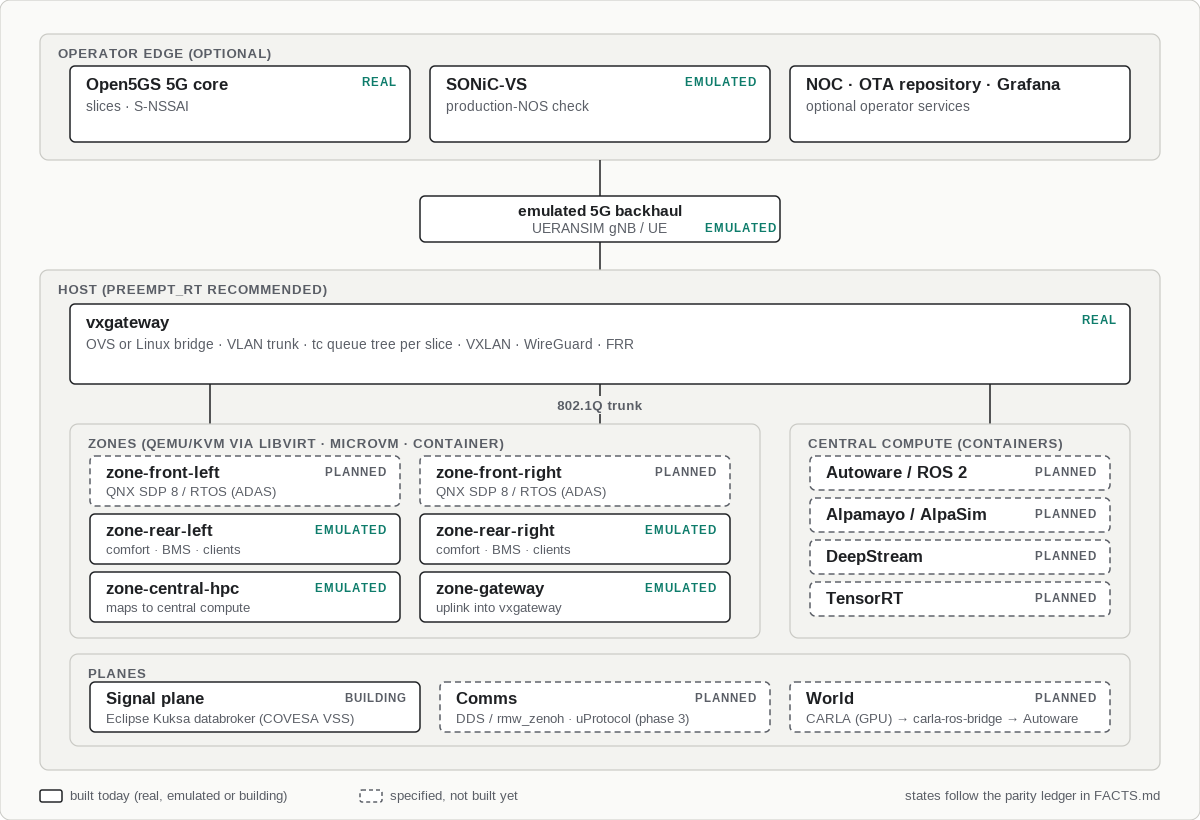
Figure 3.1: the topology (click for full size). Box states follow the parity ledger in FACTS.md: solid is built
today (real, emulated or building), dashed is specified and not built yet. Source:
diagrams/topology.py.
Key components:
- vxedged (Rust): control-plane daemon: orchestration + provisioning core behind vxAPI (gRPC/Protobuf). See §5.
- vxedge CLI (Rust): thin vxAPI client; the primary frontend.
- vxgateway: the software-defined edge gateway: Linux-native data plane (OVS or Linux bridge, tc, VXLAN, WireGuard, FRR), provisioned declaratively by the CLI. See §7.
- Zone and compute loadables (zone manifests, VM images for Zephyr, FreeRTOS and AAOS,
RTOS builds, central compute manifests, Autoware/ROS2 images, Alpamayo/AlpaSim, inference): see
vxpartsbelow. - vxota: OTA server & signing tooling (artifact store).
- vxagents: performant Rust agents for measurements and metrics.
- vxtelemetry: telemetry ingestion & Prometheus export (VSS-aligned; see §11).
- vxperiments: manifest-driven experiments, vehicle manifests, and results.
4: Repositories & single-source rules
Canonical repos (under vxedge org):
vxedge/vxedge: Rust workspace:vxedge-core(domain lib),vxedged(daemon, vxAPI),vxedge-cli(thin client),proto/(vxAPI Protobuf IDL, the source for all generated SDKs: Rust/tonic, TypeScript/connect-es), plus gateway provisioning templates (netlink/OVS/nftables/tc, libvirt domain XML templates).vxedge/vxparts: the unified loadable registry: zone VM/kernel/RTOS bundles, central-compute container images, gateway/TCU images, agent binaries, and platform-service images, every loadable the platform boots, published toghcr.io/vxedge/parts/...via OCI/ORAS, classified byclass/subtype/layer(see §13's own artifact-publication rules). Supersedes the earlier zone-image and compute-container repos (Track P, decided 2026-07-26): those two repos split loadables by deployment mechanism (VM vs. container) rather than by domain, which is exactly the kind of implementation detail this workspace's own single-source-of-truth discipline exists to keep out of repo topology. Both were archived 2026-08-04 (GitHub archive, not deleted, their history stays reachable to the owner, read-only) once their content was confirmed fully present invxparts.vxedge/vxota: OTA server, signing, manifests.vxedge/vxagents: Rust agents, metrics exporters.vxedge/vxtelemetry: telemetry ingestion and exporters.vxedge/vxperiments: experiment manifests, vehicle manifests, notebooks, results.vxedge/vxmodels: (track M) SysML v2 system models: requirements/traceability (H1–H4verify-linked to frozen result archives), vehicle structure models, the analysis-case/variant library, and thevxmodelrenderer (Rust) that generates manifests from models. See §6.3 and §15 (track M).vxedge/docs: papers, slides, reproducibility guide.
Single-source rules:
- A zone/compute's manifest is authoritative for its images and node IDs.
- Services declared under
servicesin an experiment manifest are the authoritative runtime descriptors for that experiment (image + config). The code lives in vxota or vxtelemetry as appropriate. - A vehicle manifest is the authoritative composition of zones + compute + network + services for a software-bootstrapped vehicle; experiments reference a vehicle rather than restating it.
- CLI uses manifests as sole input; state stored in ephemeral runtime directories and vxedge logs.
- Exactly two cross-language interfaces exist: manifests (YAML content) and vxAPI
(Protobuf IDL under
vxedge/vxedge/proto/, authoritative; client SDKs are generated, never hand-written). No bespoke ad-hoc RPC. - Model governance (track M, when
vxmodelslands): the SysML v2 model is the design authority upstream of manifests; manifests remain the sole execution contract, the daemon/CLI never read models. A model-rendered manifest records the digest of the model version that produced it and must passvxedge manifest validatelike any hand-written manifest. The model never duplicates what zone/compute manifests are authoritative for (images, node IDs). See §6.3.
5: vxedge control plane & API (vxedged, vxAPI, frontends, CLI)
Principle (API-first): the split every production SDV toolchain converges on, Tesla-style fleet tooling, NVIDIA DriveWorks tools, AUTOSAR Adaptive development tooling, is a headless core behind a strongly-typed IDL, with every UI a disposable thin client. vxedge adopts it outright: no orchestration logic lives in any frontend.
5.1 Layers & frontends
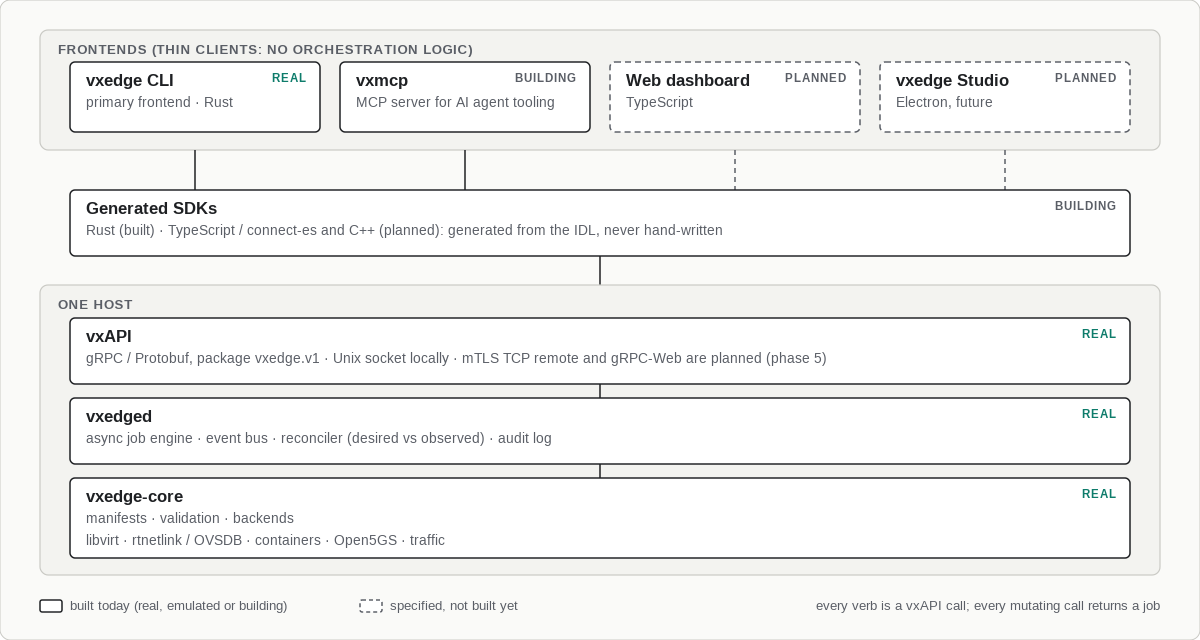
Figure 5.1: layers and frontends (click for full size). Box states follow the parity ledger in FACTS.md.
Source: diagrams/layers.py.
- vxedge-core (Rust lib): pure domain logic; no user-facing I/O.
- vxedged (Rust daemon, tonic + tonic-web): hosts vxAPI. Every mutating verb is an async
job with server-streamed progress; the reconciler compares desired (manifest) vs observed
state, that is what makes
up|downidempotent. - Frontends (all thin clients of the same API): platform administration, live status
monitoring, and experiment operation, for two kinds of operator: OEM engineers and SDV
researchers directly, and (via
vxmcp) AI agent tooling acting on their behalf. None of these are the in-vehicle HMI, that role belongs to Android Automotive (AAOS), already the infotainment zone's guest OS, or an embedded Qt/QML IVI loadable (running under a QEMU ARM zone node; both are real, alternate in-vehicle-HMI baselines, §9). Frontends here are external tooling that operates the testbed, not something running inside a simulated vehicle. Correction (2026-08-06): there is no Qt/QML operator dashboard, any platform monitoring dashboard is web-based (TS) or the CLI, never Qt.vxedgeCLI (Rust): unchanged UX; local Unix socket by default,--endpointfor remote; auto-spawns an ephemeral local daemon for single-host lab use.- Web dashboard (TypeScript; connect-es-generated SDK over gRPC-Web): not built.
vxmcp(Rust,rmcp, the official MCP Rust SDK): an MCP server exposing vxAPI to AI agent tooling (any MCP client), for the same reason every frontend above exists: a thin, 1:1 client over the same RPCs, this time addressed by an LLM agent's tool-call surface instead of a terminal or a GUI. Every MCP tool is a direct wrapper over one vxAPI RPC (GatewayService/ZoneService/ComputeService/VehicleService/ExperimentService/TrafficService/SvcService/NosCheckService/TelemetryService/LogService/RunService/WorkspaceService/HostService/JobService/EventService), never a multi-step workflow baked into the server, the hard rule stated explicitly for this frontend too. Sits directly onvxedge-api's generated tonic bindings (a Rust-to-Rust dependency, not a second codegen pipeline the way the TS SDK is). Targets MCP spec 2026-07-28: stateless request-response (noinitializehandshake), with Multi Round-Trip Requests (InputRequiredResult/InputRequest::Elicitation) as the mechanism for the one thing a thin wrapper still needs, a mutating tool (up/down/traffic up) asking its caller to confirm before it runs, the same posture a human operator gets from the CLI's own explicit verbs, not something an LLM can chain unsupervised into a destructive sequence. Read tools (status/list/events subscribe/results-archive summaries) carry no such question. Mutating tools run behind that confirmation (mcp.mutateinFACTS.md). Repo:vxedge/vxmcp.
5.2 API surface (vxAPI, proto/vxedge/v1/)
| Service | RPCs (declarative, manifest-in) |
|---|---|
GatewayService | Apply, Up, Down, Status |
ZoneService / ComputeService | Apply, Up, Down, List, Remove, PushImage (client-streaming) |
SvcService (ota, telemetry) | Up, Down, Status |
VehicleService | Up, Down, Status |
ExperimentService | Up, Down, Status |
TrafficService | Up, Down, Status |
MeasurementService | Start, Stop, Status (an experiment's measurements, run inside each end's network namespace) |
CampaignService | Plan (a campaign's trials, each point's bound document checked; touches nothing), Start (runs the trials serially as one job), Get, List, Watch (status as it changes) |
ResultService | List (a host's results: campaigns' trial archives and a workspace's results/), Get, Fetch (an archive's bytes, server-streaming), by digest; Verdict (an experiment's criteria judged over a campaign's archives, with the reference campaigns they read), Compare (a campaign against a reference campaign, run on this host or recorded in a workspace's results/) |
PackageService | Inspect (a package's descriptor, digest, lock state, requirements, typed intent, measurements and entities; touches nothing), List (the host's package cache), Pull, Import (client-streaming) |
NosCheckService | Up, Down, Status, Verify |
JobService | Get, Watch (server-streamed progress; every mutating RPC returns a Job), List, Cancel |
EventService | Subscribe (state transitions, audit events; resumable with after_id) |
TelemetryService | Collect (archive job), StreamRecords (live records, resumable with after), StreamMetrics (live samples) |
LogService | Follow (live log lines per entity and stream, resumable with after) |
RunService | Get, List, Status (every run's status in one call), Down (several runs, or every run, as one job) |
WorkspaceService | Plan |
HostService | Capabilities |
Rules: mutating RPCs carry manifest documents (or references to them), the API introduces no second source of truth beside manifests; daemon state stays in ephemeral runtime dirs + logs.
Not built. Apply, Remove and PushImage on ZoneService and ComputeService answer
UNIMPLEMENTED, and are to be deprecated: manifests define the topology, and parts come from the
registry.
Versioning. vxAPI stays in the vxedge.v1 package, and wire changes are additive: new RPCs,
fields and values, with old ones kept and marked deprecated. Behaviour may change between releases
when the changelog says so. A version roadmap is defined once vxedge can simulate real software use
cases for SDV OEM engineers.
Agent surface (built in vxedge 0.5.0). An agent must be able to plan, run,
observe and recover a run on its own, branching on typed fields and never on detail or message,
which stay for people. All of this is additive to vxedge.v1:
- Runs. A run is one provisioned workspace on the host, identified by a run id and its workspace
identity (§13). It starts when the gateway comes up, survives a repeated
upand a daemon restart, and ends when the gateway goes down. A read-onlyRunService(Get,List) reports runs. Resource verbs take an optionalRunRef; empty means the only run, and a mismatch is refused. Before vxedge 0.31.0 the host ran one at a time, soListreturned zero or one. - A run is read from its record (X0.8). Ships in vxedge 0.34.0.
upwrites the manifest it provisioned to the run's directory,runs/<s>/manifest.yaml, besideactive.json, and fails rather than run without it. For a bare vehicle that is the experiment synthesized from it, andactive.jsonrecords the vehicle's id.down, status,RunService.Statusand.Down, and a restarted daemon read the run from that record, never from its workspace again:- A workspace edited since
upcomes down as what is running, not as the edited file. A moved or deleted workspace, and an inline manifest, come down by run id or throughRunService.Down.ERROR_REASON_WORKSPACE_CHANGEDis no longer returned. - With no run named, the
manifeston adownor status picks the run. It must still resolve, and an inline one must declare that run's workspace, or the verb is refused withERROR_REASON_WRONG_WORKSPACE: a mistyped path never takes down the one run up. - A run whose manifest was not recorded refuses its
downwithERROR_REASON_WORKSPACE_INVALID. - The experiment verbs refuse a bare vehicle's run, and the vehicle verbs an experiment's, with
ERROR_REASON_WRONG_WORKSPACE. downremoves the manifest afteractive.jsonand leaves a campaign'sreserved.jsonalone.
- A workspace edited since
- Several runs (Track F). Ships in vxedge 0.31.0, with vxtelemetry 0.11.0. The host runs
several runs at once, each in its own instance slot (§6.0.5), and
Listreturns every run. Which run a verb acts on:- A verb that names a run acts on it. A named run that is not up is refused with
ERROR_REASON_NO_ACTIVE_RUNwhen nothing is up, and withERROR_REASON_RUN_MISMATCHotherwise. - A verb that names no run acts on the run of the workspace it names, and with no workspace
either, on the only run on the host.
VehicleDownRequest,VehicleStatusRequest,GatewayDownRequest,GatewayStatusRequest,ExperimentDownRequestandExperimentStatusRequestgain aRunRef run, so each run of a workspace that runs twice can be addressed. The CLI takes--run <run id>on every verb, andvxedge runslists the runs. - When that rule matches no run, the verb is refused with
ERROR_REASON_NO_ACTIVE_RUN, including a verb whose workspace has no run while other runs are up: it never acts on another run. When it matches more than one, including a bareupof a workspace that has two runs, it is refused with a new reason,ERROR_REASON_RUN_AMBIGUOUS, whose error lists the runs. Nothing is chosen silently. ERROR_REASON_WRONG_WORKSPACEno longer refuses another workspace'supwhile a run is up: thatupstarts a run in another slot. It is kept for a verb whose run and workspace disagree.- The stages a composite verb (
experiment,vehicle, a campaign's trial) sends name their slot, so they never fall back to "the only run". - Lifecycle operations still run one at a time across the host, and an interactive one is refused
as
ERROR_REASON_BUSYwhile another runs. Runs coexist; theirupanddowndo not overlap. Concurrent runs are for functional work: a timed campaign still takes the host on its own.
- A verb that names a run acts on it. A named run that is not up is refused with
- The fleet view (Track F). Ships in vxedge 0.33.0, with vxmcp 0.7.0.
RunServicegains two RPCs, so an agent reads and clears every run on the host in one call:Status(RunStatusRequest { repeated RunRef runs }) returns aRunStatusper run, every run whenrunsis empty. ARunStatusholds theRun, its rollupstatus, itscomponents, itsgatewayand its typednodes: whatVehicleStatusorExperimentStatusholds for that run, read once. A status reports absence rather than refuse: a named run that is not up, and a run whose status cannot be read, get an entry witherror_reason(ERROR_REASON_NO_ACTIVE_RUN,ERROR_REASON_RUN_MISMATCH, or the read's own reason) anderror_message, and no status. The call still answers for every other run, so a fleet poll does not break when one run goes down.Down(RunDownRequest { repeated RunRef runs; bool all }) takes the named runs down, or every run withall. Exactly one of the two is set, or the call is refused withERROR_REASON_INVALID_REQUEST.allwith nothing up succeeds and does nothing. A named run that is not up is refused as any verb's is.- It is one lifecycle operation,
run.down, refused asERROR_REASON_BUSYwhile another runs. It takes the runs down one after another, each with its kind'sdown(experiment.down,vehicle.down) from the manifest the run recorded, as a child job carrying the run'srun_id.JobService.Listwith the parent's id gives each run's outcome. - It is best effort: a run that fails does not stop the others. A run whose
downcannot start, such as one whose manifest was not recorded, still gets a failed child job with the refusal's reason, and the parent fails with the first failure's reason. - When a running campaign holds the slot of a named run, or with
allany slot, even one empty between two trials, the whole call is refused before anything is touched, withERROR_REASON_HELD_BY_RUNnaming every such slot and its campaign, as a single run'sdownis refused. Skipping those runs would leave the campaign to bring its next trial up after the call reports the host cleared. Cancel the campaign (JobService.Cancel) or wait for it to end.
- It is one lifecycle operation,
- Only the run a lifecycle operation acts on reads
RESOURCE_STATE_STAGINGinGet,ListandStatus; the other runs are observed as usual. An operation that names no single run, such asrun.down, makes every run readSTAGINGwhile it runs. - The CLI adds
vxedge runs status [RUN…]andvxedge runs down (--all | RUN…).
- Typed status.
NodeStatuscarries the zone, role, backend, port, peer, VLAN and payload (kind, reference, digest) thatdetailholds as text today.RESOURCE_STATE_UNPROVISIONEDmarks a declared device nothing provisions.observed_unix_mssays when a status was read, andsince_unix_msis 0 when the transition time is unknown. - Planning. A read-only
WorkspaceService.Planreturns typed problems, nodes, services, images and host checks without touching the host. It runs the same checks asup, so the two cannot disagree.HostService.Capabilitiesreports what this host supports. - Errors. Refusals carry
google.rpc.ErrorInfo. TheErrorReasonenum incommon.protodefines the reasons, its value names are the wirereasonstrings, anddomainisvxedge.v1.Job.error_reasondoes the same for a job that fails after it starts. - Jobs.
Jobgainsparent_job_id,run_idand a typedartifact.JobServicegainsListand a cooperativeCancel, which takes effect between steps and leaves partial state fordownto clear. One lifecycle operation runs at a time: a duplicate returns the running job, and any other is refused as busy. Verbs that do not converge (TrafficService.Up,NosCheckService.Verify) accept arequest_id, so a retry returns the original job. Job history is bounded, and job ids carry a per-boot prefix, so an id from before a restart is reported as unknown, never as another job. - Events.
Eventgainsrun_id, andSubscribetakesafter_idto resume from a bounded history. Event ids carry the same per-boot prefix. A subscriber that falls behind gets a typed error instead of a silent gap.run.upandrun.downreport vehicles and experiments. - Stages.
ExperimentStagegainsCOMPUTEandSIGNAL_PLANE, vehicleupanddownacceptstages, andResourceKindgainsSIGNAL_PLANE, so status reports the databroker as itself. - Traffic and evidence.
TrafficService.Statusreports each profile as running, finished or failed.TelemetryService.Collectruns as a job and returns the archive with its digest.StreamMetricsstays unbuilt.
Why gRPC/Protobuf (not SOME/IP, not bare REST): SOME/IP–ara::com is the in-vehicle service
plane, the wrong tool for an orchestration/tooling plane; bare REST lacks first-class streaming
and codegen rigor. One Protobuf IDL generates every SDK, gRPC-Web covers browsers,
and Protobuf is what Eclipse uProtocol already speaks, schema reuse for the signal plane.
5.3 Transport, security, deployment modes
- Local (default, live today): Unix domain socket only,
vxedged --listenrejects any other scheme outright, andvxedge --endpointrejects any non-unix://value the same way (neither side has ever accepted anything else). The access boundary today is filesystem permissions on the socket path, not a per-call identity check, noSO_PEERCRED/UCredpeer-credential extraction exists anywhere in the code yet. "Peer-credential auth" below is the target for this mode, not its current behavior; stated here per this doc's own fidelity rule (§14 /testbed-quality) rather than implying it already gates local connections. - Remote and cloud-hosted modes do not exist today: there is no TCP listener, no
authentication beyond socket permissions, and
Audit::record(rpc, detail)(vxedged/src/audit.rs) carries no caller identity.
5.4 CLI: commands & semantics
Location: vxedge/vxedge (Rust workspace: vxedge-core, vxedged, vxedge-cli, proto/).
Binaries: vxedge (thin client), vxedged (daemon).
Global behavior: all lifecycle commands follow up|down semantics. Where staging is required,
up performs staging + start; down stops + cleanup. All operations are idempotent.
Commands (canonical)
# Daemon / control plane
vxedged serve [--listen unix:///run/vxedge.sock]

# Client endpoint (applies to every command below; defaults to the local Unix socket)
vxedge [--endpoint <url>] ...

# Gateway (vxgateway, virtual edge gateway)
vxedge up|down|status

# Zones
vxedge zone up --vxid <vxid>
vxedge zone down --vxid <vxid>
vxedge zone list
vxedge zone add --manifest <zone-manifest>.yaml                      # not built, see §5.2
vxedge zone rm --vxid <vxid>                                         # not built, see §5.2
vxedge zone image push --vxid <vxid> --from <path> --registry <url?> # not built, see §5.2

# Compute
vxedge compute up --vxid <vxid>
vxedge compute down --vxid <vxid>
vxedge compute add --manifest <compute-manifest>.yaml                      # not built, see §5.2
vxedge compute rm --vxid <vxid>                                            # not built, see §5.2
vxedge compute image push --vxid <vxid> --from <path> --registry <url?>    # not built, see §5.2

# Services (OTA, telemetry)
vxedge ota up [--experiment <path>]      # cwd-resolved by default, like `experiment up`;
vxedge ota down [--experiment <path>]    # --experiment overrides with an explicit workspace
vxedge telemetry up|down --experiment <path>   # SvcService, like `ota up|down`
vxedge telemetry collect --manifest <path> [--out <zip>]   # TelemetryService.Collect: the
                                          # results archive, returned with its sha256

# Vehicle (software-bootstrapped SDV: gateway + zones + compute + signal plane + services)
vxedge vehicle up --manifest vxperiments/vehicles/<vehicle>.yaml
vxedge vehicle down --manifest vxperiments/vehicles/<vehicle>.yaml
vxedge vehicle status --manifest vxperiments/vehicles/<vehicle>.yaml

# Experiments (manifest-driven; may reference a vehicle manifest)
vxedge experiment up      # from the workspace directory; --chdir <dir> from elsewhere
vxedge experiment down

# Traffic generation
vxedge traffic up --manifest ...

# Measurements (in the workspace's folder; the experiment must be up)
vxedge measure start [--id <measurement>] [--duration-s <s>]
vxedge measure status
vxedge measure stop

# Production-NOS config-parity check (never part of `experiment up`, §7)
vxedge nos-check up|down|status|verify [--experiment <path>]
vxedge vehicle up is sugar for the ordered composition: gateway up → zones up → compute up →
signal plane up (Kuksa, phase 3) → services up. vehicle down tears down in reverse. A vehicle
with no signal_plane block (§6.0.1) has no such stage, and it is not reported as done. A
declared signal plane that does not stay running fails the job.
vxedge vehicle up|down and vxedge experiment up|down run the same order, and
--stage gateway|zones|compute|signal-plane|services restricts them to the stages named, so --stage services alone does not start the databroker.
vehicle status reads the
workspace it is pointed at and observes each declared component on the host (netlink, nftables,
QEMU, Podman), so its answer survives a daemon restart and never comes from vxedged's memory.
Every CLI verb is a 1:1 wrapper over a vxAPI RPC, anything the CLI can do, every other frontend (scripts against the generated SDK) can do identically.
6: Manifests, final schemas (YAML)
6.0 The workspace model (Track D)
An experiment is a folder. Every file declares its kind and id; the loader indexes on
that pair, and every cross-reference is by id, never by path, so files can be renamed or
reorganised without breaking anything.
h1-slice-isolation/
  vxp.yaml                 # package descriptor: schema, id, version, entry, requires
  vxp.lock                 # generated by `vxedge pkg lock`, never hand-edited (§6.0.7)
  .vxpignore               # optional: further identity exclusions (§13)
  main.yaml                # kind: experiment  — the test
  vehicle.yaml             # kind: vehicle     — the system under test
  road1.yaml               # kind: road        — the road network (omit if unused)
  scenario.yaml            # kind: scenario    — what happens on the road (omit if unused)
  parts.yaml               # kind: baseline    — which software
  scripts/run.sh           # the campaign: repetitions, warmup, measurement window
  parts/                   # this experiment's own loadables
  assets/                  # OpenDRIVE roads, OpenSCENARIO storyboards, traces, maps
  tools/                   # analysis specific to this experiment
  results/                 # archives, one per run
A workspace is a sandbox. It owns everything the experiment needs, so it can be zipped,
sent, unzipped and run, which is what makes an experiment shareable at all. A workspace whose
parts live three directories up is not something a recipient can unpack. Only the top-level
*.yaml are workspace documents; the subdirectories are content, and the loader ignores them
(a part.yaml inside parts/ describes a loadable, not an experiment).
Kinds: experiment | vehicle | road | scenario | baseline | component. Loading is: read the
descriptor, glob *.yaml (non-recursive, so a results/ archive is never absorbed), index by
(kind, id), resolve references by id. No includes, no import boilerplate, no ordering rules.
Files exist only when the experiment needs them. vxp.yaml is the descriptor, not a document, and
the glob skips it.
Descriptor name. The descriptor is vxp.yaml (§6.0.3), a fixed name as Cargo.toml is, and
.vxp names the packed, shareable file (§6.0.7). A folder whose descriptor is a legacy
<name>.vxp YAML file, the form vxedge 0.5.x read, is refused with the steps to migrate it, and a
folder holding both names is refused. A packed .vxp found in a source folder is refused as such: a
file whose bytes are a tar archive is never parsed as YAML.
A file may hold several documents, ----separated, and a whole workspace may be one file.
That follows from every reference being by id: the file boundary carries no meaning, so it is
free to move. Separate files stay the scaffold default because they teach the model, but an
engineer who wants one file, or a caller with no directory to point at, such as an inline
manifest over vxAPI, has one.
Structure and software are separate files. One vehicle.yaml with many baselines is what
an OTA campaign is, what an RxSWIN identifies, and what makes an A/B arm two baselines rather
than two vehicle files that drift apart.
The vehicle names a slice; the experiment defines it. links[].slice: adas in the vehicle,
network.slices[].mode: vlan|s-nssai in the experiment. H2's comparison is therefore one
block changed over a provably unchanged vehicle, enforced by the schema rather than asserted
in a README. This is the only reference that crosses the structure/test boundary, and
vxedge experiment validate checks it.
network: (and everything under it, slices, tunnels, data_plane, nos_check) lives in
the experiment document only, never inside a vehicle document, for a second reason beyond H2:
there is exactly one vxgateway per experiment run (one bridge, one HTB tree, a deliberate
fidelity choice, one vehicle has one gateway ECU, not an oversight). When an experiment
references multiple vehicles (vehicles: [car1, car2]), they share that one gateway, so they
share one network: block too, a per-vehicle network: would imply each vehicle gets its own
separate gateway, which the system doesn't build. Vehicles that need distinct, isolated
segments still get them: the experiment declares every slice either vehicle needs
(car1-adas/car2-adas on separate VLANs, say), and each vehicle's own links references only
the slice IDs that belong to it, car2.yaml never has to mention car1-adas at all.
Local-first. Every ref has a local form (./images/foo) and a published form
(ghcr.io/… + digest), same key, resolved by shape. digest is optional for local refs
(content-hashed into the results archive) and required for published ones, a moving tag
is not reproducible for anyone else. So a run is always reproducible for its author, and
publishing is what makes it reproducible for others. vxedge experiment up must work
offline with zero published artifacts.
Tooling: vxedge experiment new <id> [--template minimal|slicing] scaffolds a workspace;
vxedge experiment validate [path] runs every cross-file check and reports all problems at
once. vxedge pkg new | validate | lock | pack | unpack | inspect work on packages (§6.0.7),
locally and offline, as experiment validate does, since vxedge 0.6.1. experiment new and pkg new scaffold the same vxp/1 package, with id
local/<id> until --namespace names the publishing organisation, and write its first lock.
6.0.1 kind: vehicle
kind: vehicle
id: car1
class: road                          # taxonomy spine: kind > class > subtype
subtype: car

zones:                               # REGIONS of the entity, not devices
  front-left: {}
  central: { name: central compute bay, reference: <external zoning std> }

devices:                             # units LOCATED IN zones
  zonefl: { role: zone-controller, zone: front-left, backend: container }
  hpc1:   { role: hpc, zone: central, backend: container, resources: { cpu: 4, memory: 8 } }
  gw1:    { role: gateway, backend: container }

functions:                           # units of BEHAVIOUR, deployed onto devices
  adas:    { deployed_on: zonefl, asil: B }
  percept: { deployed_on: hpc1 }

links:                               # transport: how bytes move (the harness)
  - { id: trunk-fl,  endpoints: [gw1:eth0, zonefl:eth0], slice: adas }
  - id: arm-cont                     # object form, when an attachment needs a fixed address
    endpoints: [{ node: zonefl, port: eth0, ip: 10.101.0.11/24 }]
    slice: adas
  - id: seg-t1                       # a slice-bound link may emulate its PHY
    endpoints: [node-sensor-01:eth0]
    slice: adas
    impairments: { rate_mbps: 100, delay_us: 250, jitter_us: 40, loss_pct: 0.01 }
    harness: { medium: 100BASE-T1, length_m: 2.4, weight_g: 85 }

channels:                            # interaction: what is exchanged, between FUNCTIONS
  - id: adas.object-list
    from: percept
    to:   [adas]
    protocol: dds | zenoh | someip | udp
    qos: { reliability: reliable, deadline_ms: 50 }
    carried_by: [trunk-hpc, trunk-fl]

services:                            # what the vehicle hosts, each placed on one of its devices
  ota:
    id: ota-01
    type: ota
    image: { url: localhost/vxedge/ota:1, kind: container }
    on: hpc1                         # required here: joins that device's container group
    config: { listen: "0.0.0.0:9900", artifacts: ./ota-store }   # or a published store, below

signal_plane:                        # the vehicle's signals, placed the way a service is
  kuksa:
    image:
      url: ghcr.io/eclipse-kuksa/kuksa-databroker@sha256:529d8c6d3cc223362667672978bcb8f92c4d356b25aedd336e7a2e004d7279bd
      kind: container
    on: hpc1
    config: { listen: "0.0.0.0:55555" }
Zone, device, function are three different things. A zone is a place, a named region
(front-left, cabin, nacelle-2, an ATA zone), not an enum, which is what lets a non-road entity
have zones at all. A device is a unit located in one. A function is behaviour deployed onto a
device: AUTOSAR calls it a software component, and separating it from the ECU it runs on is the
whole point of the Virtual Function Bus. parts: targets functions, and channels connect
functions, a topic flows between behaviours, and which devices they sit on is a deployment
decision a study should be able to vary without rewriting the interaction topology.
role is zone-controller | hpc | gateway | ecu | sensor | actuator | switch. backend is
container | qemu-microvm | libvirt | cloud-hypervisor | wasm-capsule | attach | qemu-mcu and is required for any device attached to a slice:
the planner has to know whether to build a veth or a tap, or to adopt an interface another stack made
(attach, §9), and guessing produced a workspace that validated and then could not boot.
An endpoint's ip is one CIDR, or a list of them on the same port: the first is the device's address, and a
container device also carries the rest, as a multi-homed ECU does (ip: [10.120.0.60/24, 192.168.98.1/24]). A
VM guest is given the first only.
Addressing is <id>[:<port>]. Ids are flat and unique workspace-wide (zonefl, not
zones.front-left): structural paths break when the model is restructured, and flat ids do
not. Uniqueness is an enforced check, and so is the zone/device collision it makes possible.
A link endpoint takes two forms. The bare zonefl:eth0 is right whenever nothing has to be
reachable at a known address, which is most attachments. The object form
{ node, port, ip } pins a host address on that attachment, for the case with no other
expression: exp-002's three arms share one VLAN and are told apart only by address. An
address belongs to the attachment rather than the device, a device on two slices has two, and
it lives in the vehicle rather than the experiment because it states a structural fact ("this
ECU answers here"), which is what keeps one vehicle usable by many baselines.
One attachment per device, for now. The schema can express a device on two slices; the
planner cannot provision one yet, so it refuses the workspace and names the device. A silently
missing second NIC would pass every check and then measure the wrong topology. role: gateway
is the same kind of limit in the other direction: vxgateway is implicit in every slice, and a
device with that role runs as an ordinary node, not as a gateway. resources is recorded but no
backend enforces it yet.
carried_by binds a channel to the links carrying it, and validation requires the channel's
endpoints to be reachable over those links. This is what makes latency and loss
attributable per topic per slice rather than only per link, the measurement §12 exists to
produce. Without the reachability check, carried_by would be an unchecked assertion.
A slice-bound link may add impairments (tc netem: rate_mbps/delay_us/jitter_us/
loss_pct) to emulate the PHY it stands for, the mechanism behind §7's "Harness modeling."
Every value is per traversal, one direction: a round trip pays the declared delay twice. Exactly
one of the link's access ports renders it, in both directions (the reverse direction rides an
IFB, since a qdisc only shapes egress); which port is not observable in a measurement, only that
the segment's declared characteristics apply once per crossing. Any link, impaired or not, may
separately carry harness (medium, length_m, weight_g), the declarative record a
zonal-versus-domain harness-reduction study reports on, distinct from impairments' emulated
half: nothing about a length in meters is a tc argument.
Behaviour splits in two: interaction (channels) belongs to the vehicle; stimulus
(traffic_profiles, scenario) belongs to the experiment and the road. The vehicle is the same
vehicle whether it is driven hard or gently.
A service a vehicle hosts is placed on a device. Each entry under services has the §8 shape
plus on: <device>, which is required here. The device must use the container backend and run
a container payload; the service becomes one more member of that device's container group, in
its network namespace. It therefore answers at the device's address, on the device's slice, and
is unreachable from any other slice by the same VLAN rule that isolates the device itself. The
alternative, giving the host an address on the slice, would put a shared host inside every
slice's isolation claim. Declaring one service type in both a vehicle and the experiment that
wraps it is refused: two owners for one service would leave svc status answering for neither.
The signal plane is placed the same way. signal_plane.kuksa runs the Kuksa databroker as a
member of the on: device's container group, under the rules a placed service follows: a
container device with a payload, and a localhost/ or digest-pinned image. Its signals are
therefore reachable on that device's slice and nowhere else. It is a block of its own, not a
services entry, because it has its own stage: it comes up after compute and before services, so
a service can depend on it. vehicle status reports it as a component. A vehicle with no
signal_plane block has no such stage.
The databroker runs with --insecure, so signals are unauthenticated. It has no TLS and no
tokens here, and any client that reaches it can read and write every signal. Slice isolation is
the only protection: a study that needs more than that cannot rely on this signal plane.
6.0.2 kind: baseline
kind: baseline
id: bl-2026-07
rxswin: RX-VXE-0001-0003             # optional; UN R156, a property of the vehicle TYPE

parts:
  - ref: ghcr.io/vxedge/parts/zone/linux/stack/probe-bundle:0.1.0
    digest: sha256:…                 # required for published refs
    target_ids: [zonefl, zonefr]     # scalar or list — declared once, however many nodes
  - ref: ./images/my-autoware        # local; no digest required
    target_ids: hpc1
  - ref: localhost/vxedge/probe:1    # this host's Podman image store; no digest required
    target_ids: zonefr
  - ref: ghcr.io/vxedge/parts/agent/load/app/dds-perf:0.1.0
    digest: sha256:…
    target_ids: hpc1
    run:                             # optional; how a container payload is started
      args: [pub, 1000Hz, size, 1k]  # replaces the image's command, not its entrypoint
      env: { CYCLONEDDS_URI: "<peer list>" }
      cap_add: [NET_ADMIN]           # NET_ADMIN only
Each entry carries ref, digest, target_ids, and, only where the reference is silent
about it, kind: container | bundle | wasm | attach. Class, subtype, layer, name and the VXPN part number are
all derivable from the ref path; restating them is the drift the computed-part-number design
exists to prevent.
kind exists because a part knows what it is and a device knows how it is run, and the two
have to agree: a container backend boots a container image, libvirt, qemu-microvm,
cloud-hypervisor and qemu-mcu boot a guest bundle, wasm-capsule runs a .wasm module, and attach runs the platform adapter
an attach part declares (§9). The local/… namespace is conclusive on its own (a host process, never a
bundle), and a published vxparts ref is deliberately not read for this, its class says
what kind of node the part loads onto, not how it is packaged, and a zone guest is legitimately
a container under the netns backend. A localhost/… ref is conclusive the other way: a
container image already in this host's Podman store, run as the device's payload like a
published one. It is built per host, so a run records its image ID, and up refuses a missing
image and names it rather than letting Podman reach for a registry. Only a bare path is
ambiguous, and there kind is how the author says so. A stated kind is validated against the device's backend, so a
baseline pointing an H3 libvirt arm at a container image is rejected with both halves named
rather than silently accepted and failed at boot. A planned vxedge manifest bom (not built) will
derive them for display, SBOM export and the RxSWIN roll-up.
run says how a container payload starts, for a part whose image does nothing useful on its
image defaults (a load generator needs its mode, a client the address of its server). It is valid
only on a part a container device runs as its payload, a published or localhost/ container
image, and refused anywhere else with the entry named. args replaces the image's command
(CMD) and keeps its entrypoint, as podman run <image> <args> does. env adds environment
variables, strings only. cap_add adds Linux capabilities to the payload container, and accepts
NET_ADMIN only, the one a load part needs for its own routes (a multicast route for SOME/IP
service discovery); anything else is refused. Every target in the entry starts the same way, so
two roles of one part, a publisher and a subscriber, are two entries. run is part of the
baseline document, so it counts toward the workspace identity and the package digest, and a
changed argument is a changed input. The archive records it with the rest of the documents. Ships
in vxedge 0.29.0.
target_ids declared once for many components is deliberate: repeating a shared part
per-component is how fleet baselines silently drift when one copy is bumped and the others are
not.
6.0.3 kind: experiment and the package descriptor
kind: experiment carries network (slices, tunnels, nos_check, shaping, time_sync), traffic_profiles,
telemetry, services and results, plus vehicles: [<id>…], baseline: <id>,
scenario: <id> (below; world: <id> is its legacy name and still reads as it), and a method
block (duration_s, repetitions, warmup_s). It may also carry typed intent,
hypothesis, parameters, metrics, criteria and campaign (below). It carries no
zones/compute inline: structure is the vehicle's, and software is the baseline's.
baseline: <id> selects the software. A workspace may hold several kind: baseline documents
over one vehicle, and only the named one's parts run; with more than one, an experiment that
names none is refused. Every baseline must give every function a part. An A/B arm that changes
software is a string parameter that binds baseline, so the vehicle stays one unchanged
document:
parameters:
  load: { type: string, default: bl-idle, binds: baseline, values: [bl-idle, bl-dds] }
campaign:
  arms:
    idle: { load: bl-idle }
    dds:  { load: bl-dds }
pkg lock pins the references of every baseline, so a pulled or offline package can run any
arm, and Plan builds each arm's bound documents, so an unknown baseline is refused before a
trial starts. Before vxedge 0.29.0 every baseline document was read, whatever the experiment
named.
services declared here run as host processes (§8). A service placed inside a slice belongs to
the vehicle (§6.0.1).
Every one of those blocks is typed and validated when the model is built, a malformed
services: entry is one error against the file the author wrote, not a surprise at svc up.
network.tunnels (docs/ROADMAP.md #16) declares a point-to-point link the gateway itself
terminates, reaching a remote peer (another site's gateway), distinct from network.slices,
which partitions the local bridge fabric zone nodes attach to. Two kinds today, each with only
the fields it needs:
network:
  tunnels:
    - id: ota-uplink
      kind: wireguard                  # an encrypted, routed L3 endpoint
      listen_port: 51820
      address: 10.200.0.1/24           # this side's address on the tunnel's own overlay subnet
      peer:
        public_key: <base64>           # the peer's key, known out of band — never this side's own
        endpoint: 198.51.100.7:51820   # omit if this side only listens (WireGuard roaming)
        allowed_ips: [10.200.0.0/24]
    - id: site-b-adas
      kind: vxlan                      # extends a local slice's L2 domain across hosts
      vni: 100                         # 24-bit VXLAN network identifier
      remote: 198.51.100.7             # the remote gateway's reachable address (bare IP)
      dstport: 4789                    # optional; defaults to the IANA-assigned VXLAN port
      slices: [adas]                   # which of this experiment's own slices this link carries
wireguard carries no local key material, deliberately: a manifest is a versioned document, and
a private key does not belong in one. The gateway mints its own identity on first up, piped
straight from wg genkey into wg set's stdin, never written to disk, and vxedge status
reports the resulting public key back, which is what an operator hands to the peer out of band.
Re-applying an already-existing tunnel reconfigures its peer/listen-port declaratively without
touching that identity, so a routine reconcile pass can never silently invalidate what the peer
already trusts.
vxlan has no key material at all, an unencrypted L2 extension, the same trust model as a
physical inter-switch link, and is structurally the opposite of wireguard: a WireGuard
interface is a routed L3 endpoint, never enslaved to the bridge/OVS switch, while a VXLAN
interface joins the bridge as a trunk-like port, so slices (not an address/peer block)
is what a vxlan tunnel actually needs, which local slice(s) it extends, validated against
network.slices the same way a links[].slice reference is. Model and validation only
(docs/ROADMAP.md #16, delivered 2026-08-04), GatewayPlan refuses to plan a kind: vxlan
tunnel today (PlanError::VxlanTunnelNotYetProvisionable), loudly rather than silently
dropping it, since provisioning it is a separate, not-yet-built follow-on.
network.nos_check (docs/ROADMAP.md #16/#31, schema settled 2026-08-04) opts an experiment
into checking its network.slices VLAN intent against a real production network OS, alongside,
never instead of, the actual measured path (network.data_plane). Absent by default; most
experiments don't declare it:
network:
  nos_check:
    kind: sonic-vs                     # the only kind today
    trunk_port: Ethernet0              # validated against the pinned image's actual port list
    # part_ref / digest: optional, default to the pinned build vxparts/parts/gw/nos/os/sonic-vs
Deliberately not named "twin": the whole testbed already is one (an executable virtual
prototype of a vehicle), so reusing that word for one internal field would describe nothing.
What this does is a check, boot a real instance of the named NOS, hand it the same VLAN
declaration network.slices already expresses, and confirm it accepts and reports back exactly
that. It never carries measured traffic (§7: SONiC-VS is functional but not
timing-representative), and it is not part of experiment up's provisioning sequence, a
missing or misconfigured nos_check block never blocks or changes what an experiment actually
measures.
kind names which NOS is being checked against, sonic-vs today, the shape a second kind
would extend rather than a reason to design one now (network.data_plane's own
kernel-bridge | ovs precedent). trunk_port is not a name vxedge invents: it is one of the
pinned image's own, fixed port names (SONiC-VS's default reference platform exposes exactly 32,
Ethernet0/Ethernet4/.../Ethernet124, confirmed by booting it, not assumed), validated at
vxedge experiment validate time against that concrete list rather than a free-form string or a
loose pattern.
network.shaping and network.time_sync add a time-aware gateway, the TSN variant of §7. Both
are optional, and an experiment without them keeps the HTB tree it has today. shaping
ships in vxedge 0.28.0, and vxtelemetry 0.9.0 records its kind in each archive. time_sync
ships in vxedge 0.30.0, and vxtelemetry 0.10.0 records it in each archive.
network:
  slices:
    - { id: adas, mode: vlan, vlan: 101 }
    - { id: infotainment, mode: vlan, vlan: 103 }
  shaping:
    kind: gate-schedule                # the only kind; absent means the HTB tree
    windows:                           # one cycle, repeated; the cycle is the sum of the windows
      - { id: adas, open: [adas], duration_us: 10000 }
      - { id: rest, open: [infotainment, default], duration_us: 90000 }
  time_sync:
    kind: gptp                         # IEEE 802.1AS, run by linuxptp
    followers: [zonefl, hpc1]          # devices that follow the gateway's clock
shaping replaces the HTB tree with an IEEE 802.1Qbv gate schedule (tc taprio) on the same
port and in the same direction: the uplink, for frames leaving the bridge. kind names the
schedule, not the Linux qdisc that renders it.
- One class per slice. Each
vlanslice is one traffic class.defaultis one more, for frames that match no slice, as HTB's default class is today. An 802.1Q port has 8 traffic classes, so a schedule takes at most 7 slices. Ans-nssaislice has no VLAN on the uplink, so it is not a class and does not count. - Windows. Each window has an
id, unique in the schedule, and opens the gates of the classes it lists forduration_us, a whole number of microseconds from 1 to 4294967 (the kernel holds an interval in 32-bit nanoseconds). The windows run in order and the cycle is their sum. The schedule starts on the TAI epoch, so its phase is the same in every run. A parameter reaches a window by id path,binds: network.shaping.windows[adas].duration_us. The smallest window tested is 10 ms; a shorter one is accepted, but software gates on a stock kernel have timer jitter, so its result says so. - Comparing HTB with TSN takes two experiments, since a parameter cannot switch a block on: the
TSN one reads the HTB one through
references, as exp-010 reads exp-001. - What validation refuses, with
ERROR_REASON_WORKSPACE_INVALID:- a class that no window opens, since it could never send;
- an unknown slice id in
open, ans-nssaislice inopen, or two windows with the sameid; - more than 7 slices, or a slice named
default; - a slice
qosornetwork.defaults.bandwidthbesideshaping. They are HTB's parameters, so they are refused rather than ignored; shapingwithnetwork.data_plane: ovs, which has not been tested.
- Host.
Plan,upandGatewayService.Uprefuse withERROR_REASON_HOST_REQUIREMENT_UNMETon a host whose kernel has notaprio, andHostService.Capabilitiesreports whether it has. A daemon that predates these keys refuses them, as it refuses any unknown manifest key, so a package that uses them setsrequires.vxedgeto the first release that reads them, asrequires.simulatordoes. - Rendering.
- The planner creates the uplink with one transmit queue per class.
- A
clsactegress filter per slice sets a frame's priority from its VLAN tag (flower vlan_id <vlan> action skbedit priority <p>), the match the HTB filters use. Amatchallfilter after them sets priority 0,default's, on every other frame, whatever priority it arrived with. tapriomaps each priority to its slice's class, in software mode, timed by the kernel's TAI clock.- The
clsactqdisc is created beforetaprio. Installed the other way round, the gates held no traffic when tested. - A running gateway is not switched between the HTB tree and a gate schedule:
uprefuses and asks fordownfirst, since the uplink's queue count is fixed when it is created.
- Slice telemetry. The
vxedge_slice_*series (§12) are read from the slice'staprioclass instead of its HTB class.vxedge_slice_overlimits_totalhas no meaning without a rate and is not served. - Fidelity.
- No line rate. HTB's root rate is what makes slices contend for bandwidth. The veth uplink has no rate of its own, so a gate schedule decides when a class may send, not how much fits in a window.
- Guard band. Software
taprioholds back a frame that would not fit before its gate closes, computed from the port's reported speed, which on a veth is nominal. - Classification. Frames are classed by VLAN id, where an 802.1Q bridge classes them by the priority in the tag.
- The run record and the archive's
metadata.jsoncarry the shaping kind and, withtime_sync, software timestamping and free-running followers, soCompareand a verdict show which mode each campaign ran in.
time_sync makes the gateway the grandmaster of an IEEE 802.1AS (gPTP) domain over the
followers' access ports:
- The gateway is the grandmaster, with one master port per follower's access port, in one
ptp4l. It runs as root from the linuxptp image: vxedged keeps a rootless container of that image,vxgptp-<bridge>, holding the image's file system, and startsptp4lin it withsudo -n nsenter --mount --pid, in the bridge's network namespace. That is the passwordlessnsenterthe 5G pods already need, so Podman itself never runs as root, and removing the container ends the grandmaster. - Host.
Plan,upandGatewayService.Uprefuse withERROR_REASON_HOST_REQUIREMENT_UNMETon a host where sudo does not runnsenterwithout a password and vxedged is not root, andHostService.Capabilitiesreportsgptp. - Frames do not cross the bridge. gPTP frames go to
01:80:C2:00:00:0E, a link-local address a Linux bridge passes to the receiving port and does not forward. Each follower therefore hears the gateway only, as each port of a time-aware bridge would. - Data plane.
time_syncneedsnetwork.data_plane: kernel-bridge. Withovsit is refused, because the OVS data path takes every frame on its ports and has not been tested for gPTP. - Followers. A follower is a
containerdevice. Itsptp4ljoins the device's container group, as a placed service does (§6.0.1), in atime-syncstage after compute, which reportstime-sync.upandtime-sync.downevents and lists each follower in status. Refused withERROR_REASON_WORKSPACE_INVALID: no followers or the same one twice, an unknown device, a VM device (its guest runs its own follower, and vxedge has no way into it), a device without a container image or an access port, and a service namedgptpon a follower. - Names. Every
ptp4l's management socket, pidfile and log lives under the run's runtime directory, never at linuxptp's defaults (/var/run/ptp4l), so two runs on one host cannot collide. - One image. The gateway's
ptp4land every follower's run the same vxpartslinuxptppart, pinned by digest. A package that usestime_synclists it in the lock'simages, and the archive'simage_digestsrecords it. - Container followers measure, they do not steer. They share the host's clock, so they run free and report their offset from the grandmaster and the peer delay. That measures the time-sync path, not clock discipline.
- Offsets are telemetry. vxedged's exporter (§12, host-side measurements) serves
vxedge_gptp_offset_secondsandvxedge_gptp_path_delay_secondsfor each follower, with the follower as entity, read from that follower'sptp4lover its management socket: the offset isCURRENT_DATA_SET.offsetFromMaster, and the peer delayPORT_DATA_SET.peerMeanPathDelay, since with peer-to-peer delay the current data set'smeanPathDelaystays 0. They land in the run's samples beside the latency they help explain. A follower whoseptp4ldoes not answer, or that follows no grandmaster, leaves agap. - Run record.
Run.time_syncand the archive'smetadata.jsoncarry the time sync: its kind, its followers, software timestamping and free-running followers. - Profile. linuxptp's generic 802.1AS settings, with best-master election, which the
gateway wins on
priority1, andneighborPropDelayThreshat 100000 ns instead of the standard's 800 ns. Software timestamps on a veth put the peer delay close to 800 ns, and a follower dropped out at that value. In-vehicle networks fix the roles instead of electing.
Spiked on a veth pair and on a VLAN-aware Linux bridge between network namespaces, outside vxedge, with linuxptp 4.2 and software timestamps:
- a gateway
ptp4lon two bridge ports held a follower in each namespace, at a mean offset of 0.4 to 0.7 µs; taprioon an uplink, classified by slice VLAN, held each class to its windows. With a 100 ms cycle, frames of the class open 10 ms waited up to 88 ms, and frames of the class open 90 ms up to 9.8 ms.
Typed intent. A kind: experiment can say what it tests and how a result is judged, in
fields a machine can check before any trial runs. Every block below is optional: an experiment
without them runs exactly as before.
hypothesis:
  id: H1
  statement: A VLAN slice keeps control-traffic p99 within 2x of idle under uplink saturation.
parameters:                          # the only knobs a caller may turn
  load_mbps: { type: integer, unit: Mbit/s, default: 0, min: 0, max: 1000,
               binds: traffic_profiles[bg].bandwidth_mbps }
metrics:                             # what criteria and observability clients read
  - { id: ctl_p99_seconds, kind: gauge, unit: s, entity: measurements/ctl-rtt,
      series: vxprobe_rtt_seconds, labels: { quantile: "0.99" } }
  - { id: ctl_lost, kind: counter, unit: "1", entity: measurements/ctl-rtt,
      series: vxprobe_lost_total }
  - { id: ctl_sent, kind: counter, unit: "1", entity: measurements/ctl-rtt,
      series: vxprobe_sent_total }
  - { id: ctl_loss_pct, kind: gauge, unit: "%", entity: measurements/ctl-rtt,
      ratio: [ctl_lost, ctl_sent], factor: 100 }
criteria:
  - id: h1
    all:
      - id: h1-p99-bound
        lhs: { metric: ctl_p99_seconds, aggregate: median, select: { arm: saturated } }
        op: le
        rhs: { metric: ctl_p99_seconds, aggregate: median, select: { arm: idle }, factor: 2.0 }
        min_samples: 5
      - id: h1-loss-bound
        lhs: { metric: ctl_loss_pct, aggregate: median, select: { arm: saturated } }
        op: le
        rhs: { metric: ctl_loss_pct, aggregate: median, select: { arm: idle }, offset: 0.5 }
campaign:
  arms:
    idle: { load_mbps: 0 }
    saturated: { load_mbps: 600 }
  sweep: { load_mbps: [0, 100, 250, 400, 600] }
  repetitions: 5
  warmup_s: 10
  duration_s: 60
  profiles:
    quick: { repetitions: 1, duration_s: 12 }
    repro: { repetitions: 5 }
-
hypothesishas anidand a one-sentencestatement. It is for people and for citing a result; nothing evaluates it. -
parametersare the only values a caller may change between trials. Each has atype(integer,number,booleanorstring), aunitfor numbers, adefault, and optionalmin,maxorvalues(an allowed list).bindsnames the manifest field the parameter sets, by id path:traffic_profiles[bg].bandwidth_mbpsis thebandwidth_mbpsof the traffic profile whoseidisbg. There is no text templating, so every document still validates as plain YAML with the defaults in place. A path must name an existing field of a matching type, and two parameters may not bind the same field. -
metricsnames what a criterion or a client reads: anid, akind(counter,gaugeorhistogram), aunit, and theentityit is measured on, such as themeasurements/<id>of the measurement that produces it (below). A metric gives each trial one value. It names aseries(with thelabelsthat pick one of its lines), and its value in a trial comes from the series' samples on the entity inside the trial's measure phase, or in the whole archive when the archive records no phases. When the campaign declareswindows(below), a series metric names thewindowit reads, and only that window's samples count. Or a metric is theratioof two such metrics in the same trial, times an optionalfactor, such as a loss percentage from the lost and sent counters, or a cold window's slowest round trip over the steady window's median. -
reduceon a series metric sets how its samples become the trial's value:last(the default) is the last sample.deltais the last sample less the first. It spans the first sample to the last, not the phase's edges.rateis that delta per second between the same two samples.mean,minandmaxare the samples' mean, least and greatest.
deltaandrateneed two samples. A counter or histogram that goes down has restarted: it is counted on from 0, as Prometheus'sincreasereads it, and the value says how many times. A gauge'sdeltais plain last less first, such as memory growth.ratereads a counter or a histogram's cumulative series;mean,minandmaxread a gauge. A reduction other thanlastrefuses two lines of the series thatlabelsdo not tell apart. A node's cost over the window, as exp-002b reports it per arm, is two metrics:- { id: cpu, kind: counter, unit: "1", entity: vx-h3-vehicle/front-left/node-cont-01, series: vxedge_node_cpu_seconds_total, reduce: rate } # share of one CPU - { id: rss, kind: gauge, unit: B, entity: vx-h3-vehicle/front-left/node-cont-01, series: vxedge_node_memory_bytes, reduce: mean } -
referencesname the other campaigns a criterion reads, each<name>: { campaign: <id> }with an optionalstatement: exp-010's H2 holds when its p99 growth from 0 to 600 Mbit/s stays within 1.10x of exp-001's. A reference's trials are read with this experiment's metrics, asComparereads a reference, and its arms are its own campaign's. A criterion that reads a reference the verdict cannot find isinconclusive, and says which.references: vlan: { campaign: exp-001, statement: "the static VLAN mapping, frozen" } criteria: - id: h2 op: le lhs: { ratio: [{ metric: p99, aggregate: median, select: { load_mbps: 600 } }, { metric: p99, aggregate: median, select: { load_mbps: 0 } }] } rhs: { ratio: [{ metric: p99, aggregate: median, select: { load_mbps: 600 }, reference: vlan }, { metric: p99, aggregate: median, select: { load_mbps: 0 }, reference: vlan }], factor: 1.10 } -
criteriaare structured, never an expression string, so a caller composes one without writing a parser and a bad one is caught by type. Each has anid, anop(lt,le,gt,ge,withinoroutside) and two operands,lhsandrhs. An operand is one of:- a metric:
metric, anaggregateover the values of the trials it selects, an optionalselectby arm or by parameter values, and an optionalfactorand thenoffset. Withreference: <name>, the trials are those of a declared reference campaign instead (below); - a constant:
valuewith aunit; - a combination:
ratio: [a, b](a / b, in unit1),diff: [a, b](a − b), ormaxorminof a list of operands, each with an optionalfactorandoffset. The combined operands' units must agree.
The aggregates are
mean,median,min,max,sum,count,iqr,stddev,p50,p90,p95andp99. Percentiles are nearest-rank.medianaverages the middle two of an even count.iqris the third quartile minus the first, by the exclusive method of Python'sstatistics.quantiles, and the range below four values.stddevis the sample standard deviation.withinholds when the operands differ by no more than itstolerance, andoutsidewhen they differ by more. A tolerance is a number in the operands' unit, or an operand, such as the larger of an arm's IQR and a noise floor.all: [...]andany: [...]group criteria.min_samplesis the fewest trial values each metric operand needs.guardsare criteria that must pass for a criterion to be conclusive: exp-002b and exp-003 guard each latency comparison with a loss bound, so a lossy arm makes it inconclusive rather than failed. exp-001's loss bound above is a member ofallinstead, because its notebook fails H1 on it. - a metric:
-
Each criterion evaluates to
pass,failorinconclusive. It isinconclusivewhen an operand has fewer thanmin_samplestrial values, a selected trial has no value or incomplete telemetry (agapon the metric's entity while the trial measured), a ratio divides by zero, or a guard does not pass. An archive that is notvxarchive/2is refused, not read (§11).inconclusiveis never reported as a pass. A group ispassonly when its rule holds over conclusive members, andinconclusivewhen the outcome depends on an inconclusive one. A one-line text rendering of a criterion is for people; nothing parses it. -
campaignsays which trials to run: namedarms(each a set of parameter values), an optionalsweepover one or more parameters,repetitions,warmup_sandduration_s, andprofiles, named overrides such asquickandrepro. An arm or a sweep sets only declared parameters, within their bounds.campaignreplacesmethodfor an experiment that declares it, and an experiment may not declare both. -
windowssplit a trial's measure phase into named windows that run one after another, for a protocol that measures twice in one trial: exp-005 probes a short cold burst the moment the zone is up, then a steady window on the same zone. Each window has anid, aduration_s, and an optionalsetof parameter values for that window only. A window may set only a parameter that binds a measurement's field (measurements[<id>].…), since the rest of the trial is already up. The measure phase lasts the windows' sum, so a campaign with windows has noduration_s, and a profile does not change it. Every series metric then names its window.campaign: repetitions: 20 windows: - { id: cold, duration_s: 3, set: { probe_pps: 20 } } - { id: steady, duration_s: 60 }
Trials. CampaignService.Plan expands a campaign into the trials it runs:
- Points. Every point of the
sweepis a trial, and a sweep over several parameters is their product. Every arm is a trial too. A sweep point whose values equal an arm's carries the arm's name instead of running twice: the example above is five points, with0labelledidleand600saturated. A parameter neither sets takes its default. - Order. Points run in order within each repetition, and every point of one repetition runs before the next.
- Provisioning. Each trial is provisioned and torn down on its own, as exp-001's campaign always has been, so a trial cannot inherit another's state.
- Profiles. A profile overrides the repetitions, warmup and duration. With
windows, it changes a window's length through its ownwindows, by window id (quick: { repetitions: 1, windows: { steady: 12 } }); the windows and what each sets stay the campaign's, and a profileduration_sbeside windows, or a window id the campaign does not declare, is a problem. - No campaign. An experiment without one is a single point at its defaults, with its
method's repetitions and windows. - What a trial carries. An id (
r<repetition>-<point>, where the point is the arm's name or the parameters off their defaults, such asload_mbps=100), its arm, every parameter's value, its warmup and measure durations, and its measure windows with each window's values. The plan also gives the estimated wall time. - Checked per point.
Planbuilds each distinct point's document with its values written to the fields they bind, in memory: the package is never written, so its digest and lock hold for the whole campaign. A value the parameter allows but the document cannot run, such as a probe rate of 0, is a typed problem naming the point. A trial with windows is checked window by window, with each window's values, and a problem names the window.
Running a campaign. CampaignService.Start runs the trials serially as one campaign.run
job.
- Each trial, in five phases:
- provision:
experiment upwith the trial's values bound, in memory, as inPlan; - warmup: the traffic profiles start for the trial's windows, then the warmup passes;
- measure: the measurements run for the trial's duration. With
windows, each window starts the measurements with its own values, runs them for its duration and stops them, so the next window's senders start from nothing; each window has its ownmeasurephase record, which names the window; - cooldown: measurements and traffic stop;
- teardown: the telemetry service stops, the trial is archived, and
experiment downruns.
- provision:
- Stages and markers: every step is a stage of the campaign job, so it shows as a child job.
Each phase starts with a
phaserecord in the trial's records (§11). - Archives: each trial's archive is
vxarchive/2, and itsmetadata.jsonnames the campaign, the trial, its arm, repetition and parameter values. - Requirements: a campaign archives through the experiment's own telemetry service, so
PlanandStartrefuse an experiment without one. - Failures: a failed trial is recorded and the next one runs.
downruns after every trial that started provisioning. - State: the campaign's state, with each trial's phase, archive and digest, is kept in
campaign.jsonbeside the archives (results/<campaign id>/in the workspace by default) and under the daemon's runtime folder.Get,ListandWatchread it, after a restart too. - Resuming: a retry with the same
request_idresumes that campaign and skips the trials whose archives exist. While the campaign runs, the retry gets its job. A retry with another profile is refused asERROR_REASON_PARAMETER_INVALID, never merged. - Cancelling:
JobService.Cancelstops it between trials. - One at a time: another campaign is refused as
ERROR_REASON_BUSY, withactive_campaignandretry_after_msinErrorInfo.metadata. An unknown campaign id isERROR_REASON_CAMPAIGN_UNKNOWN.
Results through vxAPI. ResultService names each archive by the digest of its bytes and
describes it from its own metadata.json only:
- the archive format, the experiment, and the package with its lock state;
- the trial: campaign, arm, repetition and parameter values;
- the collection time, the vxtelemetry version and the kernel.
List gives a host's campaign trial archives, and those under a workspace's results/, newest
first. Get returns one by digest, and Fetch streams its bytes, so a client on another
filesystem can rerun from it. An unknown digest is ERROR_REASON_RESULT_UNKNOWN.
Verdicts. ResultService.Verdict judges the experiment's criteria, as its workspace holds
them, over a campaign's archived trials. It reads them from the archives again on every call, so
it says only what the archives hold.
- Trials: each trial the campaign archived counts once, with its arm and parameter values from the campaign's record. A trial that failed or was never archived is not judged.
- What it returns: the verdict (
passwhen every criterion passes,failwhen one fails, elseinconclusive) and every criterion's outcome. With each: its operands' and tolerance's values, every metric it read with the trials and values behind it, its members and guards, and why it is inconclusive when it is. It also returns each trial's value of each metric. - References: each campaign the experiment's
referencesdeclare is read from thereference_workspacegiven, asresults/<campaign>/campaign.jsonwith its archives hash-checked (as forCompare). With none given, it is a campaign this host ran, or a record in the judged campaign's own workspace'sresults/. A read names the reference it came from. - Recorded: when a campaign finishes, its verdict goes into
campaign.jsonandCampaignStatus.verdict, and the full verdict intoverdict.jsonbeside the archives. An experiment without criteria records none.CampaignStartRequest.reference_workspacenames where the references are recorded, and is recorded with the campaign: the verdict judged when it finishes reads them there, and so do a laterVerdictandCompare's criteria that name no workspace of their own. Without it, a criterion on a reference recorded elsewhere isinconclusiveuntilVerdictis called with the workspace. - Offline:
vxedge results verdictandresults comparetake--reference-workspaceand read the references from it the same way, hash-checked; without it, a criterion on a reference isinconclusiveand says so. - Errors: an unknown campaign is
ERROR_REASON_CAMPAIGN_UNKNOWN, and an archive that cannot be read isERROR_REASON_RESULT_UNKNOWN.
Comparing. ResultService.Compare sets a campaign against a reference campaign, both judged
by the first campaign's experiment and read from their archives. A trial's point is its id
without the r<repetition>- prefix, so the repetitions of a point are compared together.
- Per metric, at every point both archived: each side's median and IQR over its repetitions, the difference of the medians, and whether that difference is within the reference's IQR. This is the reproducibility check exp-001's reruns use.
- Per criterion: its outcome in each campaign. Also each campaign's verdict, and how many
metric points are within the reference's IQR. A criterion that reads a declared reference
(
references) reads the same one on both sides, found asVerdictfinds it, in thereference_workspacewhen one is given. - A reference this host did not run: with
reference_workspace, the reference is that workspace'sresults/<reference_campaign_id>/campaign.json, such as a frozen campaign published with its archives. Such a record needs onlycampaign_idand its trials (id, arm, repetition, parameters, state, archive, sha256). Each archive is read from the record's folder: a relative path below it, or an absolute path by its file name. Each must hash to the record'ssha256, elseERROR_REASON_CHECKSUM_MISMATCH. A record or an archive that is missing, or a path outside the folder, isERROR_REASON_CAMPAIGN_UNKNOWNorERROR_REASON_RESULT_UNKNOWN.
Checked by Plan, before any trial. WorkspaceService.Plan, experiment validate and up
check typed intent with the rest of the workspace. A parameter whose type, bounds or binds
path is wrong is a problem with ERROR_REASON_PARAMETER_INVALID. A criterion that names an
unknown metric, compares operands whose units disagree, selects an arm or a parameter value that
does not exist, uses an unknown aggregate, or names a metric with neither a series nor a
ratio of two metrics that have one is a problem with
ERROR_REASON_CRITERION_INVALID. An arm, sweep or profile that sets an undeclared parameter or a
value out of bounds is ERROR_REASON_PARAMETER_INVALID too. Plan names every problem with the
document and the field it is in, and up refuses on the first, so a bad criterion fails in a
second, not after an hour of trials.
Scenarios and roads. A scenario is what happens on the road during a trial. vxedge invents
no road or manoeuvre format: a package carries ASAM OpenDRIVE (.xodr) and OpenSCENARIO (.xosc)
files unchanged in assets/, and two kinds point at them with what a reproducible trial needs:
kind: road
id: town-grid-small
network: assets/town-grid-small.xodr       # ASAM OpenDRIVE, unchanged
---
kind: scenario
id: urban-stop-line
road: town-grid-small                      # by id
storyboard: assets/urban-stop-line.xosc    # ASAM OpenSCENARIO XML, unchanged
simulator: esmini                          # esmini | carla
clock: { tick_ms: 10, mode: synchronous }  # the simulator is the master clock
seed: 42
actors:
  Ego: { vehicle: vx-vehicle-02 }          # storyboard entity -> the vxedge vehicle it is
parameters:                                # the storyboard's ParameterDeclarations
  EgoTargetSpeed: { unit: m/s, min: 0, max: 22.2 }
- The experiment names its scenario with
scenario: <id>. A package has at most one. - Actors: only the entities named under
actorsare vxedge vehicles, each a vehicle of the package. Every other entity of the storyboard is traffic, driven by the storyboard. Campaigns run serially, so a scenario has one ego. - Parameters name the storyboard's
ParameterDeclarations and give a number aunitand bounds. An experiment parameter turns one by id path,binds: scenario.parameters.EgoTargetSpeed, so a campaign sweeps it like any other parameter. The scenario must declare it, and the experiment parameter's bounds must lie inside the scenario's, in the same unit. The value travels with the trial's parameters, for the simulator that runs the scenario. The experiment document is not changed. - Ownership: a scenario used by one package lives only in it. A reusable one lives once in
vxperiments/scenarios/<name>/and is vendored withvxedge pkg vendor, as vehicles are, which also copies the road and storyboard files its documents name. - What vxedge reads: the storyboard's entity names and parameter declarations, and that the road is an OpenDRIVE file. Checking the storyboard itself is the simulator's job.
- Checked by
Plan,experiment validateandup: each file exists and has the right root element, the road id resolves, the simulator is one vxedge knows, every actor is an entity of the storyboard and a vehicle of the package, and every parameter is declared there (a string parameter takes no bounds). Each problem isERROR_REASON_SCENARIO_INVALID, anduprefuses on the first. - Inspect:
PackageService.Inspectreturns the scenario typed: road, storyboard, simulator, clock, seed, actors, the storyboard's entities, and each parameter with its bounds and the value the storyboard declares.
Measurements. A kind: experiment declares what it measures by node id, and the daemon runs
it; no script places a probe:
measurements:
  ctl-rtt:
    kind: rtt-probe          # the one kind so far
    from: node-adas-probe-01 # a device, or `host`: where the probe sends from
    to: internet             # a device, or `internet`: the far side of the shared uplink
    slice: adas              # the slice its packets use
    rate_pps: 500            # default 100
    payload_bytes: 64        # default 64
-
rtt-probesends paced UDP probes fromfromto a reflector attoand records round-trip time, jitter and loss. Both ends are onslice, and on a VLAN slice a node end needs anippinned on its link there. -
A UE end. On a
mode: s-nssaislice a node's link pins no address: the node's end is the slice's UE, whose PDU-session address the 5G core assigns atup. Such a measurement runs between the UE and the data network, so itstoisinternet. When it starts, the daemon learns the UE's address, runs the reflector in the UE bound to it, and runs the sender on the host, which reaches the UE through the core's uplink: the path the core routes, asTrafficServiceprobes a UE. The figures are round trips, so they read the same either way round. The UE's reflector stays until the 5G core comes down. -
A probe runs inside its node's network namespace.
MeasurementService.Startruns the host'svxprobeas the sender in thefromnode and as the reflector in thetonode, forduration_s(the request's, elsemethod.duration_s). Forto: internetthe reflector runs on a VLAN subinterface of the uplink's peer for the slice, in the run's uplink-side namespacevxh<s>(§6.0.5), at the first host address of the sender's subnet, so the probe crosses the slice's queue on the shared uplink. -
from: host. The sender runs on the uplink side, in the run'svxh<s>, and reaches thetonode over the slice's VLAN, from the first host address of thetonode's subnet: the far side ato: internetprobe answers on, used the other way round.tois then a device. -
A guest as
to. A node that boots a guest (qemu-microvm,libvirt,cloud-hypervisor,qemu-mcu) has no namespace on the host to enter, but its guest may run a reflector of its own. Its part declares it,org.vxedge.reflector: udp/<port>in the bundle'smeta.json(and as a manifest annotation when published), and the probe is aimed at that port; nothing is started in the guest. A part that declares none cannot be ato.Planreads the declaration from a local bundle, or a published one already in the part cache; a published bundle not yet fetched is read when the measurement starts, afteruphas fetched it. A guest cannot send a probe, and an attached platform, whose software vxedge does not place, is no end at all. -
The reflector answers first. Before the sender starts, the reflector must echo a datagram sent from where the sender runs, within 90 s, so a guest still booting is waited for. One that never answers fails the measurement, naming its address and port, rather than recording a window of pure loss.
-
Samples. Each sender serves its metrics on
127.0.0.1inside its own namespace. The daemon's exporter reads them there and serves them withentity="measurements/<id>"(§12), so a scrape never crosses the slice it measures. When the sender finishes, its summary stays in the runtime folder. -
Checked by
Plan. An end that is not a device (orhost, forfrom, orinternet, forto), a guest asfrom, a guesttowhose part declares no reflector, an attached platform, a device end other than the device the experiment isolates, a slice that is not declared or that an end has no link or (on a VLAN slice) pinned address on, atoother thaninterneton ans-nssaislice, ato: internetmeasurement whose far side would take one address on two slices (with another measurement, or with a traffic profile sending to the uplink), or a rate or payload out of bounds is a problem withERROR_REASON_MEASUREMENT_INVALID, andupandStartrefuse it. A parameter can bind a measurement's field:binds: measurements[ctl-rtt].rate_pps. -
Load runs where the node is.
TrafficService.Upruns atraffic_profilesentry inside its source node in the same way once the node's zone is up, to a target node or to the far side of the uplink, so a campaign's load and its probes share the path they measure. -
One device up:
isolate. An experiment'sisolate: <device>makesupstart that device alone, every other device staying down, anddownstops whatever is up. A campaign whose arms are packagings of one ECU runs one arm at a time this way: concurrent guests contend for host CPU and show as loss that is not the packaging's. Per arm, astringparameter bindsisolateand another binds the measurement'sto:isolate: node-cont-01 measurements: rtt: { kind: rtt-probe, from: host, to: node-cont-01, slice: adas, rate_pps: 1000 } parameters: arm_device: { type: string, default: node-cont-01, binds: isolate, values: [node-cont-01, node-microvm-01, node-libvirt-01] } arm_target: { type: string, default: node-cont-01, binds: "measurements[rtt].to", values: [node-cont-01, node-microvm-01, node-libvirt-01] } campaign: arms: container: { arm_device: node-cont-01, arm_target: node-cont-01 } microvm: { arm_device: node-microvm-01, arm_target: node-microvm-01 }A device that is not one of the vehicles' is a workspace error.
-
Stopends a measurement's processes and removes a far-side interface no other measurement or running profile uses.experiment downandvehicle downstop every running measurement and traffic profile before they take the nodes down.
Functional checks. Some experiments are suites, not measurements: exp-015 and exp-017 judge
whether a Kuksa databroker does what kuksa.val.v2 documents, with a client that prints one JSON
line per event. A kind: experiment declares such a suite in checks: the tools it runs, the
steps a trial runs in order, and the cases that judge each step's output. No script drives a
client:
checks:
  tools:
    kv2: { image: localhost/vxperiments/kv2:1, args: [--server, "10.100.0.50:55555"] }
    broker: { image: "ghcr.io/eclipse-kuksa/kuksa-databroker@sha256:…" }
  steps:
    - { id: state-before, observe: member, on: hpc1, member: kuksa-databroker }
    - { id: sub, tool: kv2, on: cabin1, args: [subscribe, Vehicle.Speed, --count, "3"],
        background: true, ready: { op: subscribe, result: open } }
    - { id: pub, tool: kv2, on: hpc1, args: [publish, Vehicle.Speed, "10"] }
    - { wait: sub, timeout_s: 30 }
    - { id: rx0, observe: port, on: zone-rl }
    - { id: denied, tool: kv2, on: zone-rl, args: [--connect-s, "5", get, Vehicle.Speed] }
    - { id: rx1, observe: port, on: zone-rl }
    - { id: drop, tool: kv2, on: hpc1, args: [actuate, X, "false"],
        until: { op: actuate, code: UNAVAILABLE }, every_s: 0.5, attempts: 20 }
    - { id: b61, tool: broker, on: alone, args: [--vss, /vss/vss.json],
        files: { /vss/vss.json: assets/vss-6.1.json }, background: true }
    - { sleep_s: 2 }
    - { id: list61, tool: kv2, with: b61, args: [--server, "127.0.0.1:55555", list] }
    - { stop: b61 }
  cases:
    - { id: seen, step: sub, where: { op: update }, field: value, ends_with: [10] }
    - { id: refused, step: denied, where: { op: connect }, field: result, equals: refused }
    - { id: reached-bridge, compare: { lhs: { step: rx1, field: rx_packets }, op: gt,
                                       rhs: { step: rx0, field: rx_packets } } }
    - { id: actuate-code, step: drop, where: { op: actuate }, field: code, observe: true }
criteria:
  - { id: kuksa-v2, cases: [seen, refused, reached-bridge] }
-
toolsare OCI images, each pinned by digest (<reference>@sha256:<digest>) or alocalhost/image built on the host that runs the package, as a device payload may be. A tool'sargsgo before each step's own, andentrypointreplaces the image's to run another program it holds. Every image is made present before the first step, so no step's time includes a download. -
A step does one thing. A tool step runs a tool
ona container node, in that node's group and so in its network namespace, as the node's own software sees the network;on: alonegives it a namespace of its own with loopback only, for a throwaway server;with: <step>joins a background step's namespace, for a client of that server.filesmounts package files read-only. The output of every step before it is readable at/vx/checks/<step>.log. A step runs in the foreground for at mosttimeout_s(60 s by default), or, withuntil, again everyevery_suntil a line of the attempt matches,attemptstimes at most. Abackgroundstep is started and left running, the next step waiting for itsreadyline when it names one; a laterwaitwaits for it to exit andstopstops it, and any still running is stopped after the last step. Anobservestep reads the host's side:membera node's group member (running,restarts,started_at),porta node's bridge port (rx_packets,tx_packets,rx_bytes,tx_bytes).sleep_spauses. -
Output is recorded. Each tool or observe step's output, one line per event, is a log stream of the entity
checks/<step>(§12), so it lands in the trial's archive underlogs/checks/<step>.jsonl.zst, on the trial's clock, with everything else. After each step's own output the daemon adds one line,{"op": "vx.step", …}: itsexitcode, whether ittimed_out, theattemptsit took and whetheruntilmatched, whether a background step wasreadyandrunning_at_stop, andelapsed_s. A line that is not a JSON object reads as{"text": <line>}. -
Where checks run. A campaign trial runs its steps in its measure phase, within the measure duration (
campaign.duration_s, ormethod.duration_s): the phase lasts as long as they take, and a step is cut short by the time left. Steps the duration does not reach are skipped. An experiment withcheckstherefore declares a duration and nowindows. -
A case selects the JSON lines of one
stepwhose fields equal those itswherenames (anullwants a field unset; afieldis a dotted path), and expects one thing of them: the last selected line'sfieldequalsa value, isone_ofa list,containsa value (a substring, a list element or a map value), or ispresent; acountof selected lines (a number, or a rule such as{ ge: 1 }); the selected lines'fieldvalues in order are asequence,ends_witha list, orincludesone in order; or acompareof two steps' last selected values (eq,ne,lt,le,gt,ge). With no expectation, a line must match. Numbers compare by value, so10is10.0. -
Judging. Each case is
passorfailin each trial, andinconclusivewhen its step did not run in that trial: a case that never ran never passes. A criterion{ id, cases: [...] }fails when one of its cases fails in any trial, isinconclusivewhen none fails but one could not be judged, and passes otherwise. A case markedobserverecords what it found, such as what the documentation under test does not say, and is never judged; the verdict lists it underobservations, and a criterion may not name it. The verdict reports each case of acasescriterion, per trial, with the value it read and why it did not pass. -
Checked by
Plan. A tool not pinned, a step that does not do exactly one thing or runs on a node that is not a container node of the vehicles, awith,waitorstopnaming a step that is not a background step started earlier and still running, a file the package does not hold, a case that reads a step recording nothing or expects more than one thing,sampleson a step that is not a tool step, a bad series or label name, a series declared twice on one step, an emptyvalueorunit, a metric onchecks/<step>whose step does not declare its series in its unit with every label it picks, andcheckswithwindowsor with no duration are problems withERROR_REASON_CHECK_INVALID. A criterion naming a case that is not declared, or anobserveone, isERROR_REASON_CRITERION_INVALID. -
Samples. The same lines can carry numbers a tool measures itself, such as kuksa-perf's latency percentiles, and a tool step's
samplesreads them as series a metric aggregates:steps: - id: publish-idle tool: perf on: cabin1 samples: - { series: kuksa_perf_latency_us, where: { op: latency }, value: us, unit: us, labels: [quantile] } metrics: - { id: publish_idle_p50, kind: gauge, unit: us, entity: checks/publish-idle, series: kuksa_perf_latency_us, labels: { quantile: "50" } }Each line its
whereselects that holds a number atvalue(a dotted path) is one sample ofserieson the step's entitychecks/<step>, at the time the line was recorded, labelled with the values of itslabelsfields, each under the field's name. A line whose value is not a number, or that lacks a label field, gives none. A metric then reads the series as it reads a probe's, reduced over the measure phase as itsreducesays, and criteria aggregate it across trials. The samples are read from the step's archived output when a trial is judged, so an offline verdict reads the same values as the daemon's.
The descriptor holds packaging rather than content, so a version bump never touches an
experiment file. vxp/1 (ships in vxedge 0.6.0):
schema: vxp/1                       # discriminator, required
id: vxedge/h1-slice-isolation       # namespace/name, required
version: 1.2.0                      # SemVer 2.0.0, required
entry: main.yaml                    # required: the file holding the one kind: experiment
title: Slice isolation under background load
license: Apache-2.0                 # SPDX expression
authors: [{ org: vxedge }]
requires:
  vxedge: ">=0.6.0, <0.8.0"         # SemVer range the daemon's version must satisfy
  gpu: none                         # none | tier2
  kvm: true
  kernel: { preempt_rt: preferred } # required | preferred | any
  backends: [container, qemu-microvm]
  simulator: [esmini]               # esmini | carla: what the package's scenario runs on
provenance:                         # optional, written by generators such as vxmodel render
  generated_by: { tool: vxmodel, version: 0.3.0, model_digest: "sha256:…" }
x-oem-acme: { cost_centre: 4711 }   # x- keys are carried and ignored
schemadecides how the rest is read. Within a knownschema, an unknown key is refused, except keys prefixedx-, which are carried and ignored, so an organisation can annotate its packages without forking the format. Aschemathis build does not know is refused withERROR_REASON_PACKAGE_SCHEMA_UNSUPPORTED, naming the schemas it does know (HostService.Capabilitieslists them too), never with a parse error.idisnamespace/name. The namespace is the publishing organisation, the same string as its registry org, so an id never needs a mapping table and two organisations cannot collide. Each component is lower-case letters, digits and-, starting with a letter or digit. Thenamecomponent must equal thekind: experimentid, and names the packed file (§6.0.7). Catalogue aliases such asexp-002are kept by the catalogue that lists the package (vxperiments/catalog.yaml), not by the descriptor, so papers andFACTS.mdkeys keep resolving without the package carrying its history.versionis SemVer 2.0.0, checked. It versions the package, not the software it runs.requiresis checked by the daemon's preflight, whichupandWorkspaceService.Planrun;pkg validateandexperiment validateare local and check only its shape. A daemon whose version is outsiderequires.vxedgerefuses withERROR_REASON_VXEDGE_VERSION_UNSUPPORTED.kernel.preempt_rt: preferredruns on any kernel, and every run records which kernel it ran on (§13);requiredrefuses a kernel without it.requires.simulatorlists the simulators the package's scenario runs on. A simulator is available on a host when one of its executables is on vxedged'sPATH(esmini; for CARLA,CarlaUE4.shorCarlaUnreal.sh), andHostService.Capabilitieslists them. A host without one refuses withERROR_REASON_SIMULATOR_UNAVAILABLE. A scenario'ssimulatormust be listed here, or it is a scenario problem. vxedge readsrequires.simulatorfrom 0.15.0, so a package that declares it setsrequires.vxedgeto>=0.15.0.authorslists{ org }or{ name, org }entries. Packages vxedge publishes name organisations only.
entry must hold exactly one kind: experiment, and its id must equal the name component.
Both are checked by pkg validate, experiment validate, manifest validate,
WorkspaceService.Plan and up, and a malformed descriptor fails validation.
Legacy descriptor. A vxp.yaml without schema is refused: the file name already declares
the format. A legacy <name>.vxp YAML descriptor is not read: every verb that reads a workspace
(experiment and pkg verbs, Plan, up, PackageService.Inspect) refuses it with
ERROR_REASON_WORKSPACE_INVALID and the steps to migrate: rename it to vxp.yaml, add
schema: vxp/1, make id namespace/name, give it a version and an entry, and run
vxedge pkg lock. vxtelemetry collect refuses it too.
6.0.4 Requirements vs. allocation
Two different things that both sound like "resources":
requireson a part (part.yamlinvxparts), what the software needs:arch,libc,cpu,memory_gb,gpu.vram_gb,gpu.compute_capability.resourceson a component (in a vehicle), what the node is allocated.
vxedge manifest validate checks part → component → host and fails early, so "this host
cannot run this workspace" is reported before build time is spent rather than after.
depends_on between parts is metadata only: validated for presence in the same baseline,
never version-solved, a resolver is a package manager, and that would be a separate,
deliberate decision.
6.0.5 Interface naming
A device's host interfaces are derived from its id: vz-<stem> for the bridge access port
(the veth host side, or the tap itself) and vzp-<stem> for the veth peer. The stem is the
sanitised id, shortened to a readable head plus a hash of the whole id when it does not fit the
kernel's 15-byte IFNAMSIZ limit, node-cont-01 becomes vz-node-c-32cc.
This is a contract, not an implementation detail: campaign scripts address these names directly
(ip addr replace … dev vzp-node-a-c06a, qemu … ifname=vz-node-q-691e). Names used to be
positional, vz0, vz1, … in traversal order, which made ordering load-bearing in the
worst way: adding a device renumbered the rest, and two views of the same topology could
number it differently. exp-002 declares its arms cont, microvm, libvirt and sorts to cont, libvirt, microvm, so two H3 arms swapped interfaces between the two schema paths, the
campaign would have measured libvirt and reported microvm, passing every test on the way.
A name now depends on its own device and nothing else: not declaration order, not sorting, not
how many other devices exist. Two ids that shorten to one name are refused with both named.
vxedge zone list prints each device's port= and peer=, so the mapping is always
answerable without recomputing a hash.
Instance slots (Track F). Ships in vxedge 0.31.0. Several runs
share one host, so a name also carries its run's instance slot <s>: one character from 0–9
then a–z, so a host holds at most 36 runs. Every host object a run creates carries its slot:
| Object | Name |
|---|---|
| Bridge, uplink, uplink peer | vxbr<s>, vxup<s>, vxup<s>p |
| Uplink-side namespace (below) | vxh<s> |
| Access port, veth peer, ingress IFB | vz<s>-<stem>, vp<s>-<stem>, vi<s>-<stem> |
| WireGuard and VXLAN tunnels | vxwg<s>-<stem>, vxln<s>-<stem> |
| Node netns, container group, VM domain, pidfile, VMM socket | vx<s>-<node> |
| 5G pods | vx5g<s>, vx5g<s>-ran |
| Check step container | vx<s>-check-<id> |
| Run directory | <runtime-dir>/runs/<s>/ |
The peer and IFB prefixes shrink to two letters, so a stem keeps today's 11 characters and stays
the same: node-cont-01 in slot 0 has vz0-node-c-32cc and vp0-node-c-32cc. A VM guest's
command line carries vx.slot=<s> beside vx.node=<id>, and vxcapsule takes --slot <s>, so a
guest is found by its node and its slot.
A run's directory holds everything that is the run's own: its record, its manifest, its 5G and
gPTP config, its check output, its measurement and traffic pidfiles, and its telemetry ingest with
collect.log and tools.json. The daemon's socket, audit log and jobs stay at the root.
-
Choosing a slot. Every verb that starts a run (
VehicleService.Up,GatewayService.Up, experimentup) takes an optionalinstance. Without it, a workspace with no run takes the lowest free slot, and a repeatedupkeeps its run's slot. With it, the run takes that slot, so the same workspace can run twice and a script knows its names before it starts. A campaign takes itsinstance, or the lowest free slot at start, and keeps that slot for every trial.Run.instancereports the slot, andcampaign.jsonrecords the campaign's. -
A campaign holds its slot. From start to end, so another
upbetween two trials skips it and another caller's lifecycle verbs on it are refused withERROR_REASON_HELD_BY_RUN; what its workspace holds host-wide counts as held between trials too. The hold survives a daemon restart, so a retry with the same request id resumes in the same slot, and is released at the end, on failure and on cancel; a hold no retry can resume is released when the daemon starts. A campaign takes no lifecycle claim of its own: each trial'supanddownwaits its turn for it, so another run'supdelays a trial instead of failing it. -
Telemetry per run. The exporter serves each run its own page,
/runs/<s>/metrics, and a run's host entity scrapes<addr>/runs/<s>, so one run's series never reach another's archive;/metricsserves the only run.CollectRequest.instancenames the slot whose ingest to archive (a campaign collects after its trial's run is down); empty means the workspace's live run's, else the slot it last ran in. vxtelemetry records the slot asmetadata.json'sinstance. -
A run sees only its own slot.
downremoves only its own slot's objects, and a daemon restart restores every run it holds a record for. Another slot's objects are not foreign workload (ERROR_REASON_FOREIGN_WORKLOAD), and objects that carry no slot still are. -
The uplink side is the run's own (Track F). Ships in vxedge 0.32.0. Each run's uplink side lives in a network namespace of its own,
vxh<s>. It holds:- the uplink peer
vxup<s>pand its VLAN subinterfaces; - every far side on them: a
to: internetreflector, afrom: hostsender, and a traffic profile's far side; - the processes that run on those far sides, including the senders' metrics endpoints.
The uplink
vxup<s>stays on the bridge, so a slice's queue still shapes everything that crosses it.upcreates the namespace and moves the peer into it, and a repeatedupor a daemon restart finds it there.downstops the namespace's processes first, then deletes the namespace.Two things stay in the daemon's own namespace:
- an
s-nssaislice's data-network side: the bridge's own 5G port and the routes to the UE subnets. With one 5G vehicle per host, it cannot clash. - a traffic address the host puts on a container device's veth peer while its zone is down (see
"Host-wide resources"). Its traffic leaves through that veth and crosses the bridge, the access
port and the uplink to the far side in
vxh<s>.
A traffic profile whose end is a VM's tap is refused at
PlanandupwithERROR_REASON_WORKSPACE_INVALID. A tap is the bridge port itself, so an address on it would send into the guest, and vxedge runs no generator inside a guest. Until this change, such a profile and a container device whose zone was down put both of their addresses on the host, so their traffic went over loopback and never crossed the slice.Every
upenters the namespace, so the daemon needsCAP_SYS_ADMIN, as a realupalready does (GETTING-STARTED.md). Without it,upfails withERROR_REASON_HOST_REQUIREMENT_UNMETbefore it creates anything. Processes invxh<s>run as the daemon's user, never as root, and a failed metrics read inside the namespace is reported, not dropped. Registering the namespace may needsudo -n ip netns add, as a node namespace does. When that sudo rule is missing,upfails with the same reason, naming the rule.A far side's address is therefore the run's alone. Two runs may use the same subnets, so two copies of one measuring experiment run at once. The host no longer reaches a far side directly: scripts enter the namespace with
ip netns exec vxh<s>, and leak checks listvxhnames too. - the uplink peer
-
Host-wide resources. Some things a manifest names exist once per host, whatever the slot:
- a
mode: s-nssaislice, whose 5G attach subnets and UE routes live in the host's tables; - a host-side traffic address: a traffic profile whose container device's zone is down puts that
end's address on the device's veth peer on the host, in the host's routing table.
upbrings zones up, so this is checked when the traffic starts:TrafficService.Uprefuses the profile withERROR_REASON_HELD_BY_RUNwhen another interface on the host has an address in that /24; - a WireGuard
listen_port; - a VXLAN
vnianddstportpair; - an adopted
host_interface, such as the Cuttlefish tap; - the listen port of a host-process OTA service.
The first run to declare one of these holds it, and a second run that declares it is refused with a new reason,
ERROR_REASON_HELD_BY_RUN, naming the run that holds it. So is a slot that another run holds.ERROR_REASON_BUSYkeeps its meaning: another lifecycle operation is running. Far sides are not on this list: they live in the run'svxh<s>. - a
-
CPU pins are not arbitrated between runs. Two runs that pin the same CPU share it, and a timed run takes the host on its own.
6.0.6 Migration status
§6.0 is the only authored schema, and the only runnable one (2026-07-31). Every planner
takes the domain model, which is built from a workspace; vxedge up, vxedge experiment up
and vxtelemetry ingest|collect all read a workspace directory. All five experiments
(exp-001, exp-002, exp-002b, exp-003, exp-010) have workspaces, each verified to produce
plans identical to the frozen §6.1 manifest it replaced.
§6.1 and §6.2 are deleted, structs, adapter and lowering alike. vxmodel render (track M)
emits workspaces too, so vxedge manifest validate has one shape to check and CI asserts it.
The frozen vxperiments/experiments/exp-*.yaml files are kept as provenance for the results
already recorded against them, not as inputs. Pointing a tool at one now reports what the
document is and where to go instead.
6.0.7 Packages: lock, packed form, digest
vxedge 0.6.0 reads vxp/1 descriptors; 0.6.1 adds the lock, the packed form and the pkg
verbs; 0.7.0 checks the lock at up and records the package digest; 0.8.0 adds pkg vendor.
A package has two forms of the same content:
| Form | What it is | Used for |
|---|---|---|
| Source | A folder: vxp.yaml, vxp.lock, documents and content (§6.0) | Authoring, git, review |
| Packed | One file, <name>-<version>.vxp, deterministic | Sharing, signing, publishing, offline transfer |
One package per hypothesis. Variants are arms, parameters and profiles inside one package, never sibling folders, so each verdict belongs to exactly one package.
Lock. vxp.lock is written by vxedge pkg lock and never edited by hand. It is YAML with its
keys in a fixed order, so a re-lock with nothing changed rewrites identical bytes:
schema: vxp-lock/1
package: { id: vxedge/h1-slice-isolation, version: 1.2.0 }
locked_with: 0.6.0                  # the vxedge version that wrote this lock
files:                              # every identity input except vxp.lock, sorted by path
  main.yaml: "sha256:…"
  parts/probe/probe.bin: "sha256:…"
parts:                              # every published bundle, wasm or config part a document references
  - { ref: ghcr.io/vxedge/parts/zone/zephyr-ecu, digest: "sha256:…" }
images:                             # every published container image a document references
  - { ref: docker.io/library/alpine, digest: "sha256:…" }
vendored:                           # documents copied from elsewhere (`pkg vendor`)
  - { file: vehicle.yaml, source: vxedge/vxperiments/vehicles/vx-vehicle-03, digest: "sha256:…" }
files covers the same set as the workspace identity (§13) minus the lock itself, which cannot
list its own digest. parts and images record each published reference as the documents pin
it, read from the documents alone, so pkg lock stays offline (decision X-10): the digest already
fixes the content, and the lock records no media type. A container image named by tag has no
digest to record, and the entry carries only its ref. The 5G core, RAN and subscriber
database are no document's reference: vxedged starts its own digest-pinned images for them
(§15, containerization policy), and when any slice is s-nssai the lock lists those three
under images too, as an archive's image_digests records them. Local references (./parts/…,
local/…, localhost/…) are content in files, not references. Because the lock records the
vxedge version that wrote it, re-locking under another version changes the lock and so the
package digest; a package is packed from its committed lock, not re-locked per host. vxp.yaml and vxp.lock are inputs to the workspace identity, nothing
excludes them: a version bump or a re-lock is a different input, and §13's question did every
repetition run from the same input? answers it. up on a vxp/1 package recomputes files
and the referenced digests and refuses with ERROR_REASON_LOCK_MISMATCH when a file was added,
removed or changed, or a reference disagrees, naming each. A missing vxp.lock is a mismatch
too; pkg new writes the first one. up --unlocked (unlocked on GatewayUpRequest,
ExperimentUpRequest and VehicleUpRequest, and on WorkspacePlanRequest so Plan answers for
the same run) skips the check while authoring; the run record
and the archive record that it ran unlocked (§13), so an unlocked result is never mistaken for a
locked one. Locked or not, up refuses a vxp/1 package that cannot be packed (a symbolic or
hard link, a special file, a path ustar cannot hold) with the same error pkg pack gives, since
a run of a vxp/1 package always records its package digest. Inline manifests are not
lock-checked. vendored records where a copied document came from, so CI can flag
drift from its source.
Vendoring (decision X-5; vxedge 0.8.0). pkg vendor <dir> copies the vxedge documents
of another folder, such as a reference vehicle in vxperiments/vehicles/, into the package root,
so the package stays self-contained without a dependency resolver. It copies the documents and
the local part folders they reference (a ./… part ref or artifact store) whose files the
source's git checkout tracks, such as a vehicle's committed attach adapter. It never copies the
folder's other scripts, its build outputs or a package descriptor, and lists what it left behind:
a script is a host recipe that may reach outside its folder, and a file git does not track is a
build output, not content. Outside a git checkout no part folder is copied. A package keeps no
file modes, so a copied script runs only through a command that names its interpreter (§9).
Each copied file is recorded in vendored with file (its path in the package), source and
digest (the SHA-256 of the bytes copied). source names the folder as <owner>/<repo>/<path>,
read from the source's git checkout (vxedge/vxperiments/vehicles/vx-reference-sedan-01), or as
given with --as when there is none. A destination that exists and was not vendored from the
same source is refused unless --replace is given; vendoring the same source again updates the
copy. The lock is rewritten with the new entries even when the package no longer builds, for
example when main.yaml still names the vehicle the copy replaced, and the command says what to
fix before pkg lock. Local references the copied documents make and the package lacks (a
./ bundle or artifact directory, a localhost/ image) are listed, since up refuses without
them. pkg vendor --check reports a vendored file edited in the package and, when the source
resolves (the same repository checked out around the package, as in vxperiments CI), a source
that changed since it was copied. A document from a private repository is never vendored into a
public package.
Packed form. The packed file is a POSIX tar archive, uncompressed, built so that the same source always gives the same bytes on any host and with any vxedge version:
- Its entries are exactly the workspace identity's inputs (§13), in the same sorted path order,
as regular files only. Directories are implied by paths.
results/,.gitand everything else the identity excludes are therefore never packed. - Paths are relative,
/-separated UTF-8, with no.or..component. Each entry is a plain ustar header: mode0644, uid and gid 0, empty user and group names, mtime 0, type0(regular file), empty link name and device numbers, magicustar\0and version00. Numeric fields are zero-padded octal ending in NUL; the checksum is six octal digits, NUL, space. A path of up to 100 bytes is the name, with an empty prefix; a longer one is split at the shortest prefix, ending before a/, that leaves both prefix (up to 155 bytes) and name (up to 100) in their fields, as GNU tar and Python'starfilesplit it. No PAX or GNU extension headers are written, so a path with no such split is refused, bypkg validateandpkg lockas well aspkg pack. Each file's data is padded with zeros to a 512-byte block. The archive ends with two zero blocks and no further padding; Python'starfilewrites the same bytes up to its own padding to a 10 KiB record. - Every entry is
0644, executable or not. The workspace identity ignores modes, and so does the package digest: a checkout that drops the executable bit, as some filesystems andcore.fileMode=falsedo, packs to the same bytes. Scripts in a package run through their interpreter. - A symbolic link, hard link, device, socket or non-UTF-8 path among the inputs is refused by
pkg validate,pkg packandup, not silently skipped or followed, so every run of avxp/1package has a package digest.
pkg unpack writes the entries into a new or empty directory and refuses an archive that breaks
any of these rules: a reader accepts exactly the bytes a writer would produce from the same entries,
and nothing else. The unpacked folder has the source's workspace identity, since its inputs are exactly
the packed entries, and re-packing it gives the same bytes. pkg pack writes outside the source folder by
default; a packed file inside it would be an input to its own next pack.
Package digest. The SHA-256 of the packed bytes, sha256:…. It is the identity for sharing
and for reproducibility claims ("this result came from package sha256:…"), and anyone can check
it with sha256sum. The packed file is uncompressed so that this holds: compressed output is not
fixed across compressor versions, and a digest over it would reproduce only on the same build.
Transfer may compress; the digest is always over the tar. Because the packed bytes are a pure
function of the source, the digest is computed for every run of a vxp/1 package, from a source
folder as well as from a packed file, without writing one. As with the workspace identity,
vxedge-core and vxtelemetry compute it independently and pin the same packed-bytes test vector;
vxtelemetry computes it from the archive's package/, which holds exactly the packed entries,
so vxtelemetry verify checks the package digest as well as the identity. Published parts are
referenced by digest, never embedded. Air-gapped transfer of published parts travels beside the
package, never inside it, so the package digest does not depend on how the package was moved.
Verbs (local, offline, built on vxedge-core): pkg new scaffolds a vxp/1 package,
pkg validate runs every check above and §6.0's, pkg lock writes vxp.lock, pkg pack writes
<name>-<version>.vxp and prints its digest, pkg unpack restores a source folder, and
pkg inspect prints a package's descriptor, lock and digest from either form, and pkg vendor
copies another folder's documents in (above).
6.0.8 Distribution and trust
Publishing. pkg push <ref> uploads a packed package as one OCI artifact of artifact type
application/vnd.vxedge.vxp.v1. Its single layer is the packed file, unchanged, with media type
application/vnd.vxedge.vxp.v1.tar, so the layer digest is the package digest: this is why the
packed form is uncompressed (decision X-9). Its config blob, application/vnd.vxedge.vxp.config.v1+json,
holds the descriptor's id and version and the lock's parts and images, so a registry
listing says what a package needs without downloading it. The tag is the package version. A
registry may compress in transfer; the stored layer is the tar. The registry client is the oras
CLI, as for parts (§6.0); vxedge stores no registry credentials and uses whatever oras login
holds.
Pulling. pkg pull <ref>@sha256:<hex> fetches the layer into the part cache under its digest,
refuses bytes that do not hash to it, and refuses a packed file that is not canonical (§6.0.7);
pkg unpack then restores a source folder. A pull names a digest: a tag alone is refused, since a
tag can move and a result cites what ran.
Through vxAPI. PackageService does the same on the daemon's host:
-
Pullfetches a package by digest into the cache (package.pull). -
Importtakes the packed bytes from a client that shares no filesystem with the daemon (package.import). The bytes must hash to the digest the first message names. -
Listreports what the cache holds. -
Inspectreads a workspace folder, a packed file or a cached package and returns what it is:- the descriptor and the package digest;
- whether
vxp.lockmatches; - the host requirements;
- the typed intent: parameters with their bounds, metrics, structured criteria each with a one-line rendering for people, and the campaign;
- the measurements and the entities;
- every problem
Planwould report.
It touches nothing.
Once a package is cached, any verb addresses it by digest: ManifestRef.package is sha256:<hex>,
and the daemon unpacks it once into its cache. A digest the cache does not hold is
ERROR_REASON_PACKAGE_UNKNOWN.
What a signature covers. A signature is over the package digest, never over a folder. A
folder cannot hold its own signature, because the signature would be an input to the digest it
signs. So verification is recorded beside the package, not in it: pkg verify and pkg pull
write a verification record under the part cache, keyed by the package digest, naming the signer
and how it was checked. up already computes the package digest of every vxp/1 run (§13) and
looks the record up by that digest. A folder edited after it was verified has another digest, and
so no record.
Signatures. Two methods, one per audience:
- Published packages carry a GitHub artifact attestation made by the publishing workflow, checked against the repository and workflow that made it.
- Air-gapped labs use a key-pair signature in the Sigstore bundle format, written beside the
packed file as
<name>-<version>.vxp.sigstore.jsonand checked offline against a public key the lab holds.
Trust policy. A host may require signed packages. The policy is the daemon's, read at start
from a file the operator owns, and names whether signatures are required and which signers are
allowed: a GitHub repository and workflow for attestations, or a public key for key-pair
signatures. Without a policy, any package runs, as today. With require-signed, up, Plan and
PackageService.Pull (before fetching anything) refuse a package whose digest has no verification record from an allowed
signer with ERROR_REASON_SIGNATURE_INVALID, before anything is provisioned; an inline manifest
has no package digest to verify, so it is refused too. An authoring host,
where packages are built and changed, runs without the requirement.
Offline transfer. pkg pack --offline writes, beside the packed file, an OCI image layout
<name>-<version>.parts/ holding every published part and image the lock lists, and pkg pull --layout <dir> loads them into the part cache, so up needs no network. The layout also holds
the infra image vxedge runs every container node with (registry.k8s.io/pause, pinned by
digest), which no lock lists. Only its Linux platforms travel, and its index travels unchanged,
so the pinned digest still resolves. The packed file and its
digest are unchanged by how it travels (decision X-9).
6.1–6.2 Experiment and vehicle manifests: retired 2026-07-31
These two schemas are gone: the structs are deleted from vxedge-core, nothing parses them, and
no tool emits them. §6.0 is the only schema.
They are named here rather than silently dropped because results archives, RESULTS.md entries
and the frozen vxperiments/experiments/exp-*.yaml files all reference them. A §6.1 experiment
manifest was one document carrying experiment/network/zones/compute/links/
traffic_profiles/telemetry/results, with software attached to a node as a flat image:;
a §6.2 vehicle manifest carried the same composition blocks under a vehicle: header. §6.0
splits both across kind: experiment / kind: vehicle / kind: baseline documents and
separates zone (a place) from device (a unit) from function (behaviour), the conflation that
made channels unexecutable and a slice's definition unlocatable.
The frozen manifests stay in vxperiments/experiments/ as provenance for results recorded
against them. To read one against the schema it was written to, use the v0.1.0 tag, which is
where phase-1 reproducibility is anchored.
6.3 Model governance: SysML v2 (track M, vxmodels)
Why SysML v2 here: unlike v1 it is textual (git-diffable), has a standardized REST/JSON API,
and composes typed elements, the first systems-modeling standard practical for GenAI
authoring. vxedge is unusually well-placed for it: the system is already fully declarative
(manifests) and fully executable (up|down), so a model layer is live, not documentation.
Construct mapping (authoritative for track M):
| SysML v2 construct | vxedge artifact |
|---|---|
requirement def + verify | hypotheses (H1–H4, then per-experiment) → frozen result archives |
part / connection / interface defs | vehicle manifest: zones/nodes, links harness, slices + QoS |
analysis case + variant points | experiment manifest + its arms |
use case / occurrence | traffic/transportation scenarios (CARLA; ASAM OpenSCENARIO alignment) |
| metadata annotations | fidelity ledger: per-part caveats → per-experiment validity envelope |
Pipeline: .sysml sources (authored in vxmodels) → vxmodel render (Rust) → YAML
manifest (+ recorded model digest) → vxedge manifest validate --json → the normal CLI
lifecycle. GenAI-authored experiments therefore clear two typed gates (model typing,
then manifest validation) before touching the testbed, the safety argument for generated
experiments is structural, not aspirational.
Out of model scope, by rule: Rust internals, the vxAPI IDL (Protobuf stays the contract, SDKs stay generated), and anything zone/compute manifests are authoritative for.
Terminology (matches ROADMAP.md): track M makes vxedge a model-governed executable
virtual prototype. "Digital twin" is an earned claim reserved for hardware parity;
track M supplies the model half; hardware supplies the physical half.
7: Network model, vxgateway (SDN slicing)
The edge gateway is a virtual network function built entirely from the production open-source
Linux SDN stack, provisioned declaratively by vxedge (Rust rtnetlink/OVSDB, no shell
templating):
- Data plane: Open vSwitch (or Linux bridge) carrying an 802.1q trunk; one VLAN per slice. Deployed either as a set of network namespaces on the host (default; lowest overhead, fully inspectable) or as a dedicated VM (stronger isolation of the gateway itself).
- Queueing / slice QoS: hierarchical tc (HTB) queue trees per slice with guaranteed min-rate for URLLC-like slices, the object of hypothesis H1.
- Real 5G slicing (H2): Open5GS core + UERANSIM gNB/UE terminate PDU sessions per S-NSSAI;
slice definitions in the manifest (
mode: s-nssai) provision both the 5G core and the gateway. Zone nodes may additionally carry a URSP-styleslice_policy(per-traffic-class selection across concurrent PDU sessions), mirroring UE-side slicing as deployed on production automotive modems (Qualcomm Snapdragon Auto 5G; cf. the DT/BMW/Valeo/Ericsson/Qualcomm 5G SA slicing trial, which vxedge reproduces openly in software). Optional radio-channel realism via NVIDIA Sionna (6G Developer Program); full Aerial CUDA-Accelerated RAN is a stretch goal requiring specific NVIDIA platforms. - TSN variant (gate schedule shipped in vxedge 0.28.0, gPTP time sync in 0.30.0): time-aware
scheduling as an alternative gateway
shaping mode, an IEEE 802.1Qbv gate schedule (
taprio) in place of the HTB tree on the uplink, with gPTP time sync (linuxptp, IEEE 802.1AS) from the gateway to the devices that follow it (network.shaping,network.time_sync, §6.0.3). It enables HTB-versus-TSN isolation comparisons. Undershapingthe uplink has no line rate, so the comparison is in time, not bandwidth (§6.0.3). - Legacy bus edges (
type: can, phase 3): SocketCAN/vcan buses per zone, exposed to guests via QEMU CAN controllers and tunneled across the backbone with cannelloni; CAN frames map to VSS signals via Kuksa feeders, the zonal-controller CAN-aggregation role that makes the prototype vehicle-shaped rather than datacenter-shaped. - Harness modeling: the manifest
linkssection is the wiring harness. Per-linkimpairments(tc netem: rate cap, latency/jitter, loss) emulate PHY characteristics such as 100/1000BASE-T1, delivered: rendered onto the elected access port's egress qdisc and, for the reverse direction, an IFB the port's ingress traffic is redirected onto (a qdisc only shapes egress, so the return direction needs a device of its own to shape).harness(medium/length_m/weight_g) carries the same segment's physical properties declaratively, for a harness-reduction report, independent of whether it is impaired. CAN/LIN drops ridetype: canlinks (LIN modeled as a constrained bus, phase 3). Because harness topology is manifest data, it becomes an experimental variable, star vs daisy-chained zones, sensor-to-ECU path placement, iterable in minutes, which no physical testbed offers. Power distribution is modeled only as VSS signals (vxplant power tree, optional); electrical/thermal fidelity is explicitly out of scope. gPTP/TSN (above) is the harness's timing layer. - Tunnels: VXLAN for inter-host communication; WireGuard (in-kernel) for secure telemetry and
OTA transport,
network.tunnels(§6.0.3), one gateway-terminated point-to-point link per entry. WireGuard delivered (docs/ROADMAP.md#16): backend-independent (a WireGuard interface is a routed L3 endpoint, never enslaved to the bridge/OVS switch, the same mechanism regardless ofnetwork.data_plane). No local key material in the manifest; the gateway mints its own identity on firstupand reports the public key back viastatus. Kernel-level correctness (a real handshake between two simulated hosts, not just interface presence) verified bygateway_netns.rs'stunnel_completes_a_real_handshake_between_two_simulated_hosts. VXLAN: model and validation delivered 2026-08-04 (docs/ROADMAP.md#16),kind: vxlan(§6.0.3), structurally the opposite of WireGuard: it joins the bridge as a trunk-like port, extending one or more local slices' L2 domain across hosts.GatewayPlanprovisioning is a separate, not-yet-built follow-on; declaring one today is refused loudly at plan time, not silently dropped. - Routing: static for lab experiments; FRR provides BGP for cloud interconnect.
- Firewalling: nftables per VLAN/slice.
- Production NOS twin: the same slice/VLAN/VXLAN/BGP intent is also rendered onto a
SONiC-VS virtual switch (community qcow2). SONiC is the production open-source NOS
(Linux Foundation; NVIDIA ships production SONiC on Spectrum), which demonstrates that vxedge
slice configs express identically on a production NOS. The SONiC-VS data plane is functional
but not timing-representative, so all latency/jitter measurements run against the
Linux-native vxgateway path. (NVIDIA Cumulus VX is deprecated as a standalone image and is not
used; NVIDIA Air remains only an optional cloud sandbox.) Manifest field:
network.nos_check(§6.0.3). - Determinism controls: gateway forwarding cores pinned and isolated (
isolcpus), PREEMPT_RT host kernel, hugepages. An optional FD.io VPP (DPDK) data-plane variant exists for URLLC-focused runs needing minimal per-packet latency variance. - Monitoring: gateway counters, tc/OVS statistics, and syslog exported to the central Prometheus node.
8: Service model (OTA, telemetry, extensibility)
- Services are defined under top-level
services: on the experiment, as host processes, or on the vehicle, placed on a device withon:(§6.0.1). otaandtelemetryare the core supported types.- Services can be referenced in
zonesorcomputenodes. - CLI deploys services via
vxedge ota up|down [--experiment <path>](cwd-resolved by default), or as part ofexperiment up --stage services, the path an actual campaign takes, since it sequences services after the gateway/zones they depend on. - Extensible: future
vxsvc-*repos can be added and referenced in manifests. The phase-3 Kuksa databroker (vehicle signal plane, COVESA VSS) is deployed via the vehicle'ssignal_planeblock (§6.0.1) rather than as an experiment service. - Each service definition includes
id,type,image,config, and, on a vehicle,on.
OTA design (H4, vxota): the service exists to be a realistic, measurable OTA
workload for H4, not a fleet-management platform, two industry concerns are kept
deliberately separate:
-
Trust model (adopted as design vocabulary, not as a dependency): artifact metadata follows the shape of Uptane (the automotive-specific, TUF-derived OTA security framework, the closest thing to an ISO/SAE 21434 / UNECE R156-aligned standard): signed root/targets-style manifests, image-repo vs. director-repo separation. The reference implementation aktualizr (C++) is not adopted as a dependency: it would contradict the Rust-first service policy (§15) for no benefit vxota needs today.
-
Delivery/orchestration (out of scope for vxota v1): production fleet tools: Eclipse hawkBit (Java rollout server + DDI API) and Mender (Go, server+client) , are named here only as the production analogs an OEM engineer would recognize (mapped in
docs/USER-GUIDE.md§6); neither is wired in, since vxota's zones/compute nodes are ephemeral per-experiment instances, not persistent fleet devices needing campaign/rollout management. -
Slot/image-swap updates (phase 3, optional): if a later experiment wants a real atomic image swap on a running zone (vs. vxota v1's signed-blob delivery), the candidate is Rugix Ctrl (Rust, memory-safe, secure-by-default signature verification, native content-defined-chunking delta updates, chosen over the more established RAUC specifically for the Rust-policy fit; RAUC remains the fallback if Rugix's narrower deployment history or its gaps, no NAND/UBI, no encrypted updates, both irrelevant to our QEMU/libvirt block-storage bundles, become a blocker). Maps naturally onto zone guest bundles, which are already kernel+initramfs "slots" in Rugix/RAUC's sense.
-
The OTA artifact store:
config.artifactsis read by shape, as a part ref is. A workspace directory (./ota-store) must exist atup. A published config part pinned by digest (ghcr.io/vxedge/parts/svc/ota/config/<name>@sha256:<hex>) is fetched into the part cache atup, as a guest bundle is, and mounted read-only into the placed service; planning does not need it on disk. A host-process service (noon:) serves a directory only. -
A store made per run:
publish. In place ofartifacts, a host-process service may name the artifacts the daemon makes when the service starts:publish: { burst-artifact: { size_bytes: 5242880 } }. Each is that many random bytes, signed into a fresh store under its name with a fresh root key (vxota keygen, thenvxota publish). The store and the key live in the runtime folder, the key outside the store, and both are replaced on every start, so a package needs no store built on the host before it runs, and no key is ever in a package. A service givesartifactsorpublish, never both. -
An update in progress:
fetch.fetch: { target, clients, interval_s, metrics }runsclientsOTA clients (vxota-probe fetch, default 1) beside a host-process service. Each downloads and verifiestargetagaininterval_s(default 0) after its last delivery ends, pinned to the store's root key, until the service stops. They start once the service answers onconfig.listenand stop before it. Each exportsvxota_deployments_total{status}andvxota_delivery_latency_secondsonmetrics(default127.0.0.1:9902, the port rising by one per client), bound to the service's entity (host/services/<key>), and logs to the streamfetch-<n>. A parameter that bindsservices.<key>.config.fetch.clientsturns the load on per arm;clients: 0runs none. vxedged runs the client from--vxota-probe-bin. exp-003's burst arm is one client withinterval_s: 0:services: ota: id: ota-01 type: ota image: { url: local/vxota:host-process, kind: container } config: listen: 127.0.0.1:9900 publish: { burst-artifact: { size_bytes: 5242880 } } fetch: { target: burst-artifact, clients: 0 } parameters: ota_clients: { type: integer, unit: "1", default: 0, min: 0, max: 16, binds: services.ota.config.fetch.clients }Planrefuses a store given twice or not at all, apublishname that is not one path component, a size of 0 or above 1 GiB, afetch.targetthatpublishdoes not make, more than 16 clients, an address that does not parse, andpublishorfetchon a placed service (ERROR_REASON_WORKSPACE_INVALID). -
v1 service backend (fidelity caveat):
SvcService.Up(§5) spawns the service binary (vxota serve) as a host-local child process co-located withvxedged, tracked by a pidfile the same way the microVM zone backend tracks QEMU, not yet scheduled onto a compute node, since that backend doesn't exist.config.listen(new manifest field, alongsideconfig.artifacts) is the address the process binds; today that is still the gateway's own bridge address on the slice under test, an address zone nodes can already reach without a tunnel.network.tunnels(§7) now exists as a mechanism , a manifest can declare a WireGuard link the gateway terminates, butvxotais not yet wired to bindconfig.listenonto one; that integration, and scheduling onto a real compute node, do not exist today.
9: Virtualization & zone provisioning (libvirt, QEMU/KVM, RTOS, containers)
Stack, bottom to top: host Linux (PREEMPT_RT, isolcpus, hugepages) → KVM → QEMU, managed by
libvirt, driven by vxedged through virsh, run as the daemon's own user and authorized by
libvirt group membership.
- libvirt is the default zone backend for
kind: vm | rtimage. The CLI compiles zone manifests into libvirt domain XML: lifecycle (define/start/destroy/undefine) gives idempotentup|downand queryablestatus; vNICs attach to the vxgateway OVS/bridge trunk with per-vNIC VLAN tags;<cputune>(vcpupin/emulatorpin), hugepages, and virtio multiqueue express the manifest'srealtime:block; storage pools hold the SHA256-digest-tagged images. - microVM escape hatch:
backend: qemu-microvmdrives raw QEMU (QMP,microvmmachine type), bypassing libvirt's device model for the minimal-latency arm of hypothesis H3. It boots aarch64 guests too, the instruction set of production zone ECUs: a bundle names its instruction set inmeta.json("arch": "aarch64", or theorg.vxedge.archa published vxparts bundle carries; none means x86_64), and an aarch64 node runs on QEMU'svirtmachine, the same virtio-mmio transport, with the PL011 console. The bundle also names the virtio-mmio version its driver speaks ("virtio_mmio": "legacy"for version 1; the default is the modern version 2). It may size its guest,cpus(default 1, at most 16, and no more than a pinned node's pinned CPUs) andmemory_mb(default 128 MiB on x86_64, 256 MiB on aarch64), and an aarch64 bundle with"virtualization": truegets the CPU's virtualization extensions, thevirtmachine at EL2 with GICv3, for a guest that is itself a hypervisor. A bundle may carry its guest's whole system as a root disk,rootfs.img(a raw image), besidevmlinuz, in place ofinitrd.imgor with it, since vxedge 0.35.0. qemu-microvm boots the disk as/dev/vda, as a snapshot: the guest's writes go to an overlay QEMU drops when it exits, so the image stays as its checksum says and every boot starts from it. A distribution's own init reads novx.ip=, so the guest also gets its address from the kernel'sip=, oneth0withnet.ifnames=0, and no gateway; thevx.markers stay on the command line. libvirt and cloud-hypervisor boot a kernel and an initramfs only, and refuse a bundle with a root disk. KVM runs a guest only on a host of the guest's own instruction set; anywhere else QEMU emulates the CPU (TCG).NodeStatus.archandNodeStatus.acceleration(kvmortcg) report what the running guest actually got, read from its emulator, and a result names both: atcgresult is functional evidence only and is never timed.backend: cloud-hypervisordoes the same through Cloud Hypervisor's REST API on a per-node Unix socket, booting the same guest bundle. It is validated onlinux-probeonly, and it is headless. All of these hide behind the samevxedge zone upinterface. - A guest that brings its own host stack:
backend: attach. Some guests boot only on their platform's own stack: AOSP's Cuttlefish AAOS image needs about 25 Cuttlefish host services (TEE, display, sensors, input, modem) and cannot boot on a bare VMM, as a production AAOS guest needs its hypervisor vendor's board support. vxedge does not rebuild that stack. The device's part is an adapter directory (kind: attach, local) whoseattach.yamldeclares the networkinterfacethe platform creates,start,statusandstopcommands, and astart_timeout_s; the commands run throughsh -cin that directory withVX_NODE,VX_SLOT,VX_IP,VX_INTERFACEandVX_RUNTIME_DIRset.VX_SLOTis the run's slot (§6.0.5): a platform whose guest carries thevx.node=marker carriesvx.slot=beside it, since the host scan reads a guest with no slot as no run's and refuses every other run'supwhile it runs. A command names its interpreter (sh start.sh), because a package keeps no file modes and an adapter's scripts arrive without the execute bit. The device's link endpoint names the same interface ashost_interface, so the gateway plan stays a pure function of the documents. The gateway adopts the interface instead of creating a port: it records its current master, enslaves it to the slice bridge with the slice VLAN, and returns it to that master atdown. vxedge owns what the vehicle provides in production, the slice, the signal plane and the Vehicle HAL server; the platform's stack owns how the guest boots. Attach nodes are last within the zones stage both ways: a guest never boots before the vehicle services it dials, and stopping its platform kills it without closing its connections, so the vehicle's nodes stop first and close theirs while it can still answer.statusdecides idempotence, and an adapter acts on its own node only. The previous master is recorded in the interface's own alias (vxedge:adopted-from=<master>), sodownneeds no state outside the kernel. An adapter whose platform images live outside the workspace pins them by digest in a file inside the adapter directory and refuses to start on a mismatch, so the package digest covers what ran. The same contract adopts a physical NIC, for hardware in the loop. - Microcontroller firmware:
backend: qemu-mcu. The bundle isfirmware.elfand ameta.jsonnaming its board (machine, or the publishedorg.vxedge.machine); QEMU'smps2-an385(Cortex-M3) is the board, with its LAN9118 NIC on the node's tap and the node's MAC. An MCU has no kernel command line, so the samevx.ip=<cidr> vx.node=<id>words reach the firmware as its semihosting command line (onearg=per word in-semihosting-config), which it reads withSYS_GET_CMDLINE. The firmware takes its MAC from the NIC, writes its console to UART0 (the node'sserialstream) and echoes UDP on :9800. There is no KVM for M-profile cores, so the node always runs under TCG:NodeStatusreportsarch: armv7m,acceleration: tcg, and a result is functional evidence only, never timed. Status anddownareqemu-microvm's (pidfile, and thevx.node=marker on QEMU's command line). A bundle without its firmware, with nometa.json, or naming another board or arch is refused atup, naming what is supported. - A guest's reflector: a guest bundle may declare a UDP reflector its guest runs,
"org.vxedge.reflector": "udp/<port>"inmeta.json, and a published bundle carries the same key as a manifest annotation. vxedge starts nothing for it; the declaration is what lets a measurement aim at the guest (§6.0.3, "A guest asto"). The six vxparts probe guests declareudp/9800: the Linux probe bundles for x86_64 and aarch64, the FreeRTOS and Zephyr probe bundles, and the FreeRTOS and Zephyrmps2firmware. - CPU pinning: a device's
realtime.pinned_cpuskeeps the whole node on those CPUs, on every backend that can do so.qemu-microvm,qemu-mcu,cloud-hypervisorandwasm-capsulestart their process undertaskset, so every thread (vCPUs, virtio and VMM workers, the runtime's own) inherits the set.libvirtwrites<cputune>withvcpupinandemulatorpin, so the emulator, I/O and vhost threads follow the vCPU.containergives the node's payload and infra containers that cpuset, which rootless Podman applies only when the user's systemd service delegates thecpusetcontroller.Plananduprefuse, before anything starts and underHOST_REQUIREMENT_UNMET, a pinned device they cannot honour: a container without the controller, a container node that runs a host process, and anattachdevice, whose platform starts its own processes. A pinnedqemu-microvmnode gets no more vCPUs than it has pinned CPUs. - The AAOS ladder, one contract, a parity label per rung:
aaos-26q2-x86_64-cf(Cuttlefish on x86_64: the AAOS framework and the production Vehicle HAL path over a slice),aaos-26q2-arm64-cf(Cuttlefish on Arm: the production instruction set), andaaos-hil(a real head unit or SoC kit on a physical port: production hardware and BSP). A result is never quoted for a rung it was not run on. - WebAssembly capsules:
backend: wasm-capsuleruns a WASI 0.2 command component, a local file or a part published by digest, as a zone node, for a sensor or ECU simulable as a sandboxed control loop rather than a full guest kernel. The node's network is a container node's: a named namespace with the gateway port aseth0. The payload is avxcapsuleprocess inside it, unprivileged and with no filesystem access, so the WebAssembly engine stays out ofvxedged, a capsule stops by signal even while blocked on a socket, and it outlives a daemon restart. It is validated on thereflector-capsulepart only. - Guest palette:
- Zephyr / FreeRTOS: microVM images for sensor/ECU nodes, and microcontroller firmware on
qemu-mcu. - Android Automotive (AAOS): infotainment zone, through
backend: attachand the ladder above; its Vehicle HAL is the gRPC one, served from the vehicle's signal plane. - Embedded Qt/QML IVI/cluster loadable: an alternate infotainment/cluster baseline to
AAOS, not desktop tooling (correction, 2026-08-06: earlier drafts of this document
wrongly scoped Qt/QML as an operator dashboard only, it has no such role, see §5.1). Runs
under a bare QEMU ARM zone node;
exercises the same "one vehicle, many baselines" mechanism (
ARCHITECTURE.md§6.0) that lets an experiment swap AAOS for Qt/QML (or vice versa) on the same infotainment zone without touching the vehicle's structural definition. - Containers: for nodes where packaging as a container is the experimental variable.
- Zephyr / FreeRTOS: microVM images for sensor/ECU nodes, and microcontroller firmware on
- Fidelity caveat (stated in publications): production zonal controllers invert this stacking, silicon runs a Type-1 hypervisor hosting guests, whereas here KVM plays the hypervisor and the RTOS is a guest. Functionally equivalent for slice-isolation research; the hypervisor fidelity ladder below names the rung each result was measured on.
- Hypervisor fidelity ladder (production-grade rungs only, no research-toy hypervisors):
- Rung 0 (software-only, phase 1–3): KVM with strict static partitioning, isolcpus/cpuset pinned cells, hugepages, the Linux approximation of partitioning and the baseline arm of the freedom-from-interference experiment (exp-004).
- CLI stages images, creates instances, and configures network interfaces; persistent storage optional per zone; logs and telemetry collected centrally.
Sensor, actuator & I/O virtualization (four layers)
- Perception sensors (camera, lidar, radar, GNSS/IMU): synthesized by the world
simulator (CARLA; AlpaSim / Sensor RTX as the higher-fidelity path). In a real vehicle
these ride GMSL/FPD-Link serdes into the ADAS ECU; here the transport is slice traffic
through vxgateway (
traffic_profiles.source: carla), sensor streams are the measured ADAS load, not synthetic filler. - Body sensors/actuators (doors, HVAC, wipers, BMS…): restbus simulation: simulated
nodes emit/consume CAN frames per DBC definitions (
sensors:/actuators:in the node schema); Kuksa's CAN provider maps DBC signals ↔ VSS. Closed-loop behavior comes from the vxplant agent (invxagents): subscribes to actuator commands, integrates a plant model (first-order default), publishes sensor feedback. - Register-level I/O (GPIO/ADC/PWM/I2C/SPI): application-class ECUs (AAOS) use QEMU
device models (
io.devices); MCU-class ECUs needing register fidelity use Renode (backend: renode): full peripheral models running unmodified Zephyr/FreeRTOS firmware. - Actuation loop closure: control commands (steering/throttle/brake) return to CARLA via carla-ros-bridge vehicle control, closing the loop world → sensors → slices → AD stack → actuation → world. End-to-end control-loop latency under slice contention is a first-class metric (§12).
10: Compute model (compute nodes, Autoware/ROS2, Alpamayo, inference, OTA hosting)
- Compute nodes run containerized workloads. Two AD stacks are supported as ADAS-slice workloads,
which usefully stress the network differently:
- Autoware / ROS2 (Apache-2.0): classical modular AV stack; consumes CARLA sensor streams via carla-ros-bridge.
- NVIDIA Alpamayo / AlpaSim (open-sourced at CES 2026): reasoning-VLA driving model and open simulation framework; runs on the host GPU without DRIVE hardware. Fine-tuning and DRIVE Hyperion integration are out of scope.
- Perception/inference workloads use DeepStream / TensorRT; container definitions are
optimized for GPU pass-through and TensorRT runtime (see
resources.gpuin the schema). - OTA server may be deployed in a compute node if referenced in the experiment manifest.
- Resources declared in manifest (
cpu,memory,gpu); services deployed dynamically per manifest references. - Optional in-vehicle-style workload orchestration via Eclipse Ankaios/BlueChi (phase 3) to mirror production SDV runtimes.
11: Edge agents & telemetry collection (vxagents / vxtelemetry)
- Rust agents deployed per experiment to collect metrics, latency, and traffic.
- Prometheus exporters for centralized metric collection; GPU metrics tracked alongside (DCGM/NVML: utilization, VRAM boundaries, thermal/power throttling) since AD workloads share the host with the gateway.
- VSS alignment: vehicle-signal telemetry follows the COVESA VSS catalog via the Kuksa databroker (phase 3). The open-source C++ AWS IoT FleetWise edge agent serves as a design reference for signal collection/campaign semantics, as a reference only: the AWS-hosted FleetWise service closes to new customers in April 2026 and is not a dependency.
- Optional PCAP capture for detailed traffic analysis.
- Agents and telemetry services configured via manifest and CLI commands.
- Designed to be lightweight to avoid perturbing experiment results.
Records. Telemetry is one JSON object per line, the same while a run is live and in its
archive. Each record names the entity it is about (§12) and its shape in record:
| Record | Fields |
|---|---|
sample | ts_ns, entity, metric, labels (a map), value |
gap | entity, optional metric, from_ns, to_ns, reason (a required target that did not answer) |
phase | ts_ns, optional trial, phase (provision, warmup, measure, cooldown, teardown), and window on a measure phase of a campaign with windows |
log | ts_ns, entity, stream, line (one line of one of the entity's log files) |
Times are nanoseconds since the Unix epoch, taken in user space. A renderer draws a break at a
gap, never a line across it. vxtelemetry names each scrape target's samples by the entity
entities.json binds it to, and host otherwise. A target that serves many entities names each
sample's entity in an entity label instead, and vxtelemetry also scrapes the targets
entities.json lists beside the workspace's own.
Live. vxtelemetry appends every record to records.jsonl in its ingest folder as it
scrapes, and TelemetryService.StreamRecords tails that file, so a live stream carries the same
records, in the same order, as the archive built from the folder. Each Record carries its line
number as seq. A client resumes with after set to the last seq it saw, narrows to an
entity_prefix, and sets follow to keep the stream open as more is written. Without follow,
the stream ends at the last record written. StreamMetrics sends the same stream's samples, from
the first, as Metric values with their entity, filtered by a selector of labels or entity.
Logs. entities.json names each entity's log files with what each is to it (stream): a
VM's serial console, a hypervisor's own vmm log, a capsule runner's or a host service's
stdout, an attached platform's attach scripts, and a traffic generator's
traffic-<profile>-<role> output, bound to the node it runs from (a reflector to the node it
answers on, or host). A container's output stays with Podman and is not listed. Each ingest round
reads the complete lines each file gained, at most 1 MiB per file, and appends a log record per
line to logs.jsonl. A line's ts_ns is the round that read it: the files share no clock, and the
round is the bound the ingest can vouch for. logs.offsets.json keeps where each file was read up
to, so a restarted ingest resumes, and a file that shrinks is read again from its start.
LogService.Follow tails logs.jsonl as StreamRecords tails records.jsonl: seq is the line
number, after resumes, and entity_prefix and streams narrow it.
Archive (vxarchive/2, the only format vxtelemetry collect writes and the only one vxedge
and vxtelemetry read) is one zip per run whose large record files are zstd-compressed members:
index.json                  schema vxarchive/2; every other member with its size and sha256
metadata.json               the run metadata (§13), with `archive: vxarchive/2`
package/                    the workspace's identity inputs
entities.json               the entity paths records name
metrics/samples.jsonl.zst   sample and gap records
phases.jsonl                phase records, when there are any
logs/<entity>.jsonl.zst     log records, one member per entity that logged
events.jsonl                vxAPI events, when the run recorded them
Python's standard library reads it from 3.14 (zipfile, compression.zstd). vxtelemetry verify
checks every member against the index, the identity over package/ and the package digest, so a
changed, added or missing member fails it. vxtelemetry records <archive> prints an archive's
records as JSON Lines; with --logs it prints its log records, entity by entity. A vxarchive/1
archive (no index.json) is refused by verify, records and every vxedge verdict, with the
current format named: the frozen result sets are republished in vxarchive/2 (Zenodo 2026-11-v2).
12: Experiment methodology, metrics, and analysis plan
Methodology:
-
Preparation:
- Validate manifest syntax and semantics (experiment + referenced vehicle manifest).
- Stage images on host(s) using CLI (libvirt storage pools / container registry).
vxedge upprovisions vxgateway slices (VLANs, tc queue trees; S-NSSAI slices in the 5G core formode: s-nssai).
-
Execution:
vxedge vehicle up(orvxedge experiment upreferencing a vehicle) to provision gateway, zones, compute, signal plane, and services.- Generate traffic per
traffic_profiles, synthetic (pps/bandwidth) and/or real perception traffic (source: carla). - Collect telemetry (Prometheus + GPU metrics + PCAP) and service logs.
-
Postprocessing:
- Extract metrics from Prometheus exporters.
- Parse PCAPs for latency, jitter, packet loss.
- Aggregate results per slice and per node.
Metrics:
- Network: p50/p95/p99 latency, jitter, packet loss per slice.
- Closed loop (phase 2+): end-to-end control-loop latency, world → sensors → slices → AD stack → actuation → world, under slice contention.
- Compute: CPU/memory/GPU utilization, service response times.
- OTA: deployment success rate, artifact delivery latency.
- Telemetry agents: data ingestion rates, metric completeness.
Analysis plan:
- Compare latency/jitter under different virtualization choices (H3: libvirt VM vs container vs microVM).
- Evaluate slice isolation under heavy multi-zone traffic (H1), and static VLAN mapping vs real S-NSSAI slicing (H2).
- Quantify OTA and telemetry impact on URLLC slices (H4).
- Quantify the effect of determinism controls (pinning, PREEMPT_RT, VPP data plane) on tail latency.
- Generate reproducible tables, charts, and CSV datasets for publication.
Entities. Every telemetry record names one entity path, derived from the model's ids and never from an address, so a sample, a log line and an event about the same thing agree on what it is:
<vehicle>/<zone>/<node>        a device in a zone
<vehicle>/_/<node>             a device the vehicle declares in no zone (a gateway, central compute)
<vehicle>/links/<link>         a link
<vehicle>/channels/<channel>   a channel
<vehicle>/slices/<slice>       a slice the vehicle's links use
<vehicle>/services/<service>   a service placed on one of the vehicle's devices
host/services/<service>        a service run as a host process
host                           the testbed host, including the observer's own cost
measurements/<measurement>     a measurement the experiment declares (§6.0.3)
checks/<step>                  a functional check step's output (§6.0.3)
The daemon maps each scrape target to an entity once: to the node whose link endpoint carries the
target's address, and to host otherwise. WorkspaceService.Plan lists every entity with its
kind, role, backend, payloads, bound scrape targets and log files (WorkspacePlan.entities), and
TelemetryService.Collect writes the same list as entities.json beside what was ingested, so the
archive carries it. A host telemetry service finds it there from its start as well.
Host-side measurements. The daemon serves its own exporter, Prometheus text at /metrics on
vxedged --metrics-listen (default 127.0.0.1:9469), bound to host as a scrape target. Every
series carries entity="<path>", which names the sample's entity in place of the target's. Each
scrape reads the kernel's counters as they are then.
| Series | Entity | Read from |
|---|---|---|
vxedge_node_cpu_seconds_total, vxedge_node_memory_bytes | a node | A container node's cgroup (cpu.stat, memory.current); for a container node that runs no image, the processes in its network namespace, summed (such as a measurement's reflector); or a VM's or capsule's own VMM or runner process (/proc: CPU time of all its threads, resident memory). source (cgroup, netns or process) says which. A node nothing on the host runs, including an empty namespace, has none. |
vxedge_slice_sent_bytes_total, vxedge_slice_sent_packets_total, vxedge_slice_dropped_packets_total, vxedge_slice_overlimits_total, vxedge_slice_backlog_bytes, vxedge_slice_backlog_packets | a slice | The slice's HTB class on the gateway uplink. The class belongs to the gateway, so every vehicle whose links use the slice reports the same queue. |
vxedge_process_cpu_seconds_total, vxedge_process_memory_bytes | host | The daemon's own process (process="vxedged"): the observer's cost. |
vxprobe_sent_total, vxprobe_received_total, vxprobe_lost_total, vxprobe_rtt_seconds (quantile), vxprobe_rtt_seconds_max (vxagents 0.2.1), vxprobe_rtt_seconds_mean, vxprobe_rtt_seconds_stddev, vxprobe_rtt_distribution_seconds_bucket (le), _sum, _count | a measurement | A running measurement's sender, read on 127.0.0.1 inside the sender's own network namespace. The distribution's buckets are cumulative from the start of the run (10 µs to 10 s, 1, 2 and 5 per decade), so the difference between two samples is the latency distribution of the round trips between them. |
13: Reproducibility, CI/CD, artifact publication (registries)
-
Workspace identity, one rule. A run's provenance is a SHA-256 over every file the experiment is made of: the relative path, a NUL, the bytes, a NUL, in sorted path order, recursing into subdirectories. The current rule,
vxws/2, starts the preimage withvxws/2and a NUL, and excludes:results/at the workspace root;.git, file or directory, at any depth;- editor and desktop droppings:
*.swp,*.swo,*~,.#*,#*#,.DS_Store; - whatever an optional
.vxpignoreat the workspace root names, in.gitignoresyntax.
Each part of that is load-bearing. The path is hashed with the bytes, so renaming a file is a change. Order is sorted rather than as-read, so the answer does not depend on the filesystem.
results/is excluded because outputs are not inputs, including them would change a run's identity the moment it produced one..gitand editor files are excluded because a workspace that is its own repository, or that an editor has touched, is still the same experiment.results/and.gitare excluded before.vxpignoreis read, so no!line can make them inputs, and a directory.vxpignoreexcludes is not entered, so nothing under it can be re-included..vxpignoreitself is hashed: it decides what the other inputs are. The matcher is built from the workspace alone, never from a global gitignore or the environment, because an identity that depended on the machine computing it would not identify anything. The recursion is what distinguishes the identity from the document set: a sandbox'sparts/,assets/,scripts/andtools/are what ran even though they are not workspace documents, and a local part that changes is a different experiment.It answers one question, did every repetition of this campaign run from the same input?, and it is one rule because it is recorded in places that must agree: the daemon's run record and audit records,
Run.workspace_sha256, and the results archive'sworkspace_sha256.vxedge-coreandvxtelemetryimplement it independently (the latter deliberately does not depend on the former) and pin the same test vectors over the same fixtures. Two implementations of one rule stay honest by agreeing on an answer, not by sharing code; if the rule is revised, both move together.Every recorded identity names its algorithm, beside the value:
identity_algorithmin the daemon's run record, andworkspace_identity_algorithmin audit records, inRun.workspace_identity_algorithmand in the archive'smetadata.json. The previous rule isvxws/1: the same walk with onlyresults/excluded and no prefix. A record or archive that names no algorithm was written undervxws/1, andvxws/1stays computable, so archives already published keep a verifiable identity and a daemon upgraded under a running vehicle verifies the old record under the old rule. Identities computed under different algorithms are never compared for equality; the prefix makes them different even for a workspace with nothing to exclude. -
Package digest, beside the identity (
vxp/1packages, §6.0.7; recorded since vxedge 0.7.0 and vxtelemetry 0.4.0). A run of avxp/1package records the SHA-256 of its packed bytes as well as its workspace identity, in the same places:package_id,package_version,package_digestandpackage_lockedin the daemon's run record and audit records;digestandlockedbeside theidandversionthe archive'smetadata.jsonalready records underpackage; and aPackageRef(id,version,digest) onRun, withRun.package_lockedbeside it.lockedsays whether the daemon checked the lock atup, so it isfalseonly forup --unlocked;vxtelemetryrecords what the daemon tells it and omits the key when told nothing, never deriving it. The two answer different questions. The workspace identity asks whether repetitions ran from the same input, and is what a running vehicle is checked against. The package digest names what was shared, and is what a reproducibility claim cites and what anyone can check withsha256sum. Results computed under different identity algorithms are compared by package digest, never by identity equality. -
Kernel, beside the identity (every run; recorded since vxedge 0.7.0 and vxtelemetry 0.4.0). The kernel a run ran on is part of what ran, and
kernel.preempt_rt: preferred(§6.0) makes it a variable: the same package runs on a PREEMPT_RT kernel and on a stock one. Every run records the kernel release (/proc/sys/kernel/osrelease) and whether it is PREEMPT_RT (/sys/kernel/realtime, else the version string):kernel_releaseandkernel_preempt_rtin the daemon's run record and audit records, aKernel(release,preempt_rt) onRun, andkernel(release,preempt_rt) in the archive'smetadata.json, whichvxtelemetryreads on the host it collects on, the run's host. Results from the two kinds of kernel are never pooled without saying so. -
Tool binaries, beside the identity (every collect). The tools a run spawns are part of what ran, and their build changes the result: a debug
vxprobehides an effect a release one shows. At everyTelemetryService.Collectthe daemon writestools.jsonto the ingest folder, andvxtelemetryrecords it astoolsin the archive'smetadata.json: vxedged itself, then every tool flag (--vxprobe-bin,--vxtraffic-bin,--vxota-bin,--vxota-probe-bin,--vxtelemetry-bin), whether or not the run used it. Each entry hasname, thepaththat runs (resolved onPATHas the daemon spawns it, symlinks resolved), theversionits--versionreports, thesha256of the file, andprofile:debugorreleasewhen the tool says so (vxedged knows its own build; another tool's--versionline may end in(debug)or(release)), elseunknown, never guessed from the path. A tool that cannot be found, read or run is still listed, with anerror. Each file is read once, and again only when it changes on disk. -
Reproducibility:
- All manifests under
vxperimentsare versioned and authoritative. - Images and RTOS builds tagged with SHA256 digest.
- CLI ensures idempotent
up|downoperations (libvirt domain lifecycle; declarative gateway provisioning). - Because the gateway is software, its full provisioning is unit/integration-testable in CI against network namespaces, no physical router in the loop.
- All manifests under
-
CI/CD:
- GitHub Actions pipelines for building images, testing CLI, and publishing manifests.
- Artifacts automatically uploaded to private registry or S3 bucket.
- Experimental runs can be triggered and reproduced on demand.
-
Artifact publication:
- Results are archived under the experiment's
results.artifact_dir, or the--outpath given totelemetry collect. - Metadata includes the experiment ID, the workspace identity (above), the package id and
version (and, for a
vxp/1package, its digest and whether it ran locked), thevxtelemetryversion, the tool binaries the daemon runs (above), the ingest statistics, and, when the campaign opts in, the content-addressed digests of the container images it ran against (host-processfor a local host-process part). - The archive carries every file the workspace identity covers under
package/: the documents,parts/,assets/,scripts/andtools/, and nothing the identity excludes. It is enough to re-run from, and it verifies itself: re-hashingpackage/under the recordedworkspace_identity_algorithmreproducesworkspace_sha256(vxtelemetry verify <archive>). Every entry counts, so a file added to an archive is a mismatch. verifyreports the identity as checked, mismatch or not checkable with the reason, and never assumes an algorithm. The index check (every member againstindex.json) is the integrity result. An archive that records no algorithm was written before identity algorithms were recorded, when archives carried only the documents; one that records onlymanifest_sha256was written before workspace identities. Neither can be re-hashed to its identity. Exit codes: 0 every check passed; 1 the index, the identity or the package digest does not match; 3 nothing failed but the identity is not checkable (from vxtelemetry 0.7.1).- Registry uploads optional; ensures compliance with reproducible research principles.
- Results are archived under the experiment's
14: Safety, security, licensing, and industrialization notes
-
Safety:
- Non-safety-critical lab environment; no real vehicle control signals.
- Experiments simulate zonal ECU traffic in virtual/isolated networks.
- The platform is production-representative, not safety-certified; the RTOS-as-guest inversion (§9) and shared-host gateway are documented fidelity caveats.
-
Security:
- WireGuard for encrypted telemetry and OTA transport.
- Images validated with SHA256 digests.
- No root exposure in containerized services.
- nftables firewall per VLAN/slice on vxgateway.
-
Licensing:
- Open-source Rust CLI and agents (MIT/Apache-2.0).
- Zephyr/FreeRTOS under their respective licenses.
- Autoware/ROS2 under Apache-2.0; Alpamayo models/AlpaSim under NVIDIA's open-model licenses; SONiC, OVS, FRR, Open5GS, UERANSIM, Eclipse SDV components under their upstream OSS licenses.
-
Industrialization notes:
- All manifests are modular and reused across experiments.
- CI validates images and manifests.
- Results publish with the manifests and image digests that produced them.
15: Implementation policy & phases
Languages
- Rust:
vxedge-core,vxedgeddaemon (vxAPI/tonic),vxedgeCLI,vxagents, gateway provisioning (rtnetlink/OVSDB,virtcrate for libvirt). - C++: everything touching ROS 2/DDS/Autoware, DeepStream/TensorRT plugins, and the embedded Qt/QML IVI/cluster loadable (an in-vehicle-HMI baseline alongside AAOS, see §5.1, §9).
- Python: Sionna, notebooks, analysis pipelines.
- TypeScript: generated vxAPI SDK (connect-es).
- Shell: glue only.
- SysML v2 (track M): authoring-time system models in
vxmodels, rendered to YAML manifests byvxmodel. Deliberately not a third runtime interface. - Manifests (YAML) and the generated vxAPI (Protobuf) are the only cross-language interfaces.
Containerization policy (hybrid, Podman: decided 2026-07-14)
The measured path stays on the host: kernel data plane (bridge/VLAN/tc/netem/
WireGuard/vcan), KVM/libvirt zone execution, vxedged, and measurement agents. Containers
share the kernel, so containerizing these would put container networking inside the
measurement and break comparability with frozen campaigns. Everything else runs
containerized under Podman (daemonless/rootless; OCI images stay Docker-compatible;
matches the automotive ecosystem, Ankaios, AGL, RH In-Vehicle): the 5G stack (Open5GS
NFs + UERANSIM + MongoDB as one pod sharing a network namespace, so FiveGPlan's loopback
addressing is unchanged in or out of the pod; the vxparts parts gw/5gc/os/open5gs and
gw/ran/os/ueransim, pinned by digest in vxedged), service images
(vxota/vxtelemetry), the build/dev toolchain, and phase-2 workloads (CARLA/Autoware/
DeepStream, already container-first per §10). Image digests are version pins recorded into
results metadata (§13). Host keeps only: distro-standard kernel tooling, QEMU/libvirt, and
one modprobe sctp for UERANSIM's NGAP (SCTP is not namespaced). This mirrors the
SOAFEE/EWAOL production pattern (containerized workloads over a thin KVM host) and is the
portability story for non-Linux dev machines (build/analysis anywhere; measurement always
on a Linux kernel).
Phases
Phase states and gates are registered in FACTS.md; ROADMAP.md is the public status.
- Phase 1, slicing core, API-first from day one:
vxedge-core+vxedged+ vxAPI v1 (Gateway/Zone/Compute/Job/Event services) with the CLI as thin client; vxgateway (OVS/tc/WireGuard) + synthetic traffic + vxagents/vxtelemetry → the H1/H3/H4 isolation numbers. Gate passed. - Phase 2, real slices & workloads: Open5GS/UERANSIM S-NSSAI slicing (H2), the OVS data
plane, per-link harness
impairments(netem), and the SONiC-VS production-NOS twin. Gate passed. - Phase 3, production SDV alignment: the vehicle manifest end to end (
vxedge vehicle up) and the Kuksa/VSS signal plane. Gate passed; the phase's content is still in progress.
Cross-cutting track M: SysML v2 model governance (twin-readiness)
Not phase-gated; runs alongside phases 2–3 and gates nothing in phases 1–4. All public claims keep the executable virtual prototype vocabulary until hardware parity earns the term "digital twin"; track M builds the model half of that claim. Details in §6.3.
- M0, governance & home: this section + §4/§6.3 scoping;
vxedge/vxmodelscreated and seeded (AGENTS.md and quality guides), all done 2026-07-13. - M1, retroactive traceability: H1–H4 as
requirementdefinitions withverifylinks to the frozen exp-001/exp-002b/exp-003 archives (manifest digests). Zero new experiments; demonstrates the requirement → analysis-case → manifest → archive chain on already-published-quality data. - M2, structure model + renderer: vx-vehicle-01 E/E architecture as
part/connection/interfacedefinitions;vxmodel render(Rust) emits the vehicle manifest, gated byvxedge manifest validate --json; model digest recorded in the generated manifest (§4 single-source rule). - M3, analysis cases + variants (the GenAI generation target): experiments as
analysis cases; arms (packaging choice, vlan vs s-nssai) as variant points enumerated mechanically; asysml-authoringskill so LLM tooling composes typed model elements; generated experiments pass the §6.3 double gate before touching the testbed. Aligns with phase 2 (the S-NSSAI driver gives variants something real to enumerate). - M4, scenarios + fidelity ledger: open.
16: Appendix: example manifests, gateway snippets, run sequence
Example experiment document
main.yaml from the exp-001 workspace (§6.0): the vehicle and the software are referenced by id,
and live in their own documents in the same folder.
kind: experiment
id: exp-001
vehicles: [vx-h1-vehicle]
baseline: bl-exp-001

network:
  defaults:
    bandwidth: 500000000          # 500 Mbit/s root rate at the shared uplink
  slices:
    - id: adas
      mode: vlan
      vlan: 101
      qos: { min_rate_mbps: 100, max_rate_mbps: 200, priority: 1 }
    - id: infotainment
      mode: vlan
      vlan: 103
      qos: { min_rate_mbps: 0, max_rate_mbps: 400, priority: 5 }

traffic_profiles:
  infotainment-load:
    source: node-infot-load-01    # component id
    target: internet              # uplink-side sink
    bandwidth_mbps: 400
    payload_bytes: 1200

method: { duration_s: 60, repetitions: 5, warmup_s: 10 }

telemetry:
  prometheus:
    scrape_targets: ["10.101.0.2:9801"]

results:
  artifact_dir: results/exp-001
  upload: false
vxgateway provisioning (rendered by the CLI; shown as equivalent shell for illustration)
# OVS trunk + per-slice VLANs (one access port per zone vNIC, tagged)
ovs-vsctl add-br vxbr0
ovs-vsctl add-port vxbr0 vz-front-left  tag=101   # adas slice
ovs-vsctl add-port vxbr0 vz-front-right tag=102
ovs-vsctl add-port vxbr0 vz-rear-left   tag=103   # infotainment slice
ovs-vsctl add-port vxbr0 vz-central-hpc tag=105

# Per-slice queue tree (HTB): guaranteed min-rate for ADAS, capped infotainment
tc qdisc add dev vxup0 root handle 1: htb default 50
tc class add dev vxup0 parent 1:  classid 1:1  htb rate 1gbit
tc class add dev vxup0 parent 1:1 classid 1:10 htb rate 100mbit ceil 200mbit prio 1  # adas
tc class add dev vxup0 parent 1:1 classid 1:50 htb rate 1mbit   ceil 500mbit prio 5  # infotain
Run sequence (CLI)
vxedged serve# or let the CLI auto-spawn a local daemonvxedge up# vxgateway: bridges, VLANs, queue treesvxedge zone up --vxid vxzone-front-leftvxedge zone up --vxid vxzone-front-rightvxedge compute up --vxid vxzone-central-hpc-01vxedge ota up --experiment <workspace>vxedge telemetry up --experiment <workspace>vxedge experiment upfrom theexp-001workspace- Collect results:
vxedge telemetry collect --manifest <workspace> --out results/exp-001.zip - Tear down:
vxedge experiment downthen services, compute, zones, gateway
Or, end to end with a vehicle manifest:
vxedge vehicle up --manifest vxperiments/vehicles/vx-vehicle-01.yaml →
vxedge experiment up from the exp-001 workspace → collect → experiment down →
vehicle down.
Testbed setup
Target: the full vxedge virtual vehicle, control plane, vxgateway, virtual ECUs, AD workloads,
running flawlessly on a single machine. Requirements are tiered by phase so you only
install what the work in front of you needs. vxedge doctor --tier N (delivered
2026-07-13) verifies tiers 0–3 automatically with actionable fix hints; --json for CI.
Tier 0: control-plane development (works today)
| Requirement | Version / value | Check |
|---|---|---|
| OS | Ubuntu 24.04 LTS or newer (any modern systemd Linux works) | lsb_release -a |
| Kernel | ≥ 6.8 (each results summary records the kernel it ran on) | uname -r |
| CPU / RAM / disk | 4 cores, 8 GB, 20 GB free | — |
| Rust | 1.99.1 (pinned by rust-toolchain.toml; rustup auto-installs) | rustc --version |
| protoc | ≥ 3.21 (36.x current upstream, as of 2026-10) | protoc --version |
| buf (optional) | ≥ 1.71 | buf --version |
| iproute2 | ≥ 6.1 (ip, bridge, tc) | ip -V |
Tier 1: H1 experiments: gateway + probes (phase 1)
Everything in Tier 0, plus:
| Requirement | Notes |
|---|---|
| CAP_NET_ADMIN | Two mechanisms now, not one, corrected 2026-08-05 after a live exp-010 --repro run failed against the 2026-07-17 guidance below. The 2026-08-04 rtnetlink port (docs/ROADMAP.md #16) moved bridge/veth/VLAN/address/route creation, WireGuard device creation, and the fiveg host-attachment path off the ip/bridge shell-out and into vxedged's own in-process syscalls, for exactly that portion, sudo setcap cap_net_admin,cap_sys_admin+ep <path-to-vxedged> now does work (cap_sys_admin is for setns(2) into a named network namespace) (no child process involved, so the fork+exec propagation problem below doesn't apply), and needs re-running after every rebuild since a fresh binary carries no capability. tc, nft, wg (key/peer config), and ovs-vsctl are still shell-outs, unchanged, and still need the NOPASSWD-sudo config below (e.g. <user> ALL=(root) NOPASSWD: /usr/sbin/ip, /usr/sbin/bridge, /usr/sbin/tc, /usr/sbin/nft, /usr/bin/wg, /usr/bin/ovs-vsctl), a cached interactive sudo credential (sudo -v, kept alive) works just as well as NOPASSWD for these, and is what every current campaign runner actually uses. Do not run vxedged itself as root either way, phase 2's fiveg driver needs podman to keep running as the deploying user's own identity (see Tier 2). Original 2026-07-17 finding, still true for the shell-out half: capabilities don't propagate across fork+exec to separate child processes, which is why setcap alone was insufficient before the rtnetlink port and still doesn't cover tc/nft/wg/ovs-vsctl today |
| iproute2 + nftables | present on most Linux distributions |
| CPU isolation (recommended) | pin gateway + probe cores: isolcpus/cpuset, record in results metadata |
| Kernel flavour caveat | generic (non-PREEMPT_RT) is fine for first numbers; must be recorded as a determinism caveat (§12). PREEMPT_RT (Ubuntu Pro real-time kernel) is the upgrade path |
No OVS and no WireGuard needed for H1, the gateway uses the kernel bridge.
Tier 2: real workloads: zones, 5G, CARLA (phase 2)
Everything above, plus:
| Requirement | Version / value | Notes |
|---|---|---|
| CPU / RAM / disk | 12+ cores, 64 GB, 250 GB free (NVMe) | CARLA + Autoware + zones concurrently |
| KVM + QEMU | qemu-system-x86 ≥ 8.x | kvm-ok; user in kvm/libvirt groups. qemu-microvm zone/vehicle nodes need no sudo entry, confirmed live 2026-08-06: vxedged launches qemu-system-x86_64 unescalated (kvm-group access to /dev/kvm plus TUNSETOWNER on the tap it attaches to, set at tap-creation time, is everything it needs). Do not add a NOPASSWD sudoers entry for qemu-system-x86_64, it buys nothing this backend needs and grants root code execution the daemon doesn't require |
| Cloud Hypervisor | v54.0 | Only for backend: cloud-hypervisor. Static release binary on PATH as cloud-hypervisor; /dev/kvm access through the kvm group; no sudo entry. |
vxcapsule | same version as vxedged | Only for backend: wasm-capsule. Ships in the release archive; keep it beside vxedged. Runs unprivileged. Creating a node's namespace uses the ip sudo entry. |
| libvirt | ≥ 10.x | virsh version; daemon enabled |
| Open vSwitch (optional variant) | apt install openvswitch-switch | alternative gateway data plane; do not hand-create bridges, vxedge owns its bridge lifecycle |
| WireGuard tools | apt install wireguard-tools | telemetry/OTA transport links |
taprio (TSN gate schedule, optional) | the sch_taprio kernel module: in stock distribution kernels, loaded on first use; sudo modprobe sch_taprio loads it now | only experiments with network.shaping (vxedge 0.28.0 or later) need it. Plan and up refuse such an experiment on a kernel without it, and vxedge doctor --tier 2 reports it. Running a gate schedule also loads cls_flower and act_skbedit |
| NVIDIA GPU | RTX-class, ≥ 12 GB VRAM; driver ≥ 550; CUDA per DeepStream/TensorRT matrix | CARLA server + inference share it |
| Container runtime | Podman (preferred; Docker-compatible OCI) + NVIDIA Container Toolkit | digest-pinned images only; hybrid policy: ARCHITECTURE §15 |
Podman API socket + passt | rootless user socket: systemctl --user enable --now podman.socket, then loginctl enable-linger $USER; apt install passt | vxedged drives the 5G pods over this socket ($XDG_RUNTIME_DIR/podman/podman.sock), not the podman CLI, so enable it as the user who runs vxedged, never as root: another identity has another image store, and vxedged refuses root's socket outright. Linger keeps the socket alive after your login session ends (an SSH logout otherwise stops it). Check with curl -s --unix-socket $XDG_RUNTIME_DIR/podman/podman.sock http://d/version. Each pod's network namespace is a pasta one, as podman pod create gives it, so passt must be installed. vxedged starts without the socket and connects on first 5G use. Upgrading from a vxedged that used the podman CLI: remove its pods once, podman pod rm -f vx5g vx5g-ran $(podman pod ps -q --filter name=vx5g-ran-ue-); up and down refuse to run over them and print that command |
| Open5GS + UERANSIM | containerized: published images pinned by digest, pulled on first 5G use: ghcr.io/vxedge/parts/gw/5gc/os/open5gs:0.1.0 (Open5GS 2.8.0), ghcr.io/vxedge/parts/gw/ran/os/ueransim:0.1.0 (UERANSIM v3.2.7 with the vxprobe release) and mongo:7 (MongoDB 7.0.45). No local image build | S-NSSAI slicing (H2). Host needs only modprobe sctp. Host PPA install is legacy, disable its services (systemctl disable --now 'open5gs-*'), purge once the pod path is proven. Extend the Tier 1 sudoers entry to also cover nsenter (fiveg's CN/RAN transit link + bridge attachment join a pod's netns by PID), same NOPASSWD-for-the-deploying-user model, no wider than that |
Tier 3: full vehicle + HMI (phase 3)
Adds: Kuksa databroker container, CARLA assets (~20 GB), AAOS emulator images, Qt ≥ 6.8 (QML HMI), Node 20+ (web dashboard build). RAM comfortably 96 GB for the six-zone vehicle manifest with AAOS and RTOS guests concurrently.
Tier M: modeling workstation (optional, any phase; track M)
Authoring-time only, none of this runs during a measured experiment, so it has zero effect on results and no host-resource requirements beyond an editor.
| Requirement | Version / value | Notes |
|---|---|---|
| SysIDE (parse/type gate) | 0.9.1 (syside-languageserver.zip, sha256 1c3da428…) | headless via vxmodels/scripts/validate-sysml.mjs (LSP driver; SysIDE has no one-shot CLI); VS Code extension of the same version for authoring |
| SysML v2 standard library | SysML-v2-Release 2026-09.1 sysml.library (tarball sha256 00efd27e…) | required for stdlib imports (ScalarValues::* …) to resolve |
| Node | ≥ 20 | runs the language server + driver |
| OMG pilot implementation (optional) | 2026-05 (Jupyter kernel) | semantic reference / visualization; not in the CI gate |
vxmodel renderer | Rust (Tier 0 toolchain) | builds with the same toolchain once the crate lands (M2) |
| Validation loop | — | model gate above, then vxmodel render output must pass vxedge manifest validate --json (Tier 0 binaries) |
Rules
- Versions above are the verified set; bumps go through this file in the same PR.
- One machine is the design target through phase 3; multi-host (
vxedged --controller, VXLAN inter-host) is optional scale-out, not a requirement. - Anything the testbed needs that this file doesn't list is a bug in this file.
Versioning and changelogs
Each repo under github.com/vxedge/ is an independent git repo with its own version
history (see the workspace contributor guide): there is no single "vxedge version." This document
is the convention every repo follows so an OEM engineer can clone one, read one file, and
know exactly what they're getting.
Rules
- SemVer per repo. Tags are
vMAJOR.MINOR.PATCH(e.g.v0.1.0), following Semantic Versioning 2.0.0. Pre-1.0 (all repos today): breaking changes bump MINOR, everything else bumps PATCH: normal SemVer-0.x practice. CHANGELOG.mdper repo, Keep a Changelog format: an## [Unreleased]section accumulates entries as work lands; cutting a tag moves that section under a dated version heading and opens a fresh## [Unreleased]. Categories:Added,Changed,Fixed,Deprecated,Removed,Security. EveryCHANGELOG.mdgets a repo-localAGENTS.mdpointer alongside the other docs it already lists.- No tag before the entry exists. A version is cut by moving
[Unreleased]content under a new heading in the same commit as the tag; never tag first and backfill later. v0.1.0cut 2026-07-13: the phase-1 gate closed that day (H1+H3+H4 numbers in hand). Tagged:docs,vxedge,vxagents,vxtelemetry,vxota,vxperimentsand the zone-image repo (since archived): the seven repos that actually delivered phase-1 content. Three other repos (since archived) were empty, and a tag on nothing is meaningless. Tagging and visibility are decoupled: a tag is cut the moment a milestone is real, independent of whether the repository is public yet.- Compatibility across repos. The only thing that couples repos is vxAPI
(
vxedge/proto/vxedge/v1/*.proto). Its wire changes are additive and stay invxedge.v1(ARCHITECTURE.md§5.2). A behaviour change, such as a new refusal, is called out in thevxedgechangelog and in every dependent repo's nextCHANGELOG.mdentry (vxagents,vxtelemetry,vxotaall speak vxAPI-adjacent conventions even before they use the client SDK directly). Manifest schema changes (ARCHITECTURE.md§6) are the second coupling point, same rule. - Reproducibility tags stay separate from release tags. Experiment results already
pin an exact state via
metadata.json: the workspace identity, the package digest, andtools, every tool binary the daemon runs with its version, sha256 and build profile (ARCHITECTURE.md§13). That's a finer-grained provenance mechanism than a repo release tag and is not replaced by this policy: a campaign can run between tags, or on a tool built from a branch, and the binary's digest still says which.
What OEM-adoption needs beyond this doc
Cutting tags and writing changelogs by hand doesn't scale past the first release. Part of the
automation exists: a tag-triggered release workflow in vxedge, vxagents, vxota,
vxtelemetry, vxmodels and vxmcp publishes each version's changelog section as its release
notes, and vxedge's also builds the CLI and daemon for x86-64 and ARM64 Linux, writes
SHA256SUMS and attaches build provenance. There is still no git-cliff/Conventional-Commits
enforcement and no cross-repo compatibility-matrix generation. That work is tracked as its own devops board section (see docs/ROADMAP.md
"Release engineering") rather than implemented ad hoc here.
Release checklist
For each release of any repository:
- Changelog: a curated section for the version, dated the tag day, with a short summary first.
- Version: the version in
Cargo.tomlor its equivalent, and inCITATION.cffwith itsdate-released. - Tag: an annotated
vX.Y.Zon the release commit, and the release workflow passing. - Facts: the repository's row in the Releases table in
FACTS.md, in the same week. A docs release also updatesproject.versionandproject.released, whichscripts/check-release.pychecks againstCITATION.cff. - Roadmap and site:
ROADMAP.mdif open work changed, then a website update review.
Acronyms and glossary
Every acronym used across ARCHITECTURE.md and the other program docs, explained in
plain language and grouped by field. Not auto-generated, update it by hand alongside
ARCHITECTURE.md when a new acronym enters the vocabulary (same discipline as
AGENTS.md's other cross-referenced docs).
Two acronyms are ambiguous in this project's own docs, depending on context, flagged inline where they occur: UDS (Unix Domain Socket vs. Unified Diagnostic Services) and OSI (ASAM's simulator interface vs. the classic 7-layer networking model, vxedge only ever means the former).
5G / RAN / mobile core
The vxedge core-network/RAN stack (Open5GS + UERANSIM), relevant to H2 and the
open5gs-ueransim-patterns skill.
- 5G: Fifth-generation cellular network standard; the slicing technology H2 tests.
- RAN: Radio Access Network. The base-station side of the network (here: UERANSIM's
simulated
gNB). - CN: Core Network. The non-radio side (AMF, SMF, UPF, etc.), here: Open5GS.
- gNB: "next-generation NodeB," the 5G base station.
- UE: User Equipment. The device connecting to the network, here, a simulated modem (UERANSIM) inside a zone/pod, not a phone.
- UERANSIM: Open-source UE + RAN simulator; vxedge's RAN implementation.
- PDU (session): Packet Data Unit session: the data connection a UE establishes to reach a network (roughly, "the tunnel that carries its traffic").
- S-NSSAI: Single Network Slice Selection Assistance Information: the identifier for one network slice, made of an SST + optional SD.
- SST: Slice/Service Type: the broad category of a slice (e.g. "URLLC-like").
- SD: Slice Differentiator: a finer-grained tag distinguishing slices that share an SST.
- URSP: UE Route Selection Policy: rules that tell a UE which slice to send a given traffic class over.
- URLLC: Ultra-Reliable Low-Latency Communication: the 5G traffic class the ADAS slice is modeled on.
- DNN: Data Network Name: the network a PDU session connects to (successor to the older term APN, Access Point Name).
- AMF: Access and Mobility Management Function: handles UE registration/mobility.
- SMF: Session Management Function: manages PDU sessions.
- UPF: User Plane Function: actually forwards user traffic (the data-plane NF).
- NRF: Network Repository Function: lets core NFs discover each other.
- AUSF: Authentication Server Function.
- UDM / UDR: Unified Data Management / Unified Data Repository: subscriber data functions.
- PCF: Policy Control Function.
- BSF: Binding Support Function.
- NSSF: Network Slice Selection Function: picks the right slice for a UE.
- NF: Network Function: generic term for any of the boxes above.
- SBI: Service-Based Interface: the HTTP-based protocol core NFs use to talk to each other.
- PFCP: Packet Forwarding Control Protocol: the SMF↔UPF control channel.
- NGAP: NG Application Protocol: the signaling protocol between gNB and AMF.
- NAS: Non-Access Stratum: UE↔core signaling that rides over, but is logically independent of, the radio link.
- N2 / N3: 3GPP reference points; N2 is gNB↔AMF (control), N3 is gNB↔UPF (data); vxedge's CN-pod↔RAN-pod transit subnet stands in for both.
- GTP / GTP-U: GPRS Tunneling Protocol (User plane): how UPF tunnels a UE's actual traffic.
- SCTP: Stream Control Transmission Protocol: the transport NGAP rides on.
- SA: Standalone (5G SA = a 5G core end-to-end, not anchored on 4G), the architecture the DT/BMW/Valeo/Ericsson/Qualcomm slicing trial vxedge cites reproduced.
- V2X: Vehicle-to-Everything: umbrella term for vehicle wireless comms.
- V2V / V2I: Vehicle-to-Vehicle / Vehicle-to-Infrastructure.
- RSU: Roadside Unit: a V2I endpoint (phase-3 node type).
- PC5: The 3GPP sidelink interface used for direct V2X (no core network hop).
- 5QI: 5G QoS Identifier: the class a 5G core assigns to a traffic flow (delay budget, priority).
- AMBR: Aggregate Maximum Bit Rate: the rate cap a 5G core enforces on a session or UE.
SDN & Linux networking (vxgateway)
The vxgateway data plane, relevant to network-provisioning-patterns.
- SDN: Software-Defined Networking: separating the control logic from the packet forwarding, vxgateway's whole premise.
- OVS: Open vSwitch: a software switch; one of vxgateway's two bridge backends.
- OVSDB: Open vSwitch Database protocol: how OVS is configured/queried.
- VLAN: Virtual LAN: tags that separate traffic on one physical/virtual wire, how
vxgateway maps slices today (
mode: vlan). - VXLAN: Virtual Extensible LAN: tunnels VLAN-style segments across hosts.
- HTB: Hierarchical Token Bucket: the Linux
tcqueueing discipline vxgateway uses for per-slice bandwidth guarantees. - rtnetlink: The Linux kernel's netlink socket family for network configuration; the planned successor to today's iproute2-shell-out backend.
- FRR: FRRouting: open-source routing daemon suite (provides vxgateway's BGP).
- BGP: Border Gateway Protocol: the routing protocol FRR speaks for cloud interconnect.
- TSN: Time-Sensitive Networking: deterministic-latency Ethernet extensions (phase-3 gateway variant).
- gPTP / PTP: (generalized) Precision Time Protocol: clock sync TSN depends on.
- NOS: Network Operating System: SONiC (SONiC-VS) is vxedge's "production NOS twin."
- BASE-T1 (100BASE-T1 / 1000BASE-T1): Automotive Ethernet PHY standards vxgateway's
link
impairmentsemulate. - DPDK: Data Plane Development Kit; VPP, Vector Packet Processing (FD.io): a kernel-bypass data-plane option for URLLC-focused runs.
- DOCA: NVIDIA's SDK for offloading OVS/tc-style intent onto a BlueField DPU (phase-4 hardware exit ramp).
- CAN: Controller Area Network; LIN, Local Interconnect Network: legacy
automotive buses, modeled via
type: canlinks (phase 3). - SocketCAN / vcan: Linux's native CAN subsystem / its virtual-CAN device.
- DBC: A CAN database file format defining frame layouts (used by restbus simulation to map CAN ↔ VSS).
- DSCP: Differentiated Services Code Point: the IP header field that marks a packet's traffic class.
- QoS: Quality of Service: rate, delay and priority guarantees for a class of traffic.
- netns: Linux network namespace: an isolated network stack; the
containerzone backend and the probes use one each. - NIC: Network Interface Card.
- UDP: User Datagram Protocol: the connectionless transport the probes and
vxtrafficuse. - PHY: Physical layer: the transceiver that drives the wire (100/1000BASE-T1 in a vehicle).
- PCAP: Packet capture: the file format for recorded network traffic.
SDV & automotive E/E architecture
- SDV: Software-Defined Vehicle: a vehicle whose behavior is primarily defined by software, not fixed wiring, vxedge's whole subject.
- E/E: Electrical/Electronic (architecture): how a vehicle's electronics are wired and organized (zonal vs. domain-based, etc.).
- ECU: Electronic Control Unit: an embedded computer controlling one vehicle function, what vxedge's "zones" stand in for.
- ADAS: Advanced Driver-Assistance Systems: the URLLC-like traffic class H1/H2 test.
- AD: Autonomous Driving.
- HMI: Human-Machine Interface. In-vehicle: Android Automotive (AAOS) or an embedded Qt/QML IVI/cluster loadable, two real, alternate infotainment-zone guest baselines (§9). There is no Qt/QML operator dashboard (corrected 2026-08-06); any platform monitoring dashboard is web-based or the CLI (ARCHITECTURE.md §5.1).
- AUTOSAR: AUTomotive Open System ARchitecture: the standard automotive software architecture vxedge's C++ conventions are described as "adjacent" to.
- OEM: Original Equipment Manufacturer: the vehicle maker, vxedge's target audience/adopter.
- VSS: Vehicle Signal Specification: COVESA's standard catalog of vehicle signal names (speed, door state, etc.), used via the Kuksa databroker.
- COVESA: Connected Vehicle Systems Alliance: the standards body behind VSS/Kuksa.
- BMS: Battery Management System: one of the comfort/EV zone workloads modeled.
- HVAC: Heating, Ventilation, and Air Conditioning: another comfort-zone workload.
- GMSL / FPD-Link: Gigabit Multimedia Serial Link / Flat Panel Display Link: the physical transport real camera/sensor data rides in a vehicle (vxedge substitutes slice traffic through vxgateway instead).
- UDS (automotive sense), Unified Diagnostic Services: the ISO 14229 diagnostic protocol behind the phase-3 UDS/DoIP probe. Not to be confused with the networking sense below.
- DoIP: Diagnostics over IP: carries UDS diagnostics over Ethernet/IP.
- SAE: Society of Automotive Engineers: standards body (e.g. the WCX venue).
- IVI: In-Vehicle Infotainment.
- LIN: Local Interconnect Network: a low-cost in-vehicle serial bus, usually behind a zone controller.
- SOAFEE: Scalable Open Architecture for Embedded Edge: an industry group for cloud-native vehicle software.
- Kuksa: Eclipse Kuksa: an open-source data broker that serves VSS signals inside a vehicle.
- QML: Qt Modeling Language: the declarative UI language of an embedded Qt infotainment loadable.
Virtualization & zones
- VM: Virtual Machine.
- KVM: Kernel-based Virtual Machine: the Linux hypervisor vxedge builds on.
- QEMU: Quick EMUlator: the machine emulator KVM uses; also runs standalone as the
qemu-microvmzone backend. - QMP: QEMU Machine Protocol: how the microVM backend controls QEMU directly.
- microVM: A minimal-device-model QEMU machine type, for lower overhead than a full VM.
- VMM: Virtual Machine Monitor: the process that runs one guest on top of KVM.
- Cloud Hypervisor: A VMM built for minimal guests and controlled over a REST API on a
Unix socket: the
cloud-hypervisorzone backend. - Wasm: WebAssembly: a portable, sandboxed instruction format. The
wasm-capsulezone backend runs a sensor or ECU simulable as a control loop as a WebAssembly module. - WASI: WebAssembly System Interface: the standard way a WebAssembly module reaches files, clocks and sockets. A capsule is a WASI 0.2 command component.
- RTOS: Real-Time Operating System (Zephyr, FreeRTOS).
- AAOS: Android Automotive OS: the infotainment zone guest.
- MCU: Microcontroller Unit: the class of chip Renode-backed zones emulate at register level.
- GPIO / I2C / SPI / PWM / ADC: Low-level hardware I/O buses/peripherals (General-Purpose I/O, Inter-Integrated Circuit, Serial Peripheral Interface, Pulse Width Modulation, Analog-to-Digital Converter), the register-level I/O layer QEMU device models / Renode expose to guests.
- NAND / UBI: Flash storage technology; came up as a reason Rugix (not RAUC) fits vxedge's QEMU/libvirt block-storage bundles (no real NAND to manage).
- MMIO: Memory-Mapped I/O: the virtio transport of QEMU's
microvmmachine type (compared with PCI in H3). - PCI: Peripheral Component Interconnect: the virtio transport of the
q35machine type (compared with MMIO in H3).
Compute, AI & GPU (vxparts: hpc-class parts)
- GPU: Graphics Processing Unit.
- CUDA: NVIDIA's parallel-compute platform/API.
- TensorRT: NVIDIA's inference-optimization SDK (DeepStream pipelines target it).
- DCGM: Data Center GPU Manager; NVML, NVIDIA Management Library: how GPU utilization/VRAM/thermal metrics get collected.
- VRAM: Video RAM (GPU memory), one of the tracked GPU metrics.
- MIG: Multi-Instance GPU: NVIDIA's hardware GPU-partitioning feature
(
resources.gpu: mig-slice). - ROS2: Robot Operating System 2: the middleware Autoware runs on.
- DDS: Data Distribution Service: the pub/sub protocol standard under ROS2.
- rmw: ROS MiddleWare: ROS2's pluggable transport layer (
rmw_zenohvs.rmw_fastrtps). - CARLA: Open-source autonomous-driving simulator (proper name, not an acronym); the source of realistic sensor/perception traffic.
- LLM: Large Language Model: relevant to track M's GenAI-authored-experiment goal.
- HPC: High-Performance Compute: the central compute node of a zonal vehicle (
role: hpc).
API & software architecture (vxAPI)
- API: Application Programming Interface.
- gRPC: Google's RPC framework (originally "gRPC Remote Procedure Calls"); the transport vxAPI is built on.
- RPC: Remote Procedure Call: a function call made across a network boundary.
- IDL: Interface Definition Language: the Protobuf
.protofiles describing vxAPI's contract. - Protobuf: Protocol Buffers: Google's binary serialization format, the wire format gRPC uses.
- SDK: Software Development Kit: the generated per-language vxAPI client libraries (Rust/tonic, TypeScript/connect-es).
- CLI: Command-Line Interface: the
vxedgebinary, a thin vxAPI client. - UDS (networking sense), Unix Domain Socket: vxedge's default local transport
between the CLI and
vxedged. Not to be confused with the automotive sense above. - mTLS: mutual Transport Layer Security: both client and server present certificates, vxedge's remote-transport auth.
- TLS: Transport Layer Security: the encryption protocol mTLS builds on.
- OIDC: OpenID Connect: the bearer-token auth scheme for remote vxAPI access.
- REST: Representational State Transfer: the alternative API style vxAPI deliberately isn't (it's gRPC), though an optional REST façade is possible later.
- gRPC-Web: A gRPC variant browsers can call directly; how the web dashboard/Electron frontends reach vxAPI.
- JSON: JavaScript Object Notation: used for
--jsonCLI output and iproute2's machine-readable reads. - YAML: the manifest file format (experiment/vehicle manifests).
- FFI: Foreign Function Interface: cross-language function calling (relevant to any native bindings).
- OCI: Open Container Initiative: the standard container image format Podman images conform to.
- GHCR: GitHub Container Registry: where container images get published with digests.
- MCP: Model Context Protocol: the open standard AI agent tooling
uses to call external tools.
vxmcp(phase 3) is vxAPI's MCP server, a thin frontend for agents, the same role the CLI plays for a human at a terminal. - MRTR: Multi Round-Trip Request: MCP spec 2026-07-28's mechanism for a tool call
that needs a follow-up (e.g. a confirmation) before it can complete, without a
held-open bidirectional stream, how
vxmcp's mutating tools ask their caller to confirm before running, the agent-tooling equivalent of the CLI's own explicit verbs. - rmcp: the official Rust SDK for MCP (
modelcontextprotocol/rust-sdk);vxmcp's chosen implementation, reached spec-2026-07-28 Tier-1 conformance 2026-07-31. - ORAS: OCI Registry As Storage: the client
vxpartsuses to publish and pull loadables as OCI artifacts.
Standards, modeling & simulation (track M)
- SysML: Systems Modeling Language: the modeling language
vxmodelsauthors in (v2 specifically, textual, git-diffable). - OMG: Object Management Group: the standards body that owns SysML.
- MBSE: Model-Based Systems Engineering: the discipline SysML/track M applies.
- INCOSE: International Council on Systems Engineering: an MBSE-adjacent standards community.
- ASAM: Association for Standardization of Automation and Measurement Systems: the body behind OSI/OpenSCENARIO.
- OSI (ASAM sense), Open Simulation Interface: the boundary standard between a world simulator (CARLA) and the AD stack (phase 4). vxedge never means the classic networking "7-layer OSI model."
- OpenSCENARIO: ASAM's standard format for traffic/scenario definitions (phase-4 mapping target for CARLA scenarios).
- FMI / FMU: Functional Mock-up Interface / Functional Mock-up Unit: the
standard for importing plant models (e.g. Simulink-exported) into
vxplant. - XIL: X-in-the-Loop: umbrella term for SIL (Software-in-the-Loop) and HIL (Hardware-in-the-Loop) testing, vxedge aims to speak the same bench-API semantics as OEM HIL rigs.
OTA & security (vxota)
- OTA: Over-The-Air (update): vxota's whole subject, and H4's workload.
- Uptane: An automotive-specific, TUF-derived OTA security framework; vxota follows its metadata shape without depending on its reference implementation.
- TUF: The Update Framework: the general (non-automotive) update-security spec Uptane derives from.
- RAUC: Robust Auto-Update Controller: an established atomic-update tool, considered as vxota's phase-3 slot-update fallback.
- Rugix (Ctrl): A Rust-native atomic-update tool; vxota's preferred phase-3 candidate over RAUC (Rust-policy fit).
Methodology, reproducibility & DevOps
- CI / CD: Continuous Integration / Continuous Delivery: automated build/test/publish pipelines (GitHub Actions here).
- PR: Pull Request.
- RTT: Round-Trip Time: the core latency metric vxprobe measures.
- IQR: Interquartile Range: the spread measure used to judge whether a rerun's numbers are "reproducible" (within the original's IQR).
- p50 / p95 / p99: Percentile latency notation (the value below which 50%/95%/99% of samples fall), not an acronym, but ubiquitous enough to define: p99 is the "worst-case-ish" tail latency figure.
- RSS: Resident Set Size: a process's actual in-memory footprint, one of H3's resource-cost metrics.
- SHA256 / SHA-256: The cryptographic hash algorithm used to digest-tag every manifest, image, and archive for reproducibility.
- CSV: Comma-Separated Values: the tabular result-export format.
- SemVer: Semantic Versioning: the
MAJOR.MINOR.PATCHconvention every repo follows. - LTS: Long-Term Support (e.g. an OS/toolchain release channel).
- PPA: Personal Package Archive: an Ubuntu third-party package source (the now-removed host Open5GS install came from one).
- NOPASSWD: A sudoers option letting a specific command run without a password
prompt, how
vxedgedgetsCAP_NET_ADMIN-requiring privileges without running as root. - DCO: Developer Certificate of Origin: the
Signed-off-byline (git commit -s) every contribution carries; there is no CLA. - CLA: Contributor License Agreement: not used here.
- SLA: Service Level Agreement: the latency and loss target a slice must keep (H4 checks the ADAS one).
- DOI: Digital Object Identifier: the permanent citation handle for an archived bundle.
- PREEMPT_RT: The Linux real-time kernel configuration; the testbed host class does not use it, which is a stated caveat.
- SO_TIMESTAMPING: Linux socket option for kernel (and hardware) packet timestamps; probes use userspace timestamps today.
Changelog
All notable changes to this repo are documented here. Format follows
Keep a Changelog; versioning follows
Semantic Versioning, see VERSIONING.md.
[Unreleased]
Added
ARCHITECTURE.md§9 specifies a VM bundle's root disk, implemented in vxedge 0.35.0. A bundle may carryrootfs.img, a raw image of its guest's whole system, whichbackend: qemu-microvmboots as/dev/vdafrom a snapshot, with the guest's address in the kernel's ownip=. libvirt and cloud-hypervisor refuse such a bundle.ARCHITECTURE.md§5 specifies the fleet view, which is not implemented yet:RunService.Statusreturns every run's status in one call, with a typed per-run error for a run that is not up or cannot be read, andRunService.Downtakes several runs, or every run, down as one job with a child job per run. A slot a running campaign holds refuses the whole call. The CLI addsvxedge runs statusandvxedge runs down.ARCHITECTURE.md§6.0.5 specifies a run's uplink-side namespace,vxh<s>, which ships in vxedge 0.32.0.- It holds the uplink peer, its VLAN subinterfaces, the far sides on them and their processes, so two runs may use the same far-side subnets. A far side leaves the host-wide list.
- A traffic profile whose end is a VM's tap is refused.
- A container device whose zone is down keeps its traffic address on the host. That address is checked when its traffic starts.
- §6.0.3's
to: internetreflector andfrom: hostsender run in that namespace. experiment downandvehicle downstop every running measurement and traffic profile before the nodes.
ARCHITECTURE.md§6.0.3 and §7 specify the TSN variant of the gateway, which is not implemented yet:network.shaping(kind: gate-schedule) puts an IEEE 802.1Qbv gate schedule on the uplink in place of the HTB tree, with one class per slice, classified by VLAN;network.time_sync(kind: gptp) makes the gateway the 802.1AS grandmaster for the listed container devices, whose offset and peer delay vxedged's exporter serves as samples. The §7 TSN bullet points to them and states that undershapingthe uplink has no line rate. It no longer namescbs:gate-schedule, rendered bytctaprio, is the only shaping kind specified.network.shapingalso states the choices made while building it:s-nssaislices are not classes and are refused inopen, a slice nameddefaultis refused,duration_usruns from 1 to 4294967, amatchallfilter sends every unclassified frame todefault,GatewayService.Upmakes the host check too, and a running gateway is not switched between HTB and a gate schedule withoutdown.
ARCHITECTURE.md§5.2 and §6.0.5 specify several runs on one host (Track F), which is not implemented yet:- every run holds an instance slot (
0–9,a–z), and every host object it creates carries it:vxbr<s>,vz<s>-<stem>,vp<s>-<stem>,vi<s>-<stem>,vx<s>-<node>,vx5g<s>. Stems keep their 11 characters; - verbs that start a run take an optional
instance; without it a new run takes the lowest free slot, a campaign keeps one slot for every trial, andRun.instancereports it; - a verb that names no run acts on its workspace's run, or on the only run, and is refused with the new
ERROR_REASON_RUN_AMBIGUOUSwhen more than one matches.VehicleDownRequestandVehicleStatusRequestgain aRunRef; down, daemon restart and the foreign-workload check work per slot;- an
s-nssaislice, overlapping host-side addresses, a WireGuard listen port, a VXLAN VNI and port pair, and an adopted host interface are held by one run per host. A second run declaring one, or asking for a held slot, is refused with the newERROR_REASON_HELD_BY_RUN.network.time_syncstates how it was built: the grandmaster runs as root from the linuxptp image throughsudo -n nsenterinto a rootless container, followers start in atime-syncstage, everyptp4lpath lives under the run's runtime directory, the peer delay is read fromPORT_DATA_SET.peerMeanPathDelay, and the host check and refusals are listed.
- every run holds an instance slot (
Changed
- vxedge is described as a virtual vehicle with environmental parity, for packaged, measured SDV experiments;
5G slicing is one family of its measured cases.
FACTS.mdregisters the wording asproject.summaryandproject.description.README.md,GETTING-STARTED.md,USER-GUIDE.md,TESTBED-SETUP.md,ARCHITECTURE.md§1 and theCITATION.cfftitle, abstract and keywords use it. No identifier, schema, result or DOI changes. scripts/check-wording.shrefuses the retired descriptions in*.md,*.cffand*.drawio, andscripts/test-check-wording.sh(in CI) checks that a planted one fails.ARCHITECTURE.md§5.2 and §6.0.5 describe several runs on one host as built on vxedgemain(Track F): every verb'sRunRef, the CLI's--runandvxedge runs, stages that name their slot, one lifecycle operation at a time across the host, the run directory's contents, guests'vx.slot=, a campaign's hold on its slot and its queued trials, the exporter's per-run pages,CollectRequest.instance, and the OTA host port as a host-wide resource.TESTBED-SETUP.mdTier 2 lists thesch_tapriokernel module thatnetwork.shapingneeds.ARCHITECTURE.md§9 lists the guest bundle's reflector declaration,org.vxedge.reflector: udp/<port>, beside its othermeta.jsonkeys, and names the six probe guests that declareudp/9800. §6.0.3 still says how a measurement uses it.FACTS.mdReleases: vxedge 0.26.0, vxtelemetry 0.8.0 and vxmcp 0.5.0 (one archive format and one descriptor, X-30).USER-GUIDE.mdsays a legacy<id>.vxpdescriptor is refused, andGETTING-STARTED.md§4 says to run thereprocampaign from outside the home directory.- Reproduce instructions follow vxperiments' package-only layout (X9.5):
GETTING-STARTED.md§4 andUSER-GUIDE.md§b run exp-001 from its package withvxedge campaign plan|start --profile quick|repro, in place of the removedscripts/run.shandnotebooks/analyze_exp001.py, and the runner's staleness-gate troubleshooting entry is gone.RESULTS.mdsays how to reproduce a result (the packages andvxedge campaign) and re-judge the published archives (scripts/verdict-parity.sh --fetch, with exp-010's H2 checked bynotebooks/analyze_exp010.py), and links the retired analysis notebooks at the vxperimentsv0.2.1tag. No FACTS key or value changes. ARCHITECTURE.md§6.0, §6.0.3, §6.0.7, §6.0.8, §11 and §13: one archive format and one descriptor (decision X-30).vxarchive/2is the only archive vxtelemetry writes and the only one vxedge and vxtelemetry read; avxarchive/1archive is refused with the current format named. A legacy<name>.vxpdescriptor is refused with the steps to migrate, and the archive's workspace copy ispackage/.FACTS.mdarchives.doi: the latest archive version is 2026-11-v2 (10.5281/zenodo.24192950), the frozen campaigns invxarchive/2plus the exp-003 release rerun of 2026-11-13.ARCHITECTURE.md§6.0.3: a check tool step'ssamplesread its output lines as series onchecks/<step>, which metrics and criteria aggregate like a probe's, and whatPlanrefuses in them (X9.15).FACTS.mdzone backends:backend.qemu_mcu, live, validated on the FreeRTOS and Zephyrprobe-mps2firmware (vxpartszone/{freertos,zephyr}/firmware/probe-mps20.1.0, public;vx-vehicle-04gate 10/10 on vxedge 0.17.0).ARCHITECTURE.md§9:backend: qemu-mcu, microcontroller firmware on QEMU'smps2-an385: the firmware bundle, the semihosting command line, the NIC's MAC, and TCG-only results. §6.0 lists the new backend value.ARCHITECTURE.md§6.0.3: a parameter can bind a storyboard parameter (scenario.parameters.<name>), andpkg vendorcarries a scenario's road and storyboard.ARCHITECTURE.md§6.0.3: the descriptor'srequires.simulator, how a host has a simulator (HostService.Capabilities), andERROR_REASON_SIMULATOR_UNAVAILABLE.ARCHITECTURE.md§6.0 and §6.0.3:kind: roadandkind: scenariopoint at OpenDRIVE and OpenSCENARIO files, and an experiment names its scenario withscenario:(world:still reads as it). Covers whatPlanchecks,ERROR_REASON_SCENARIO_INVALID, and the typed scenario inPackageService.Inspect.ARCHITECTURE.md§6.0.8: an offline layout also carries the infra image every container node runs, with its Linux platforms only.ARCHITECTURE.md§6.0.3: the example writes exp-001's loss bound as a member ofall, as its notebook judges it, and theguardstext names where guards are used instead.ARCHITECTURE.md§6.0.3: avxarchive/1archive's failed scrapes are noted on a value, not counted as a gap.USER-GUIDE.md:vxedge results verdictandcompare, offline.ARCHITECTURE.md§5 and §6.0.3,USER-GUIDE.md:ResultService.Compare. It sets a campaign against a reference, per metric at each point against the reference's median and IQR, and per criterion. Addsvxedge campaign compare.ARCHITECTURE.md§5 and §6.0.3,USER-GUIDE.md:ResultService.Verdict. It judges an experiment's criteria over a campaign's archives, typed per criterion. The verdict recorded at a campaign's end goes intocampaign.json,CampaignStatus.verdictandverdict.json. Addsvxedge campaign verdict.ARCHITECTURE.md§6.0.3: how a criterion reads results. A metric names itsseriesandlabels, or theratioof two metrics, and gives each trial one value: the series' last sample inside the trial's measure phase (decision X-24). Aggregates run across the selected trials and addmedian,iqr,sumandstddev. Operands combine asratio,diff,maxandminand take anoffset. A tolerance can be an operand,outsidejoins the ops, andguardsmake a criterion inconclusive unless they pass (decision X-25).ARCHITECTURE.md§5 and §6.0.3:ResultService(List,Get,Fetch): results by digest, described from their own metadata, andERROR_REASON_RESULT_UNKNOWN.ARCHITECTURE.md§9: whatrealtime.pinned_cpusdoes on each backend, and the devicesPlananduprefuse to pin (vxedge#127, #129).ARCHITECTURE.md§5 and §6.0.3:CampaignService.Start,Get,ListandWatch. These cover a trial's five phases, archives that carry the trial's identity,campaign.json, resuming byrequest_id, cancelling between trials, one campaign at a time, andERROR_REASON_CAMPAIGN_UNKNOWN.ARCHITECTURE.md§5 and §6.0.3:CampaignService.Planand how a campaign becomes trials. Every sweep point and every arm is a trial, an arm equal to a sweep point names it (decision X-22), each trial is provisioned on its own (X-23), and each point's bound document is checked.ARCHITECTURE.md§5 and §6.0.8:PackageService(Inspect,List,Pull,Import), the package cache through vxAPI,ManifestRef.packageby digest andERROR_REASON_PACKAGE_UNKNOWN.ARCHITECTURE.md§12: a measurement's samples includevxprobe_rtt_distribution_seconds, a cumulative histogram whose differences between samples give latency over time.USER-GUIDE.md:vxedge traffic upruns a profile inside its source node once the node's zone is up, instead of refusing it.ARCHITECTURE.md§5, §6.0.3 and §12: an experiment'smeasurementsblock (rtt-probe, by node id), run byMeasurementService(Start,Stop,Status;vxedge measure) inside each end's network namespace, with the far side of the uplink forto: internet. Samples reach the ingest through the daemon's exporter asmeasurements/<id>.Planchecks each measurement underERROR_REASON_MEASUREMENT_INVALID, and a VM or attached end is refused.- Guest-OS examples are generic and name only guest images that have shipped:
ARCHITECTURE.md§1, §3, §6.0.2, §9, §14 and §15,FACTS.md(parity ledger and zones),ACRONYMS.md,USER-GUIDE.md,TESTBED-SETUP.md,NOTICEand both diagrams. Planned guest images and hypervisor targets are no longer listed. ARCHITECTURE.md§5 and §11:LogService.Followstreams the log lines the ingest reads from each entity's files (serial consoles, hypervisor logs, service and traffic output) aslogrecords, resumable byseqand filtered by entity and stream; archive v2 keeps them aslogs/<entity>.jsonl.zst;Planandentities.jsonname each entity's log files.ARCHITECTURE.md§5 and §11:TelemetryService.StreamRecordsstreams the ingest's sample, gap and phase records live, in archive order, resumable byseq;StreamMetricsis built and carries its samples by entity.ARCHITECTURE.md§12: host-side measurements. The daemon's exporter serves per-node CPU and memory and per-slice queue counters, each series labelled with its entity, and is scraped as ahosttarget.ARCHITECTURE.md§12: entity paths, the one name every telemetry record uses for what it is about, derived from model ids; scrape targets bound to entities by address;Planlists them andcollectarchives them asentities.json.ARCHITECTURE.md§11: telemetry records (sample,gap,phase), named by entity, the same live and archived; and archive v2 (vxarchive/2), a zip with an index of every member's sha256 and zstd-compressed records, readable by Python's standard library from 3.14.ARCHITECTURE.md§6.0.7 andUSER-GUIDE.md:pkg vendoralso copies the local part folders the documents reference whose files the source's git checkout tracks, such as an attach adapter; untracked files are build outputs and stay behind.ARCHITECTURE.md§9,backend: attach: the commands run throughsh -c, and each names its interpreter (sh start.sh), since a package keeps no file modes.ARCHITECTURE.md§9: aqemu-microvmbundle sizes its guest (cpus,memory_mb), and an aarch64 bundle can ask for the CPU's virtualization extensions ("virtualization": true: EL2, GICv3).FACTS.md: vxedge 0.11.0, vxmcp 0.2.5.ARCHITECTURE.md§6.0.3: typed experiment intent.hypothesis;parameterswith type, unit, default, bounds andbindsby id path (no templating);metrics; structuredcriteria(operands,lt/le/gt/ge/within,all/any,min_samples) that evaluate topass,failorinconclusive, never roundinginconclusiveto a pass; andcampaign(arms, sweep, repetitions, warmup, duration, profiles), which replacesmethodwhere declared.Planreports bad parameters and criteria asERROR_REASON_PARAMETER_INVALIDandERROR_REASON_CRITERION_INVALIDbefore any trial.ARCHITECTURE.md§6.0.8, distribution and trust:pkg pushas one OCI artifact whose single layer is the packed file (application/vnd.vxedge.vxp.v1.tar, so the layer digest is the package digest);pkg pullby digest only; a signature covers the package digest, and verification is recorded beside the package, keyed by digest, since a folder cannot hold its own signature; GitHub attestations for published packages and Sigstore key-pair bundles for air-gapped labs; a host trust policy that refuses unverified packages withERROR_REASON_SIGNATURE_INVALID; andpack --offlinewith parts in an OCI layout beside the package.- Direction stays internal:
ROADMAP.mdis now phase status and what has shipped, with no open-work or publication list.ARCHITECTURE.mddrops the market positioning in §14, the scope of later phases in §15, the planned remote and cloud-hosted modes in §5.3, the phase-4 hardware rungs, and unreleased frontends.GETTING-STARTED.md,USER-GUIDE.md,README.mdandAGENTS.mdno longer point to per-repoTASKS.mdfiles, which moved to the maintainers' internal board. USER-GUIDE.md: thepkgrow addspkg vendorandvendor --check(vxedge 0.8.0), and theexperiment upandvehicle uprows say that avxp/1package whose lock does not match is refused withERROR_REASON_LOCK_MISMATCHand that--unlockedruns it anyway (0.7.0).ARCHITECTURE.md§6.0.7 and §13 name the releases that shipped lock enforcement, the package digest, the kernel record and vendoring, and the lock'spartsinclude a published config part such as an OTA artifact store (vxedge#100, not yet released).ARCHITECTURE.md§6.0.7:pkg vendor(decision X-5), ahead of the release that ships it: it copies another folder's documents into a package, never its scripts or build outputs; the lock records each copy'ssource(<owner>/<repo>/<path>) and digest;--replace, re-vendoring, the lock written even when the package no longer builds, the local references it lists, and--checkfor local edits and source drift. A private source is never vendored into a public package.TESTBED-SETUP.mdTier M: the SysML v2 standard library pin is SysML-v2-Release 2026-09.1, matchingvxmodelsCI.- CI uses
actions/checkout@v7instead of v4. - Rust 1.99.1 is the documented toolchain, matching vxedge 0.6.1:
TESTBED-SETUP.mdTier 0,GETTING-STARTED.mdprerequisites andAGENTS.md.vxedge doctornow compares versions against the pin and enforces the protoc 3.21 and buf 1.71 floors listed in Tier 0. ARCHITECTURE.md§6.0, §6.0.7 and §13: what vxedge 0.6.0 shipped is thevxp/1descriptor; the lock, the packed form and thepkgverbs are onmainand unreleased, and no release records the package digest yet. The lock records parts and images as the documents pin them, offline, with no media type (decision X-10). The packed form's ustar header is spelled out field by field, including the name/prefix split and empty device numbers, so a second implementation writes the same bytes.USER-GUIDE.md:experiment newscaffolds a lockedvxp/1package, and thepkgverbs are listed.ARCHITECTURE.md§6.0.7 and §13 name what a run records, ahead of the release that records it:unlockedon the threeUprequests and onWorkspacePlanRequest;Run.package_lockedbesideRun.package,falseonly forup --unlocked;uprefuses avxp/1package that cannot be packed; and every run records its kernel release and whether it is PREEMPT_RT (kernel_release,kernel_preempt_rt,Run.kernel,kernelinmetadata.json), sokernel.preempt_rt: preferredresults say which kernel they came from.ARCHITECTURE.md§6.0, §6.0.7 andUSER-GUIDE.md: the lock, the packed form and thepkgverbs shipped in vxedge 0.6.1;upchecking the lock and recording the digest are onmain.
Added
ARCHITECTURE.md§6.0.3 and §6.0.7: the package formatvxp/1, which ships in vxedge 0.6.0. The descriptor becomesvxp.yaml, withschema, anamespace/nameid, SemVerversion,requiresincluding a vxedge range, andx-keys.vxp.lockrecords each input's digest and every published reference, anduprefuses a package that disagrees with it. The packed form is<name>-<version>.vxp, an uncompressed, deterministic tar of exactly the identity's inputs, and its SHA-256 is the package digest. Legacy<name>.vxpdescriptors load through vxedge 0.7.x.ARCHITECTURE.md§13: a run records the package digest beside the workspace identity.ARCHITECTURE.md§6.0.3 (planned): aschemadiscriminator for the.vxpdescriptor, withx-extension keys.ARCHITECTURE.md§13: the workspace identity rulevxws/2, with its default excludes and.vxpignore, and every recorded identity naming its algorithm.vxws/1stays verifiable.
Changed
-
ARCHITECTURE.md§13: the archive records the package digest and lock state under thepackageobjectmetadata.jsonalready writes (id,version), not as new top-level keys. -
ARCHITECTURE.md§6.0.3: the.vxpidandentrychecks are in place, no longer planned. -
ARCHITECTURE.md§13: the results archive carries the full workspace and verifies itself (vxtelemetry verify). -
vxmcp0.2.2 in theFACTS.mdreleases table. -
vxedge0.5.3 andvxtelemetry0.3.0 in theFACTS.mdreleases table. -
vxedge0.5.2,vxmcp0.2.1 andvxtelemetry0.2.1 in theFACTS.mdreleases table. -
USER-GUIDE.md:telemetryverbs live,--stage compute, the traffic endpoint refusal, and a row for the agent-surface RPCs reached throughvxmcp.ROADMAP.md: the agent surface and signal plane released; CLI verbs for the agent surface are the open vxAPI work.ARCHITECTURE.md§5.1: every servicevxmcpwraps. -
vxedge0.5.1 in theFACTS.mdreleases table. -
vxedge0.5.0 andvxmcp0.2.0:FACTS.mdreleases,api.agents(the agent sequence throughvxmcp, verified live),frontend.mcp,mcp.mutateandgate.confirmlive, and the signal plane released.ARCHITECTURE.md§5.2: the agent surface is built, and its services are in the table. -
scripts/check-links.pyandscripts/check-release.pyin CI: relative links must resolve, andCITATION.cffmust matchproject.version.VERSIONING.md: a release checklist. -
ACRONYMS.md: VMM, Cloud Hypervisor, Wasm and WASI.GETTING-STARTED.md: every zone backend.USER-GUIDE.md:vxedge ota status.ROADMAP.md: the vxAPI agent surface for 0.5.0. -
FACTS.md:signal.plane, the Kuksa databroker as a stage ofvehicle up, andvehicle.upnow names the backends each run covered and thatlibvirthas not run in a full vehicle.ROADMAP.mdlists the signal plane's open work. -
ARCHITECTURE.md§5.4 and the CLI table inUSER-GUIDE.md:experiment up --stage signal-plane. -
ARCHITECTURE.md§5.4 andUSER-GUIDE.md:--stageonvehicleverbs,--stage compute, and hpc devices answering tovxedge compute, notvxedge zone. -
ARCHITECTURE.md§6.0.1, §5.4, §8:signal_plane.kuksaon a vehicle, placed on a container device, with its own stage between compute and services. It runs with--insecure, so slice isolation is its only protection. -
FACTS.md(vehicle.up): every-backend run onvx-vehicle-03. -
Phase-3 gate passed on
vx-vehicle-02:FACTS.md(phase.3,project.status,vehicle.up),ROADMAP.md,RESULTS.mdand the CLI table inUSER-GUIDE.md. -
Zenodo DOI
10.5281/zenodo.23802762(all versions;0.2.3is10.5281/zenodo.23802763) inCITATION.cff,FACTS.md(project.doi) and the README badge. -
Dataset DOI
10.5281/zenodo.23804197(all versions;2026-11is10.5281/zenodo.23810053) for the raw result archives:FACTS.md(archives.doi),RESULTS.mdandGETTING-STARTED.md. -
Second campaigns for H2 and H4 run on 2026-10-30 and published in the dataset:
FACTS.md(h2.repro_ratio,h2.repro_floor,h2.repro_inside,h4.repro_inside) andRESULTS.md. -
FACTS.md:repro.kernel, the host kernel of the 2026-10-30 second campaigns. -
ARCHITECTURE.md§6.0.1, §6.0.2, §6.0.3, §8: a vehicle may host services, each placed on a container device withon:;localhost/…refs name images in the host's Podman store; the one-attachment-per-device limit is stated. -
ARCHITECTURE.md§5.4:vehicle statusobserves the host instead of reporting daemon memory, and a stage that does not exist yet is not reported as done. -
backend: cloud-hypervisorinARCHITECTURE.md,USER-GUIDE.mdandTESTBED-SETUP.md, validated onlinux-probeonly. -
backend: wasm-capsuleandkind: wasminARCHITECTURE.md,USER-GUIDE.mdandTESTBED-SETUP.md, validated onreflector-capsuleonly. -
ARCHITECTURE.md§5.2:NosCheckService, what is not built, the versioning policy, and the agent surface planned forvxedge0.5.0. §5.4: thenos-checkcommands. -
FACTS.md: a Releases table with each code repository's version, and a Zone backends table.
Fixed
ARCHITECTURE.md§5.4 and §16:vxedge telemetryverbs are wired (up/downthroughSvcService,collectthroughTelemetryService.Collect). §16's example is now a workspacemain.yaml, replacing the §6.1 shape and its:latestimage tags.ARCHITECTURE.md§13: results go toresults.artifact_dir, notresults_prefix. Archive metadata records thevxtelemetryversion, not a CLI version. The archive carries the workspace's documents only, so it is not yet re-runnable on its own; the full workspace is planned.ARCHITECTURE.md§6.0.2 and §6.0.3:vxedge manifest bomis planned, not built. The daemon's preflight, notexperiment validate, checks.vxprequires.ROADMAP.md: tag-triggered releases exist in six repositories, not onlyvxedge.GETTING-STARTED.md,TESTBED-SETUP.md,USER-GUIDE.md:vxedgedneedsCAP_SYS_ADMINas well asCAP_NET_ADMINundersetcap, because entering a named network namespace issetns(2).
[0.2.3] - 2026-10-30
Fixed
CITATION.cff: a singlelicense(CC-BY-4.0, for the docs, results and figures; the code licence staysApache-2.0inLICENSE). Zenodo rejected the two-licence list ("Citation metadata load failed"), sov0.2.2was never archived;v0.2.3is the first archived release.
[0.2.2] - 2026-10-29
Changed
GETTING-STARTED.md: prebuiltvxedgebinaries (checksums and provenance) as the first way to get the CLI and daemon;VERSIONING.mdandROADMAP.mdrecord thevxedgerelease workflow andv0.2.0.vxmcpis public (all nine repositories are now): linked fromREADME.mdandGETTING-STARTED.md(clone loop and repository status).FACTS.md: vxmcp list and watch tools are live; mutating tools and the confirmation gate (gate.confirm,mcp.mutate) are building, withsvc_downandexperiment_downbehind confirmation.vxagents,vxtelemetry,vxotaandvxperimentsare public: linked fromREADME.md,GETTING-STARTED.md(clone loop and repository status), the org profile,RESULTS.mdandFACTS.md(evidence paths now link to the frozen summaries; theexp-001repeat source pointed at a path that does not exist and now points at the run-2 check file).
[0.2.1] - 2026-10-19
Added
FACTS.md: per-zone (zone.*) and per-frontend (frontend.*) states, so the website quotes them instead of typing them.- Supplementary
exp-001repeats on kernel 7.0.0-38 registered inFACTS.md(h1r.*) and summarised inRESULTS.md, with a note on why a current checkout's workspace hash matches neither run; the frozen numbers are unchanged.
Changed
- Getting started and the user guide: the example vehicle boots a locally built, per-host zone bundle, so no registry login is needed; added the daemon-socket and
/boot/vmlinuzhost notes and a note thatsudo -Eis ignored under sudo-rs. - Repositories that are not public yet are no longer linked (README,
RESULTS.md,FACTS.md), andGETTING-STARTED.mdclones onlydocs. - protoc "current" is 36.x in
GETTING-STARTED.mdandTESTBED-SETUP.md. AGENTS.md: the org profile quotesh1.ratio, so it changes with it.
[0.2.0] - 2026-10-13
Added
FACTS.md: the registry of every published number and state, read byscripts/facts.py(CI runscheck); the website and READMEs quote it.- Generated architecture diagrams (
diagrams/topology.py,layers.py) replacing the ASCII figures inARCHITECTURE.md, with a CI sync check. - Open-source release preparation:
LICENSE(Apache-2.0),NOTICE, rewrittenREADME.md. Program board, status journal and publication plan moved out; public summaries now live inRESULTS.mdandROADMAP.md.
Changed
- Reproduction commands in
GETTING-STARTED.mdandUSER-GUIDE.mdcorrected toexperiments/exp-001-ws/scripts/run.sh;vehicle updocumented as live on a bare vehicle. - Page titles cleaned up for the rendered docs.
[0.1.0] - 2026-07-13
Phase-1 gate passed: ARCHITECTURE.md §2's H1, H3, and H4 hypotheses all have
reproducible numbers (vxperiments' exp-001/exp-002/exp-002b/exp-003). First tagged
release across the phase-1-participating repos.
Added
ARCHITECTURE.md(16 sections): the architecture specification: hypotheses H1-H4 (§2), vxAPI control-plane design (§5), manifest schemas for experiments and vehicles (§6), vxgateway network model (§7), service model incl. OTA/Uptane design (§8), virtualization/hypervisor fidelity ladder (§9), compute model (§10), metrics/methodology (§12), reproducibility rules (§13), language policy + phase roadmap (§15), worked examples (§16).ROADMAP.md: program-level task board: critical path, phase gates 1-4, the devops/ release-engineering board.RESULTS.md: living progress report, updated every push that moves progress.ROADMAP.md: arXiv/venue plan, paper skeletons, partner-selection procedure, the publication gate.GETTING-STARTED.md,TESTBED-SETUP.md(host requirements tiered by phase),USER-GUIDE.md(public-facing usage doc, CLI verb state table).VERSIONING.md: the SemVer + Keep-a-Changelog convention this release itself follows.
Notable decisions folded in along the way
- Cumulus VX deprecated in favor of a from-scratch software-defined vxgateway (bridge/VLAN/tc HTB, OVS variant planned), no physical/vendor router anywhere.
- Jailhouse hypervisor evaluated and rejected (stale upstream, no OEM adoption).
- OTA design (§8) adopts Uptane's trust-model vocabulary (signed root/targets metadata, image-repo vs. director-repo split) without taking aktualizr as a dependency; Rugix Ctrl recommended over RAUC for phase-3 atomic slot updates, evaluated against https://rugix.org's OTA engine comparison.
- "Digital twin" avoided as project terminology in publications, reserved for phase-4 hardware-in-the-loop; this is an "executable virtual prototype."
docs/diagrams
Editable architecture diagrams for the vxedge platform. Source format is native draw.io
(.drawio = mxGraphModel XML), diffable in git, editable in draw.io Desktop or
app.diagrams.net.
| File | Contents |
|---|---|
sdv-ee-architecture.drawio | Next-generation SDV zonal E/E architecture, two pages: 1, Hardware (physical E/E) and 2, Software (logical stack) |
Both pages derive from ../ARCHITECTURE.md. That file stays the source of truth, if a diagram
and ARCHITECTURE.md disagree, the diagram is wrong. Change the specification first, then the diagram.
The two perspectives
Page 1, Hardware. Blocks are physical/virtualised hardware entities, connectors are physical
link types. A single VEHICLE container holds all six zones (front-left, front-right,
rear-left, rear-right, central-hpc, gateway), each with its zone controller (ZCU),
zone-local bus segment, ECUs, sensors and actuators. Zones attach to a shared Ethernet backbone
(802.1Q trunk, one VLAN per slice); body zones additionally ride a CAN-FD/LIN backbone. Off-board
elements (5G core, RAN, OTA repo, Prometheus, SONiC-VS twin) sit outside the vehicle boundary.
Front zones are laid out mirrored (ZCU at the bottom, nearest the backbone) so every ZCU→backbone connector is a short vertical drop, front and rear zones read symmetrically about the spine.
Page 2, Software. The same six zones read as a layered stack: applications → middleware
(signal/comms plane) → guest OS → vxedge zone/compute backend, over a shared vxgateway data-plane
band and host-platform band. Columns align 1:1 with the hardware zones, so a block on page 1 has a
stack on page 2 at the same horizontal position. The right-hand column is the API-first control
plane (CLI/frontends → vxAPI → vxedged → vxedge-core, fed by manifests and, upstream of those,
the SysML v2 model).
Conventions
Connector semantics map to a vehicle's links (ARCHITECTURE.md §6.0.1). Ethernet backbone,
zone access link, CAN-FD, LIN, GMSL2 serdes, actuator drive, 5G Uu and internal fabric each have a
fixed stroke colour/weight/dash, the legend panel on page 1 is the authority, and it is built from
the same style strings the diagram uses.
Zone containers carry manifest metadata. Each zone is an <object> with data attributes:
vxid, role, kind, backend, slice, spec, visible in draw.io via right-click → Edit
Data. This keeps the picture traceable to the manifests rather than drifting into decoration.
Populate them on any zone you add.
Fill colour encodes domain, not vendor: blue = ADAS/safety, green = body/comfort/energy, amber = connectivity, purple = central compute.
The diagram is descriptive; the manifest is the contract. Nothing exists in the testbed
because it is drawn here. A block added to the diagram must land in a vehicle or experiment
manifest (ARCHITECTURE.md §6) before it is real.
Extending
Page 1's legend panel doubles as an extension palette:
- Copy the dashed ZONE SLOT group into the
VEHICLEcontainer. - Right-click → Edit Data and set
vxid/role/backend/slice. - Fill in ZCU, sensors, ECUs, actuators from the block palette above it.
- Connect the ZCU to the backbone with the Ethernet backbone connector style.
- Add the matching column on page 2 (headers at the top; each band takes one box per column).
Everything is a plain container/child hierarchy with absolute geometry, no layout engine to fight.
Zone containers are container=1, so dragging a zone moves its contents with it.
Page geometry and printing
Both pages are 2420 × 1711 units, exactly √2 : 1, A-series landscape, with the content inset by a uniform 100-unit margin (content box 2220 × 1511 at 100,100 → 2320,1611). One page is one sheet: File ▸ Print ▸ Fit to page, landscape, fills the paper with no tiling and nothing clipped.
Legibility is the real constraint, not fit. Scaled onto each sheet size, the 12-unit body text lands at:
| Sheet | Body text | Verdict |
|---|---|---|
| A4 landscape | ~4 pt | fits perfectly, but reference-only, expect to lean in |
| A3 landscape | ~6 pt | recommended for handouts and design reviews |
| A2 landscape | ~8 pt | comfortable; the right size for a wall or poster session |
Screen and PDF are unaffected, zoom is free there. If you need a readable A4, print a region rather than shrinking the whole page: select a zone (or the legend) and use File ▸ Print ▸ Selection Only.
If you change the layout, keep the page ratio at √2, set File ▸ Page Setup to a custom size whose width ÷ height is 1.4142, or the fit-to-page print stops being a clean single sheet.
Editing and export
drawio docs/diagrams/sdv-ee-architecture.drawio          # open in the desktop app

# export a page to PNG/SVG/PDF with the diagram XML embedded (stays editable)
drawio -x -f png -e -b 10 -p 1 -o hardware.drawio.png docs/diagrams/sdv-ee-architecture.drawio
drawio -x -f svg -e -b 10 -p 2 -o software.drawio.svg docs/diagrams/sdv-ee-architecture.drawio

# print-ready PDF, both pages, page geometry preserved
drawio -x -f pdf -e -a -o sdv-ee-architecture.pdf docs/diagrams/sdv-ee-architecture.drawio
SVG is the best choice for papers and slides, it scales without the type-size penalty above.
Exported images are deliberately not committed, they go stale silently, and the .drawio
renders on GitHub. Generate them on demand.
One gotcha worth knowing
draw.io typesets backtick-delimited text as AsciiMath. A label reading `links[]` renders
as l ∈ ks[] (in → ∈). Do not use backticks for code spans in labels, write links[] plain.
Setting math="0" on the model does not suppress it in CLI export.